
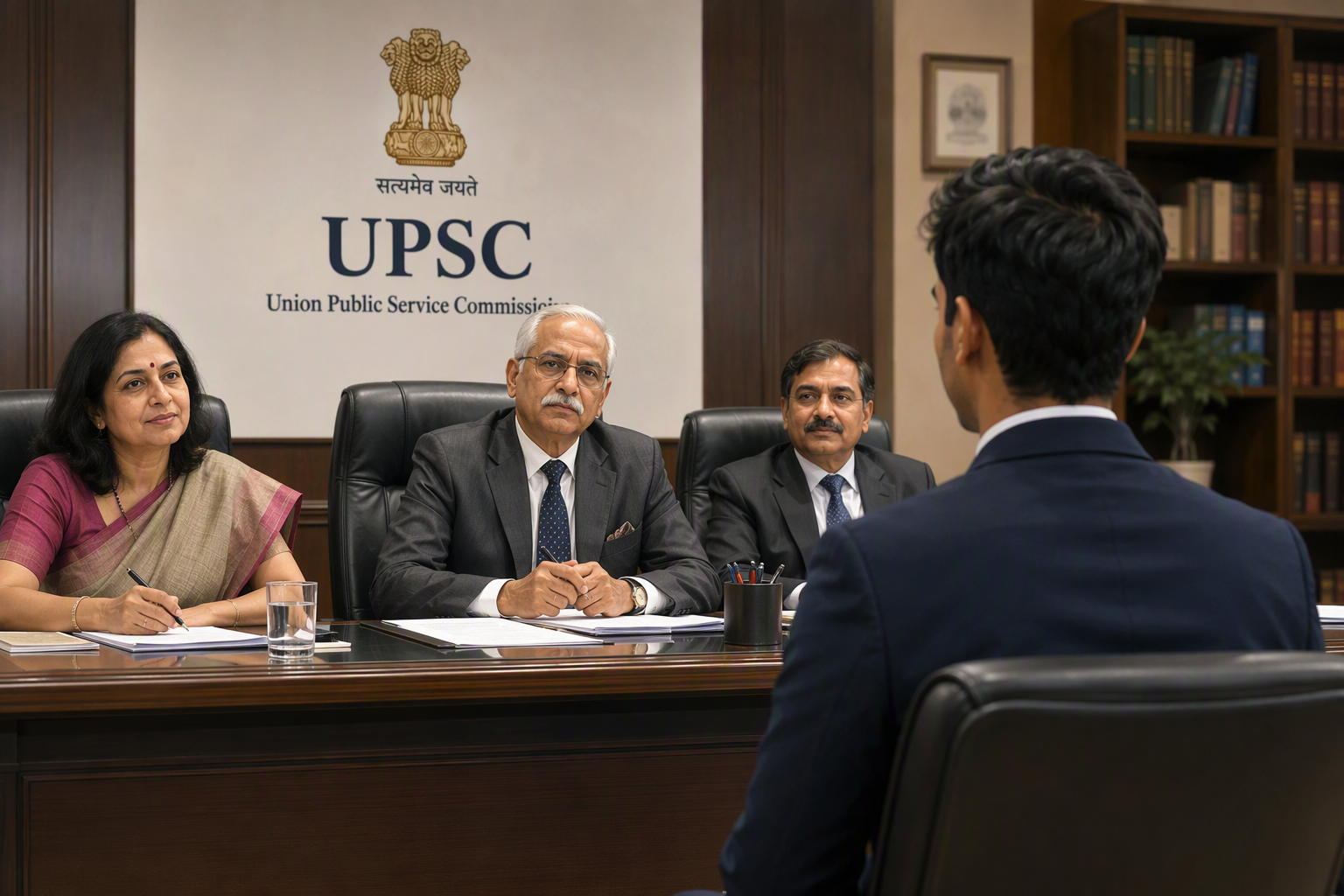
Key Highlights
- The upsc interview is not just about facts. It is a personality test.
- The interview board will talk a lot about your detailed application form.
- Mock interviews help you feel more sure, speak better, and stay calm.
- In the final stage of the civil services examination, honesty, balance, and having clear thoughts matter the most.
- You have to get ready for current affairs, your background, and hobbies. All of these are important.
- In the interview, good body language, calm listening, and giving easy answers can help you do well.
Introduction
Getting to the upsc interview stage is an important part of your upsc cse journey. It is not just about writing strong answers. Now, you need to show that you can think, speak, and act like one of the future civil servants of India. This can feel exciting, but it can also make you feel a bit worried. The good news is that you do not have to be perfect for this. What you need is the right practice, to know yourself well, and to stay calm while you talk. This guide will help you use upsc interview tips in real life.
Understanding the Importance of UPSC Interview Preparation
The upsc cse interview is a big thing for people who want to join civil service. It is not only about what you know or can remember. The interview works as a personality test. The board will look at the way you think and how well you listen. They also check how you talk to people and if you can be calm when the time gets hard.
Its weight is very important. The final stage has a lot of interview marks. This part can change your rank and the service you get. Because of this, you need to get ready in more ways, not just remember facts. You have to work on who you are, how you think, and how ready you are. The next parts show what makes the final stage special and not the same as other stages.
What Makes the UPSC Personality Test Unique
What makes the upsc personality test special is that it is about you as a person, not just what you wrote before. In the civil services examination, Prelims and Mains see what you know. But here, the interview panel wants to find out who you are after all the work you put in.
Inside the room, the panel members do not want to trip you up with tough facts. They watch how you think and how calm you are. They also see if you respect others and practice good habits. They want to know if you can handle work well. When you talk about your graduation or your optional subject, they check if you can speak in a clear and calm way. The panel members do not just want deep or hard facts.
So what can you get ready for? Start with your DAF. Take a look at your school life and your own background. You should read more about your home state and things you like to do for fun. Think about your work experience and the main points of your optional subject. You should also know about what is going on now in the world.
Try to practice speaking about complex issues in a way that is simple. This will show your real public service skills.
Key Qualities the Interview Board Looks For
The interview panel looks for the things that help with a job in administration. Board members know that civil servants get things they did not plan for, have fights, and feel stress from the public. Because of this, they want to see how you act when you know the answer and also when you do not know it.
They care more about how grown-up you are than about big words. Having good communication skills is important. But being honest, calm, and showing emotional intelligence are also key. When you do not know something, it is better to say, “I am not aware of this at the moment,” instead of guessing. This shows you know how to pause and think.
Look at the qualities that usually stand out:
- Think clearly and say things so people understand.
- Be honest and not too defensive.
- Show emotional intelligence and stay calm.
- Have humble confidence and treat others with respect.
These tips are not only to help you look good. They also show if you are the right one for the job. The board will use this to get to know you first.
The Role of the Detailed Application Form (DAF) in Interview Success
A good Detailed Application Form (DAF) is the central pillar of your UPSC personality test. It shows the interview panel your school and work history. The form also lets them see what you like and what drives you. A good answer on the DAF leads to great talks with panel members. This is way for you to have good and effective communication with them. Every detail on your form matters. What you put down tells people if you will be a good fit for the civil service. A strong personal narrative on your DAF helps you show what makes you the top choice for the job.
How to Analyze and Use Your DAF Effectively
Looking at your Detailed Application Form (DAF) is very important if you want to do well in the UPSC interview. Take time to go over your school and work life, as these parts tell the main story of who you are. Write down your strong points and the big things you have done. These will show your best skills. When you practice through mock interviews, talk about these ideas. Be clear and sure each time you speak.
The interview panel members want to see if you remember your details in a clear way. While you give your answers, use your DAF, and try to link them with current affairs. Let your personality come through as you talk with the interview panel. This way, you will use effective communication and show a strong personal narrative to the interview panel members.
Common DAF-Based Questions to Expect
Most questions in the interview are not random. The upsc board looks at your detailed application form to get topics to ask you about. This is why you have to be ready for questions about your background and hobbies. If the upsc board sees it in your detailed application form, you will feel good talking about it.
You can get questions that check if your answers are true and show how much you really know. They will ask about your academic background. You might get asked about why you decided to change your career. There could be questions about your home state and the problems there. They may ask you how your work experience has made you see things in a new way. If you practice and get ready, even your hobbies can help you do well.
Common DAF-based questions include:
- Why did you choose that graduation field or optional subject?
- What are some big issues people talk about most in your home state or hometown?
- How do you talk about your work experience or if you changed your career?
- What have your hobbies taught you about life?
- How would you talk about or explain any gap in your academics or your work?
After you finish your DAF, you will need some good resources. These will help you make your study plan.
Essential Resources Needed for UPSC Interview Preparation
You do not need to read a lot of study material to get ready for a good interview. The main thing is to use the right sources. You should read the recommended books, look at current affairs, read your DAF notes, and join mock interview programs. The aim is not to feel you have too much to read. Try to do sharp revision, think through your answers, and practice. This will help you get good at answers and feel sure about yourself.
You need to choose resources that help you change answer writing into clear spoken words. A good interview guidance program should feel like a real interview. It should also give you feedback that you can use.
| Resource Type | Use in Preparation |
|---|---|
| Current affairs compilations | Revise recent developments and opinion-based issues |
| DAF notes | Prepare personal questions with depth and clarity |
| Recommended books | Build balanced views for situational and public issues |
| Mock interview programs | Improve delivery, composure, and response structure |
Recommended Books and Study Materials
For the interview, your study materials should help you speak well, not just read more. You need books and notes that help you know about current affairs. These should let you give balanced views and say things in a simple way. If you just collect a lot of notes and do not read them again, it will not help you at this point.
A good set of materials should have your Mains notes. It should also have a collection of current affairs for each month. There should be short write-ups on issues and the simple ideas of your subject, either from your optional topic or your past study field. With these, you can get better at answering situational questions. You will feel more sure when you talk in opinion-based talks.
Here is a useful way to organize material:
| Study Material | Why It Helps |
|---|---|
| Mains notes | Converts answer writing knowledge into spoken responses |
| Monthly current affairs consolidation | Covers recent developments in a compact format |
| Optional subject basics | Helps answer subject-related questions clearly |
| DAF-based personal notes | Builds confidence for background and hobby questions |
| Governance and issue summaries | Supports balanced views on public issues |
Keep your list short. Check it well so there are no mistakes. After you finish, start practice with mock tests. This is the next big tool you can use to get better.
Importance of Mock Interviews and Where to Find Them
Yes, mock interviews can be good if you use them in the right way. They help you practice your interview skills. You get to hear your answers out loud. You also notice your body language. You find out where you feel nervous when you feel pressure.
A good interview guidance programme or mock interview programs can feel much like the real interview. This is important. A lot of people know what they want to say but have a hard time saying it the right way. By practicing again and again, you get to know yourself better. You also feel more calm when it is time for the interview.
You benefit most from mock interviews when you:
- Use these chances to practice. Do not use them to judge people.
- Go over the feedback you get about tone, clarity, and how you say things.
- Work on getting better at one weak spot first.
- Take DAF-based follow-up questions in a serious way.
Look for platforms that let you practice real interviews and give you clear feedback. When you have these resources, you can start to make a step-by-step preparation strategy.
Step-by-Step Guide to Using UPSC Interview Preparation Tips Effectively
A good preparation strategy can help you stay on track and make the most of your time. The upsc interview panel does not look at how much information you can gather. The interview panel wants to see if you can think in a clear way and answer like a balanced future leader during the civil services examination.
Use your time in several steps. First, take some time to look at yourself. After that, make a simple plan that fits your life. Next, try to get better at how you talk with people. Think about any problems you have right now and find ways to fix them. Practice ways to deal with things that come out of nowhere. This step-by-step way helps to make your work clear and easier to check. Let us start by getting to know yourself better.
Step 1: Self-Assessment and Knowing Your Strengths
When you really know your own profile, you feel more sure about yourself. This is why self-assessment is the first step. Before you go before the board, think about your greatest strength. See where you feel the need to protect yourself. Notice which parts of your personal narrative feel strong and which feel weak.
This way helps you feel sure of yourself in a real way. You do not have to try hard to sound smart. You get to talk in a clear way and feel calm. A positive attitude comes to you when you stop being scared of every new thing you hear. You only need to trust what you practice and what you know.
Use self-assessment through these steps:
- Write down the things you do well, the things that give you trouble, and what makes you feel stress.
- Write quick answers about your past and what you want to do next.
- Make sure you talk openly and honestly about any breaks or changes in your work.
- Practice how you can stay calm if you do not know an answer.
When you get to know yourself better, your answers will feel more sure. Now, it’s time to make a good plan to use the time you still have.
Step 2: Organizing Your Study Schedule and Week-by-Week Plan
If you have four weeks to go, try to keep your preparation strategy easy. This way, you can follow it every week. You should make a study plan that lets you work on DAF analysis, practice current affairs, practice speaking your answers, and stay calm every week. Do not practice knowledge and how you answer questions at different times. Try to practice both together.
Here is a useful week-by-week plan:
Week 1: Go over your full DAF breakdown and practice a few personal questions. Week 2: Spend the time on current affairs and learn the basics of your optional subject. Week 3: Work on mock answers and practice for some common situations. Week 4: Focus on mock interviews, do revision, and stay calm as you answer.
Every day, you should practice speaking. Do not just read the text. This will help you get better fast.
Your weekly focus can look like this:
- Week 1: You will work on DAF entries. You will talk about your hobbies and your home state. You will practice telling your personal narrative.
- Week 2: You will read current affairs and recent developments. You will cover topics from your graduation subject and optional subject.
- Week 3: You will practice giving opinion-based answers. You will learn how to change answer writing to speaking. You will practice in different situations.
- Week 4: There will be mock sessions. You will review feedback. You will practice your body language and work on stress control.
When you have a clear plan, the next step is to work on the way you talk and show yourself to other people.
Step 3: Practicing Communication and Body Language Skills
Your answer can be good, but if you do not share it well, it may not give the same effect. This is why you need to pay attention to your communication skills and body language when you are in the interview room. The people on the board will see how you come in, say hello, sit down, listen, and answer before they hear what you say.
Confidence is easy to see in small, everyday things. When you have good eye contact, stay calm as you speak, and show positive body language, you come across as steady and sure. You do not have to do big things. A few simple, calm moves with your body language and eye contact work better than forcing yourself to try too hard.
Practice these habits regularly:
- Sit up straight and try to let your body feel loose.
- Look at the panel members and have natural eye contact.
- Pause for a short time before you answer hard questions.
- Do not move around, rush, or talk at the same time as others.
You should practice the way you greet the board first. Make sure you talk at a steady speed. When you finish talking to them, the next step is to stay up-to-date. This will help you know about the issues that can guide the talk.
Step 4: Staying Updated with Current Affairs and Relevant Topics
When you get ready for the interview, think about current affairs in a smart way. You are not getting set for Prelims now. At this time, you need to know about recent developments. This will help you talk about them and say what you think. The board might ask how these topics link to governance, ethics, or public administration.
Focus on topics that can show you know about work in an office and how people act in a group. You may get questions about rules, what worries people, the center and state not getting along, news from your state, or things that are part of your optional subject or your job. Try to keep your answers useful, stay close to what the law says, and always think of a good way to fix problems.
Prioritize these areas:
- Here are some big changes lately that have an effect on the way things are done.
- There are also some problems linked to your home state or area.
- You may see worries about how public administration works and the way services get to people.
- Some topics may connect with your school life or your job in the past.
Don’t feel that you need to remember a lot of points when you talk. It is good to use simple ways to arrange your thoughts. This can help you, especially if people on the board change the topic or ask a hard question.
Step 5: Handling Tricky or Unexpected Interview Questions
Tricky questions often feel hard because they catch you off guard. Most of the time, it is not that you cannot answer them. The reason panel members use such questions is to see how you balance yourself. They do not want to see only what you know. They also want to know how you act when you feel stress. The main thing they look for is not always, “Do you know this?” but, “How do you respond when you feel pressure?”
When this happens, you should slow down. Listen to everything and try to find out what the real problem is. Give your reply one step at a time. For situational questions, think about who else is there, what is the fair thing to do, and what can help people. If you do not know something, say so in a kind way. Making a random guess can make things worse than just being honest about not knowing.
These habits help with tricky questions:
- Take a short time to pause and make the question easy to understand if you have to.
- Break your answer into three parts. First, give some background. Next, share what is important. Last, tell what actions to take.
- Stay calm if the group changes what they are talking about or choose a new direction.
- If you do not know something, let them know in a polite way.
The main thing here is not just to try to win every time. It is important to show good judgment and to stay calm. Still, there are many people who lose points because they make mistakes that they could have avoided when getting ready.
Common Mistakes in UPSC Interview Preparation and How to Avoid Them
Many of the problems that people face in the upsc cse interview are because they lose focus, not because they do not have the skill. A lot of people make some simple mistakes. They may skip parts of the DAF. They often do not take their hobbies in it seriously, read too much current affairs, or think talking strongly means having good confidence. Because of these things, the interview board may read your personality the wrong way in the upsc cse interview.
Another mistake that a lot of people make is that they do not practice how they will show themselves when talking. Many people get ready with what they want to say, but they do not practice how to say it. The best way to stop doing this is to spend time learning about your own profile, practice speaking about it with someone, and always tell the truth about what you know and what you do not know. Now, we can take a closer look at two more mistakes.
Overlooking DAF Details or Hobbies
One big mistake many people make at the UPSC civil services exam interview is to think their DAF details are only background and they do not need to check them again. The truth is, the details you give can shape how the whole talk goes. If you do not build a strong personal narrative before, you will feel less sure of yourself during the interview.
Hobbies are often not easy for people to talk about. Many people list their hobbies in a casual way. But when someone asks more about them, they feel lost. The same thing can happen when you speak about your home state, your achievements, or why you chose a certain course for your studies. All these topics are related to your own profile. If you are not ready to talk about them, it will show, and others may see that you could have been better prepared.
To avoid this mistake:
- Go through each DAF entry and be ready to ask or answer any follow-up questions.
- Find out more about your hobbies, not just the easy stuff.
- Know the big issues about your home state.
- Make sure your personal narrative is true and stays the same everywhere.
Your DAF should feel like your safe space. It should not be the weak spot. A lot of people find it hard to keep calm when they are in the room.
Neglecting Confidence and Composure Practice
Some people spend a lot of time to read and get ready for the interview room, but still do not do well. They do not practice how to stay calm or feel sure of themselves. These people know what to say. But when they are in the interview room, stress can change how they talk. They might talk very fast, or not speak clearly. This is why it is good to work on being steady with your feelings, just like you practice other skills.
Real confidence does not mean you need to talk all the time or try to look bold on purpose. It comes from practice and having a positive attitude. When you practice answering common questions, learn how to nicely say you are not sure, and fix your posture, you feel more calm when it is time for the real thing.
Build composure through these habits:
- Try to answer out loud every day.
- Use practice in the interview room to feel less afraid.
- Teach yourself to say “I don’t know” in a calm way.
- Keep a positive attitude even if your answer is not perfect.
You do not need to feel brave all the time. You only have to stay calm, so you can think in a good way. Taking this steady way helps us remember the last idea we talk about.
Conclusion
To sum up, good UPSC interview preparation is not only about reading books. You need to know yourself well and show your best to the interview board. Spend some time on self-assessment, and make a clear plan for your study. It is also good to practice your communication skills, so you can speak well at the interview. Use your Detailed Application Form (DAF) in the best way. Make sure you read new and important topics, and keep up with what is happening around you. You might make mistakes as you learn, but if you stay away from common errors, you will be on the right path. Keep your confidence up, stay positive, and look at the interview with a good mindset. If you want to get better at your UPSC interview preparation, feel free to get a free talk with our experts!
Frequently Asked Questions
Is attending mock interviews really necessary for UPSC preparation?
Mock interviews are not needed for the upsc interview, but they can be very helpful. They show you how the upsc interview board or interview panel might act when you answer questions. A good interview guidance program will help you build your interview skills. It can also help you to pay more attention to feedback, work on your body language, and feel more confident before the real interview.
How can I boost my confidence before the UPSC interview?
Build your confidence by speaking many times. Go over DAF a lot. You can also do practice interview sessions that feel real. Show positive body language to the interview panel members. Try to keep a calm posture when you are in the interview. Practice saying what weak areas you have in an honest way. Remember, the panel members will look to see if you will be a good civil servant, not if you are perfect in the whole interview process.
Which topics should I focus on for the UPSC personality test?
For the UPSC personality test, you have to focus on your DAF, current affairs, your optional subject, and the main things you learned in graduation. You also need to know about the problems in your home state, your hobbies, and your work profile. In the mains examination, they have already checked how you write. So, in this stage of the civil services examination, you need to show that you think in a clear way, have balanced opinions, and really understand who you are.
What are some effective strategies for answering background and hobby-based questions?
Start with your detailed application form. Take your time as you read every part of it. Think about what you put in for work experience, academic background, home state, achievements, and hobbies. When you meet the interview board, get ready to talk about these things in a clear and honest way. They want to see the real you. So, do not say things that are too much, and try to keep your answers simple, clear, and not changing every time.

