Key Highlights
- These geography notes for India give you short, easy summaries based on NCERT books. Use these for fast revision notes before your exams.
- You get a breakdown by topic that matches the upsc syllabus. This covers things like physical geography, farming, climate, and more.
- The blog points out india’s total area, where it is, its main land parts, and resource patterns.
- It also shows you how geography links with current affairs to help you prepare better.
- You will see short points that are ready for upcoming prelims and mains.
- Each part is made to help you remember things better when you read the revision notes.
Introduction
If you want indian geography notes for upsc prelims, it’s best to have something short, clear, and useful. A good structure will help you avoid bulky books. This guide can help you with that. It turns core ideas from NCERT into easy material for quick revision and puts focus on the main parts of physical geography that show up a lot in these exams. You will get simple notes for landforms, climate, vegetation, soils, and agriculture, so your preparation will be focused and easy to go over.
Overview of Indian Geography for UPSC and Competitive Exams
The best way to study Indian geography for exams is to read short, clear notes for each topic. These notes should match the upsc syllabus. Be sure to read about physical geography, human geography, and world geography. It helps to read these notes in a way that is good for exams, not just one chapter after another.
Your notes should also link static topics to current affairs. For both prelims and mains, it is important to cover areas like climate, rivers, soils, agriculture, minerals, population, transport, and map work. The next two sections will explain why using NCERT books to prepare helps you. They also show how geography is useful at both stages of the exam.
Importance of NCERT-Based Summaries for Effective Preparation
Start with NCERT-based summaries because these help you get the base ideas. They do not have many extra things to read. For geography, you will learn about landforms, monsoon, soils, rivers, and plants in a simple order. If you want to get ready for the IAS, these are a good starting point.
A useful way to get ready for upsc prelims is to use a hands-on method, not just read passively. Start by going through NCERT books. Then write your revision notes by topic, not by chapter. For example, keep one page for each topic like types of rainfall, major passes, or soil distribution. This helps you remember things faster when the exam is near.
You should tie each idea to an easy-to-understand example. For example, when you read about the Western Ghats, link them to important ideas like biodiversity and questions that have come up in past exams. If you read topic-wise summaries, it will help you revise your Indian geography notes faster. You should try to solve MCQs after every topic and keep your geography notes and prep focused, not all over the place.
Scope and Relevance in Prelims and Mains
Geography is important in both upsc prelims and upsc mains. This is why having good notes can save you time. In upsc prelims, you will get questions about maps, rivers, climate, natural vegetation, soils, and places that are in the news. So, it is very helpful to do a quick and clear revision before your exam.
For the main topics, you have to go deeper. Learn about human geography, how people settle, how resources are spread, farming, travel, and how these link with money matters and disaster plans. Geography is not just about spots on a map. It is about the link between land, people, and resources.
Current affairs make this subject important right now. You can see this with heatwaves, changes in the monsoon, landslides, climate problems, changes in flat land near the sea, and new island projects. All these show how things you read in geography become exam questions. So, your notes should have both basic ideas and what is happening now. Try to connect these in your writing.
Major Physical Features of India
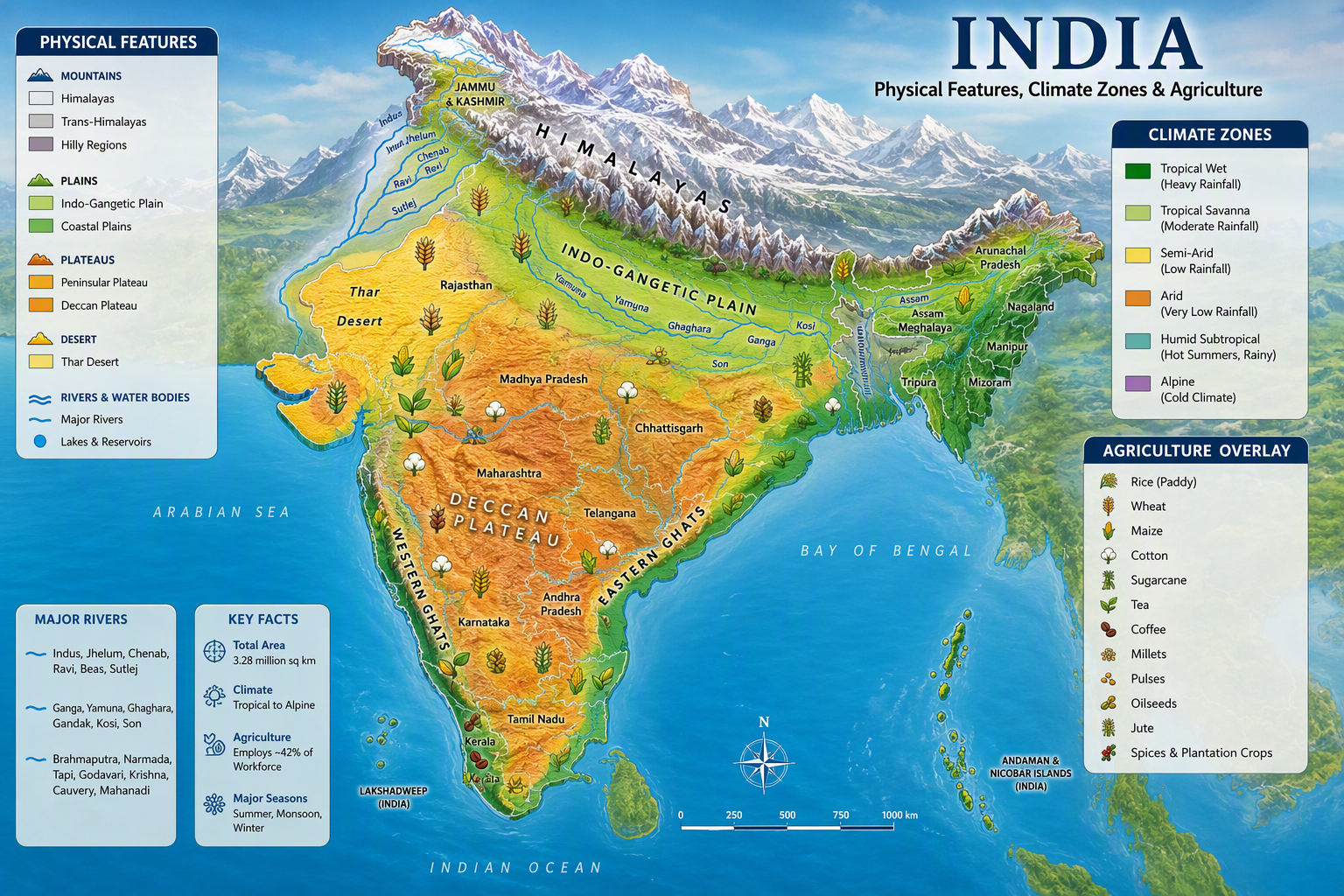
The physical features of India are seen in its main physiographic divisions. These are the Himalayas, the Northern Plains, the Peninsular Plateau, the coastal plains, and the island groups. All these areas play a part in the climate, the rivers, how people farm, travel, and live.
To prepare for your exam, you should link these divisions with the deccan peninsula and the drainage differences between Himalayan and Peninsular areas. When this idea is clear in your mind, it will be easier to remember more details. The next parts break down these land divisions and give you simple notes that are ready for your exam.
The Himalayan Region and Northern Plains
The Himalayan region makes up the northern edge of India. You will find young fold mountains here. These mountains are important. They block winds and act as a wall for weather. Many rivers that never dry up start in these mountains. There is also a lot of plant and animal life in this area.
The Himalayas are important for exams because they affect rain, rivers, and mountain passes. They also impact big roads and bridges. These mountains stop cold winds and help bring rain to much of the area. This is why the Himalayas are a key topic in the upsc syllabus. States like Arunachal Pradesh are often part of map questions as they sit in the eastern part of the Himalayas.
South of the mountains, there are the northern plains. These northern plains are one of the big physiographic divisions in India. The area has rich soil that helps things grow. A lot of people live here. Most people in this part work on farms. Rivers are important in this place. When you study these plains, always link them to the rivers, how people grow crops with water, and where people choose to live.
Peninsular Plateau, Coastal Plains, and Islands
The peninsular plateau is one of the oldest land areas in India. It has the deccan plateau and other high ground nearby. This place has a lot of minerals. Many river systems start here, and people farm on the plateau. The western ghats and eastern ghats also change how water flows and where rain falls in this area.
Moving out from the center, the coastal plains sit next to the Arabian Sea and Bay of Bengal. These coastal plains are good for ports, fishing, trade, and people to live in. India also has islands, and these islands matter a lot for both safety and the environment.
| Region | Key exam-ready points |
|---|---|
| Peninsular Plateau | Old landmass, mineral-rich, includes the deccan plateau |
| Coastal Plains | Stretch along the Arabian Sea and Bay of Bengal, support ports and trade |
| Lakshadweep Islands | Located in the Arabian Sea to the southwest of the mainland |
| Nicobar Islands | Part of the Andaman and Nicobar group in the Bay of Bengal |
Climate and Vegetation Zones in India
The climate of India is very important. It changes the crops people can grow, rivers, forests, and daily life. Good notes for this topic will help you understand monsoon patterns, how seasons change, and the types of rainfall there. This helps you know why some parts of the country get floods, droughts, or rain that does not fall the same everywhere.
Natural vegetation is looked at along with climate. It is not something you study by itself. That is why ncert insights are helpful. If you know about rainfall and temperature, you can see where different forests are found. The next parts make it easy to learn about climatic regions first. Then, these are connected to natural vegetation zones all over India.
Climatic Regions Explained with NCERT Insights
To know about the climate of India, you should start with a few main things. These are the location, land shapes, and the monsoon. If you read NCERT, you will see how the southwest and northeast monsoons help decide where and how rain falls in the country. This will also show you how each season is linked to farming, problems caused by weather, and what you might be asked on maps about the climate of India.
Some quick NCERT insights are easy to keep in mind when you see them clearly listed:
- The Tropic of Cancer cuts India into almost equal parts.
- The standard meridian of India is 82°30’E. It goes through Mirzapur in Uttar Pradesh.
- The Western Ghats help bring heavy rain on the west side.
- India sits in the northern hemisphere. It stretches out into the Indian Ocean.
- Rainfall changes mostly with how the monsoon moves.
You should also read about climate areas, and check for any new changes happening now. For example, look at things like changes in the monsoon, heatwaves, floods, and landslides. This matters, because in tests, you will see questions that test the idea and how you use it. A small note on the climate becomes much more helpful when you link it to these new everyday examples.
Types of Natural Vegetation and Their Distribution
The natural vegetation in India connects closely to rainfall and temperature. It can be hard to remember forest types if you look at them one by one. But if you tie them to the climate of India, it gets much easier to see where each kind is found. This way, you can learn about natural vegetation better and keep this knowledge for a long time.
The main groups talked about in standard preparation are tropical evergreen, deciduous, thorny, and montane forests. These names are not just used by chance. They show differences in moisture, height, and seasons. This means forests are a good example of physical geography.
To help you review, remember this simple rule: climate decides where plants grow. Places that get more rain have thick plant cover. Dry places, on the other hand, have less plants. Mountains change with height, so plant life is different at different heights. Keeping this in mind will help you when you need to write about forests, wildlife, variety in nature, saving nature, and how we use land in your exam answers.
Agriculture, Soils, and Economic Geography
Agriculture and soils play a big role in economic geography. They bring together land, weather, people, and how things are made. In India, you need to know the main types of soil, when crops are grown, how water is used in farming, and the way rain changes how much is grown. All these basic facts are part of many papers, whether they ask short or long questions.
Crop patterns are easier to understand when you also learn about soils and where they are. That is why good notes link black soil to cotton, or alluvial soil to rich flat land. First, the next two parts will explain different soil types. Then, you will read about farming areas and crop patterns.
Key Soil Types and Their Importance in Indian Agriculture
Soil types are more than just a topic in physical geography. They shape indian agriculture and the way we grow crops. Soil also affects how much water people need for crops and how much food a place can make. Because of this, soil is a big part of economic geography. When you read or revise, try to link soil with how good it is for crops and climate in that area.
The main soil types that people usually read about for exams are very clear:
- Alluvial soil is very good for growing crops in the river plains. People use it for a lot of farming in these areas.
- Black soil is great for growing cotton. Many cotton fields have this kind of soil.
- Red soil is found in many places that have plateaus.
- Desert and mountain soils are in dry places and highland areas.
Many students get fewer marks because they try to only remember the soil names. They do not link them to what crops grow there. Do not make that mistake. Keep each note about soil short and useful. Always ask yourself, where is the soil found? What grows there? How does it help or hurt farming? This way will make your study work better.
Major Agricultural Regions and Crop Patterns
Agricultural regions in India should be learned by looking at climate, soil, irrigation, and land use together. This is how physical geography and economic geography come together. If you also look at population and how people work, you see the topic also connects with human geography.
A solid way to revise this topic is to learn different farming types, main crops, and seasons like kharif, rabi, and zaid. You also need to know how rainfall and when monsoon arrives changes what crops people grow around the country. This is why the study of farming is always linked to knowing about weather and climate.
For exams, make sure your notes show how things are connected. For example, explain how fertile land helps in growing food crops. Talk about how black soil areas are good for cotton farming. Say how using water in farming helps people do more with the land. If your course talks about land reforms, caring for animals, or things the government is doing, add a short line on these too. Short notes that link ideas together work better than long lists that do not connect.
Conclusion
To sum up, knowing Indian geography is very important for doing well in UPSC and other big exams. If you read NCERT-based geography notes, you can learn the key points and main ideas that you need to get high scores. These geography notes can help you find out more about big landforms, weather types, and farming ways. Everything is set up so you get a good quick look before exams. It is good to know geography well. It will help you in questions, and it will also help you understand India and its many areas better. If you want more to read, feel free to get our Indian geography notes in PDF. Good luck with your learning in geography!
Frequently Asked Questions
Where can I find downloadable Indian geography notes in PDF format for UPSC?
You can get indian geography notes as a pdf file on different exam preparation sites. These platforms break down the material topic-wise for the upsc syllabus. When you study, pick revision notes that cover physical geography, rivers, soils, climate, and agriculture. It is good to use sources that match their notes with prelims, mains, and practice for maps.
How do I use NCERT notes for quick revision of Indian geography?
Use NCERT books as your base for upsc prelims. Break each chapter into short revision notes based on the topic. Try to keep one page for each, like one for climate, one for soils, one for rivers, and one for vegetation. Go over these pages many times and practice MCQs. You can add world geography links where you feel they help, so all the topics connect and they get easier to remember.
Are there reliable handwritten or summarized geography notes available in English?
Yes, many people use handwritten notes and short notes in English, but the best ones are those that come straight from NCERT. These are changed and updated to fit the upsc syllabus. The top indian geography notes are short and linked to maps. They are also updated with current affairs, not just copied without meaning.