
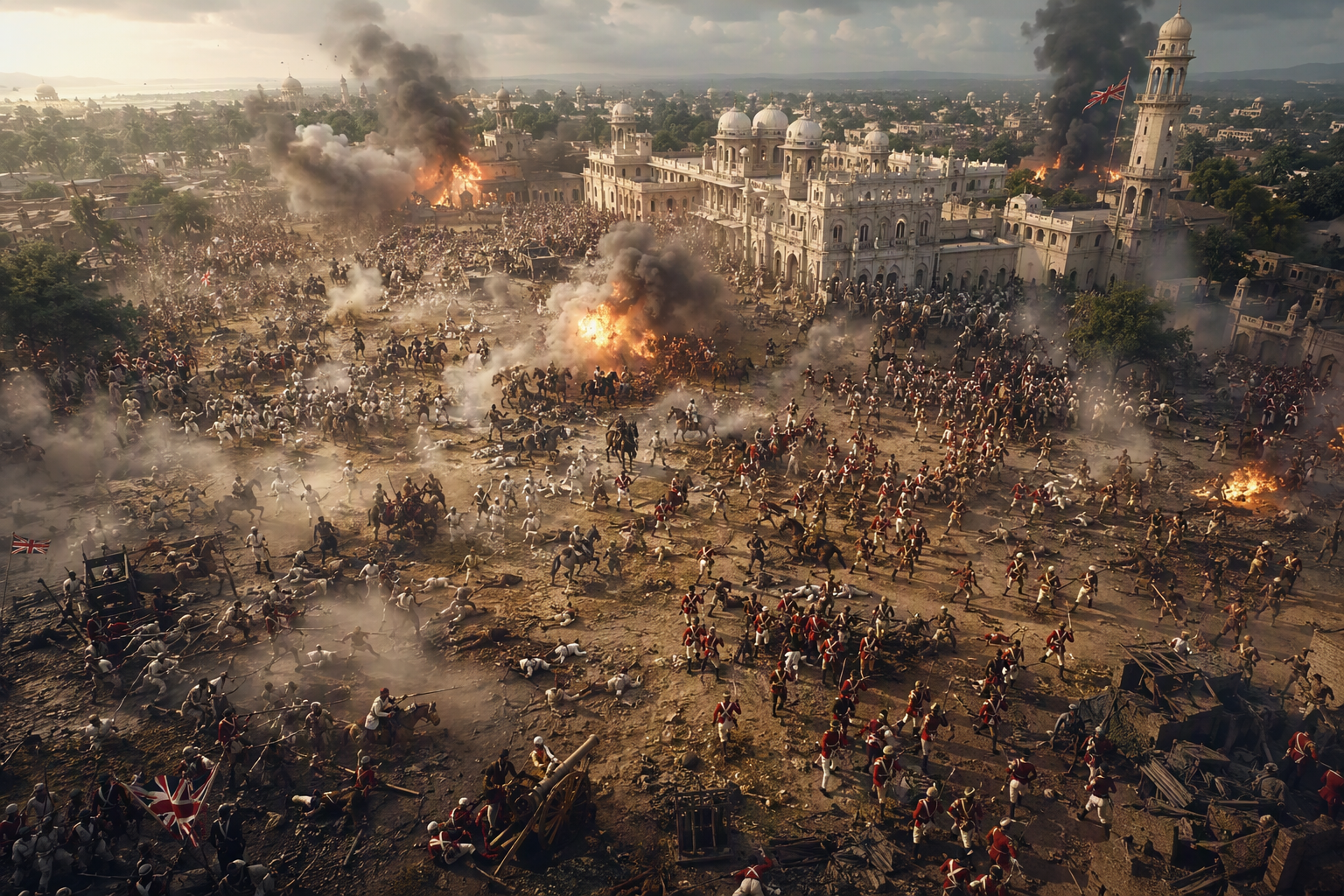
Key Highlights
- The failure of the revolt was because the rebels were weak and the british rule was very strong.
- The sepoy mutiny started with soldiers’ anger, but it soon turned into a bigger fight.
- Some of the main causes of the revolt were taking land, money problems, and social discontent.
- People remember this movement in indian history as the first war of independence.
- Rebel groups did not have unity. They did not plan well or work toward one national goal.
- The british military had strength, allies, and better ways to talk with each other. This helped them stop the uprising.
Introduction
The Revolt of 1857 has a special spot in Indian history. It was the first big problem for British rule in the country. Many people know it as a war of independence. The Indian mutiny and the Sepoy Uprising are other names people use for it. This story is not only about brave acts and courage. It is also about the failure of the revolt and how it did not end British control. To understand why this happened, you need to look at the event’s background, what stopped it from going further, and what effects it left behind.
Background of the Revolt of 1857
The Indian mutiny of 1857 started when the East India Company was in control. It began with Indian soldiers getting upset. Soon, the anger grew, and many people joined in. The uprising spread across North India and Central India, and it became a bigger fight against the British colonial rule.
The First War of Independence had some big problems from the start. The British had better groups, more soldiers, and more help. The rebels had trouble working together. They also only cared about their own areas. This mix made the war grow at first but soon led to defeat for the rebels. The parts below show how the war of independence changed because of these things.
Overview of the Sepoy Uprising
At the beginning, the sepoy mutiny was when Indian soldiers who worked in the army for the East India Company started a revolt. This happened in Meerut on May 10, 1857. After that, it moved fast to Delhi. The revolt then started to have a bigger political effect.
Soon, the fighting was not only about the army. The indian rebellion pulled in the peasants, people who lived in the towns, zamindars, artisans, and some indian rulers. The uprising then spread out to more groups of people in many parts ruled by the british, especially in north india and central india.
The revolt was not the same everywhere. In some areas, there was just a soldiers’ uprising. In other places, people rose up together against colonial control. This mix gave the revolt some power, but it also made it hard for everyone to act as one group. Later, this tension became very important.
Key Events Leading to the Outbreak
Tensions started rising across the Indian subcontinent long before open fighting broke out. The British used the doctrine of lapse, which made many Indian rulers feel hurt and left out. At this time, both soldiers and common people felt there was racial arrogance, and they suffered from economic pressure. The British also got into their customs and daily life.
Then there was a problem with the Enfield rifle cartridges. People thought they were greased with cow and pig fat. This made many feel very angry and hurt their religious feelings. The anger grew stronger and soon turned into action. Mangal Pandey’s attack at Barrackpore showed early on that things were getting out of control.
Key events included:
- On March 29, 1857, there was a revolt by Mangal Pandey at Barrackpore.
- The sepoys at Meerut said no to using the Enfield rifle cartridges.
- On May 9, 1857, 85 sepoys were put in jail.
- The troops marched to Delhi and saw Bahadur Shah II as the emperor.
Geographic Spread and Main Centers
The revolt took place in many areas of North India and Central India. But it did not turn into a movement for all of India. This was one of the biggest limits of the revolt. Important places where the revolt took place are Delhi, Kanpur, Lucknow, Jhansi, Meerut, and some parts of Bihar and Gwalior.
Delhi became the main place of the uprising when Bahadur Shah II was made the leader. In Kanpur, Nana Saheb was the main leader. Lucknow became important as Begum Hazrat Mahal and others led there. People also know Jhansi because of Rani Lakshmi Bai.
Here is a simple text table of the main centers:
| Center | Importance in the Revolt |
|---|---|
| Delhi | Symbolic political center; Bahadur Shah II was declared emperor; Bakht Khan later held real power there |
| Kanpur | Major uprising led by Nana Saheb; became a key military theater |
| Lucknow | Strong resistance linked to Awadh; Begum Hazrat Mahal played a leading role |
| Jhansi | Important rebel center under Rani Lakshmi Bai |
| Meerut | Starting point of the open sepoy revolt |
| Gwalior | Later focus of fighting involving Tantia Tope and Rani Lakshmi Bai |
Causes Behind the Failure of 1857 Revolt
The causes of the revolt were not small or simple. There were some deep issues. British actions like the doctrine of lapse angered people, and many felt heavy land pressure from them. The British also did not show respect to Indian rulers, and this made many feel bad. There was social discontent everywhere. Soldiers, peasants, landlords, and people in different religious groups were all unhappy.
Still, the same movement that had a lot of energy also had some big problems. The indian population did not come together as one group, and many rebel groups did not work as a team. To see why it did not work out, you have to look at the political, economic, social, and immediate causes one at a time.
Political Factors and British Policies
Political anger was one of the biggest reasons for the uprising. British policies led by Lord Dalhousie made traditional power weaker. They also took away the rule from many Indian rulers. The doctrine of lapse gave the British East India Company and the british east india company the power to take over states if there was no natural heir. This rule led the British to take control of places like Jhansi, Satara, and Nagpur.
Awadh was taken over in 1856 because the British said it was not ruled well. This made many people feel very angry. Bahadur Shah II was hurt too, as the British lowered the standing of the Mughal family. The landlords, princes, and chiefs felt they were losing their place because of the British rule.
These actions caused a big political crisis. But the rebels also made some mistakes. They did not set up one main command or a plan together to take the British political power. So, even though there was a lot of anger, people did not come together as one. This made it easy for the British to beat them.
Economic Pressures and Discontent
Hard times came for a lot of people in the Indian subcontinent. British officials asked for high land taxes. Many farmers found it hard to pay and live at the same time. The people who used to own the land also felt less safe. This came because British systems changed the old ways of looking after land.
At the same time, many workers and artisans had a hard time. This was because British machine-made goods hurt local handicrafts. A lot of workers lost their jobs and could not make money. The economy started to work mainly for the british empire. That meant all the resources and money were used in ways that were good for the British, not for local people.
There was widespread discontent in the villages and cities. People were forced to grow crops like indigo and opium, which made things worse. Food was in short supply in many areas. This economic anger helped cause the revolt, but it was not enough for people to come together as one strong group to beat the British.
Social and Religious Divisions
Social discontent got worse under british rule. A lot of people in India saw british rulers as arrogant and not close to their way of life. Many felt hurt by the way they were treated, with racial discrimination and changes that seemed to go against old customs. Missionary work made people feel scared as well, as they worried it would lead to forced changes in their religion.
The cartridge issue was a big problem for people with strong religious beliefs. Both Hindu and Muslim soldiers felt that the issue was against what they believe in. This fear brought them together for a short time. The anger they shared made the revolt grow fast. This showed how fear can bring different groups together, even if just for a short time.
There were still differences in the sections of Indian society. Not every group wanted the same thing. Not every region was as committed to the fight. Muslim soldiers, Hindu sepoys, princes, peasants, and local leaders each had their own reasons to fight. Sometimes their reasons were the same, but not always. This made it hard for the rebel side to stay strong and united for a long time.
Immediate Triggers of the Revolt
The introduction of the Enfield rifle was the main cause. Soldiers needed to bite the cartridges, and there was talk that these had cow and pig fat on them. For many sepoys, this was not just about the army. It was seen as an attack on their faith and pride.
Mangal Pandey’s action at Barrackpore showed that the place had become very dangerous. Soon after this, the sepoys were punished at Meerut. This made the revolt even bigger. When the rebels got into Delhi, Bakht Khan later became an important leader there. British commanders like John Nicholson led the effort to take the city back.
Keywords: mangal pandey, bakht khan, john nicholson
Important triggers included:
- The introduction of the Enfield rifle cartridges
- Mangal Pandey’s attack on British officers
- Imprisonment of sepoys in Meerut
- Rapid rebel movement to Delhi without a long-term strategy for expansion
Weaknesses of the Rebel Forces
One big reason for defeat was the weakness inside the rebel forces. The indian mutiny spread fast. But this speed did not give the rebels a strong base. Many centers fought in brave ways. But most of the time, they fought on their own.
There was no strong unity between the Indian rulers, soldiers, and the people who helped them. Because they did not work together or have one main goal, their fight stayed broken up. They did not share one leader or plan. The next parts talk about how these problems inside their group hurt their work from within.
Lack of Unity Among Rebels
One big reason for failure was that the people did not stand together. Many groups wanted to fight against british rule, but they did not work as one team. People from each area had their own needs. Most of the time, what mattered most was their local problems, not the bigger goal for the whole country.
Some indian rulers took part in the uprising, but many did not join. A lot of princes and chiefs stayed with the British or kept their distance and did not pick a side. Because of this, the revolt never became a big political movement in the country. In places where there was a lot of social discontent, people still did not always come out and give support.
Because of this, the British dealt with several small uprisings instead of a big, organized war. The rebels could not join their men, plans, and supplies across the country. A group that seemed strong in Delhi, Kanpur, or Lucknow was still weak as a whole. Having all groups together may not have made them win, but not being united made them much more likely to lose.
Limited Leadership and Coordination
The revolt had many brave leaders, but that was not all it needed. Tantia Tope, Rani Lakshmi Bai, Nana Saheb, Begum Hazrat Mahal, and Bahadur Shah helped people fight in their own regions. Their names still have a lot of meaning for people in Indian history.
Leadership stayed local, not in one place. Bahadur Shah was an important symbol, but he did not control all the rebel groups in a clear way. A group in one place could start fighting while another group would wait. One leader doing well did not always help the other leaders. Because of this, they did not work together well, and it made the military weaker.
Yes, not having strong leaders really hurt the revolt’s success. The people fighting did not have one command center. There was no steady way to talk to each other or make plans together. This made it hard for them to act fast when the British moved in on them. They also could not help each other for a long time. Some strong people did step up, but they did not come together to lead as one team from all over the land.
Absence of a Common Ideology
Many writers later called 1857 the First War of Independence. This name shows the feeling against the British at that time. But inside the revolt, all rebel groups did not have one main idea that they all followed. This made the war of independence weak on the inside.
Some fighters wanted the old rulers to come back. Some were upset about land. A few were not happy with the army or had fears about religion. Most indian states joined the fight only when they felt someone was trying to hurt their own side. So, even though they were all against the British, they did not agree on what should happen next or how to rule.
There was no shared way of thinking among the people. This made it hard for them to stay together for a long time. A war of independence needs more than just bravery. People also need to know clearly what they want after the old system ends. In 1857, people did not have that clear idea. Because of this, there was a lot of confusion. Some people were not ready to give their all. There was also not much working together in different rebel places.
Regional Limitations and Localized Support
The revolt was strong, but it did not happen everywhere. It was at its highest in North India and Central India. Places like Delhi, Kanpur, Lucknow, Jhansi, and other nearby spots saw the most action. This helped people see the movement. But, it still did not reach as many people as it could.
Many other regions did not rise up with the same force. Some Indian states chose to stay loyal to the British. A few other states did not get into the main fight. Because of this, there was not much help from every region. So, the fight never became a big uprising across the whole country against colonial rule.
Yes, this had a big effect on the outcome. Since most of the support was local, the British were able to target rebel strongholds one at a time. They did not have to fight a single large front from all sides. People in each region showed real bravery, but without more people joining, the rebellion could not last for long.
British Advantages in the Revolt
The revolt did not fail just because those fighting against the British were weak. British rule stayed strong because the british government and its officers had clear advantages. They had a better organized army. Their leaders gave steady orders. They also moved together in a planned way.
British troops and British forces had things that helped them win. The rebels did not have these things. They had good supply lines. They could share news fast. Loyal princes also helped them. These things gave them a strong edge. The next parts will show how these advantages helped stop the uprising.
Superior Military Strength and Organization
The British army had a strong military setup during the revolt. The British soldiers and British troops were more organized. They were led well. In big fights, they showed more discipline. This was very important when the rebels had to hold cities for a long time.
The British had better artillery. Their leaders gave clear orders. Commanders like John Nicholson, Henry Havelock, Hugh Rose, and Sir Colin Campbell each led with purpose. They carried out strong campaigns in different big areas. Because of what they did, the British were able to get Delhi back, help the people in Lucknow, and take control of Kanpur and Central India once again.
Yes, the British army was too strong and stopped the revolt for good. The rebel fighters showed a lot of courage, but they could not beat the well-trained and well-organized British army. When the British took back control, they did not just protect their land—they began to win it back. The rebels were brave the whole time, but the power difference led the British army to win in the end.
Advanced Communications and Supplies
The British had another edge because they had better ways to talk to each other and to move things around. The ways they used to share news were strong and worked well. This helped leaders and soldiers answer quickly when things happened. When there is big trouble happening far and wide, being fast can be the reason people stay safe.
Railways and telegraphs made it easier for places far from each other to connect during colonial rule. Troops, orders, and things needed for work could move faster than messages or help from rebels. This let the British bring their forces together where needed most and act quicker when problems started.
Supplies were also very important. Armies need more than just courage to win. The British had better ways to move things, they brought in good equipment, and they had strong support to handle everything. The rebels, on the other hand, had to use what they could find nearby and made short-term plans. This difference in what each side had and could use helped the British regain ground and slowly make the revolt weaker.
Reliable Support from Indian Princes and Allies
Not every Indian prince was against the British. In fact, help from indian princes and some other friends of the British was one main reason the British could stay in power. This help kept the rebels from getting the strong political support they needed.
Many indian states stayed loyal or did not fully join the uprising. british officials got help from these alliances. They could get local support, military help, or at least not face any trouble from them. This made it hard for the rebels to find safe places to operate.
The fact that indian rulers did not give support had a big effect on why the revolt did not work. A lot of important princes stayed out of it. Because of this, the rebels did not have enough men or things they needed. They also did not look as strong to the people. The rebels did not get many safe places to stay. This made it hard to bring people together for a common cause. The British did not win only by fighting. They also got help from local leaders to keep their power in India.
Strategic Mistakes Made by the Rebels
Yes, there were clear mistakes by the rebels, and these had serious effects. Anger drove the uprising, but anger by itself was not enough to take the place of careful planning. A lot of the fighters showed courage, but because things were not planned well and because the rebels did not work together, their actions did not have as much impact.
Indian rulers and rebel leaders often chose to work inside their own areas. They did not come together to make one solid plan for war. This is why they won some fights, but these did not give them any long-term control. The next sections talk about the main strategic errors that stopped the movement from winning.
Poor Planning and Execution
The revolt grew fast. But many parts of it did not have a clear plan. In any war of independence, timing is important. Supply, command, and how people talk with each other also matter a lot. In 1857, many acts were brave. But they were often done in response to something. They were not thought out fully in advance.
The rebel centers did not plan well on how they would join with each other. Some groups began revolts before the bigger plan was set. After they took over important towns, the rebels often found it hard to keep control, protect those towns, or grow from there. This made it clear that the campaign did not have a good overall plan.
The way things were carried out did not go well for the same reason. The rebels did not set up a stable military or political system in the places they had power. Because of this, the first wins did not last. The British could come together again, cut off the rebels’ groups, and attack. A movement with better planning could have stayed longer, but this one stayed weak and did not last.
Missed Opportunities for Alliance
The indian insurrection did not get as many partners as it needed. A few key leaders and areas did join, but many others did not. Because of this, the revolt was unable to build a big enough group to take on British power all over India.
A stronger alliance network with Indian princes could have made a big difference. More rulers would have given troops, money, and land. But this did not happen. The rebels did not get enough support from many powerful states. This hurt their spirit and made their army weak.
These missed chances were important. The British were good at making friends with local people. While the rebels did not do well at building ties, the British often did much better. This made the gap between both groups bigger. The rebels were brave, but what they did not have were strong and lasting teamwork to back them up for a long fight.
Internal Betrayals and Rivalries
Internal divisions made the revolt even more weak. When a group is not united, people often fight with each other. There were many local interests, old problems between people, and different leaders in charge. This made it harder for everyone to work together.
There were many betrayals and mistrust during this time. This situation hurt the rebel cause. Some rebel groups did not trust each other. A few people in power also stayed loyal to the colonial administration. The British held strong control over the administration and civil services. This helped them keep order in several places. At the same time, the rebels found it hard to make a stable government.
These problems inside the group made it hard for the rebels to act together. Every time one group fought with another, the big goal became weaker. Instead of putting all focus on the enemy they shared, the rebels spent time on things near them and on what each wanted most. Because of this, the British were able to take back control quicker and easier.
The Consequences of the Failure of 1857 Revolt
The results of the revolt were big and stayed for a long time. In indian history, the year 1857 was a big change. After the British stopped the uprising, they changed the way they ruled. The first thing that happened was a change in political power.
After the revolt did not work, the power moved from the East India Company to the British Crown. This change had a big effect on the way the rulers ran things, the army, and how they worked with the Indian rulers. The parts below will talk about what happened right away in politics and will also look at the bigger social and money changes that came after.
Immediate Political Changes After the Revolt
The biggest political change that happened right away was the end of the East India Company rule. After 1857, the British Crown took control of India through the Government of India Act of 1858. This was a big change in who had the power.
Queen Victoria’s announcement started a new time for british rule in India. After this, british officials began to rule India in a more direct way. The Governor-General got a new place in the empire system. This shift in power showed that London wanted to have more control after what happened with the rising.
Other changes in how the British ruled followed soon after. The British became less strict with their annexation policy. They also let local rulers who were in power choose someone to be heir. The British did this because they saw how their past actions made many people angry. So, the first result of the failed struggle was not freedom. Instead, it was a stronger and more careful imperial state.
Social and Economic Impacts
The indian population went through hard times with social and money troubles after the revolt. The British were tough on them. Many places saw a lot of violence and lost things because of punishment and damage. This made long-lasting fear and anger in people.
British rule became more careful, but at the same time, it got more strict. There was still social discontent, and it did not go away. The rulers tried to handle this in a different way. They stopped some of their control in social and religious matters, but they watched people more and acted with more care in politics.
Economic problems did not stop. The things that made life hard for people were still there after 1857. Peasants, artisans, and many others kept struggling with the colonial economy. So, even though the revolt did not win, the same problems stayed and became a part of daily life.
Long-term Effects on Indian Society and British Rule
The revolt had a big effect on both Indian society and british colonial rule over time. The british made changes to the army. They brought in more European soldiers. The indian regiments were changed, too. They used caste, community, and where people came from to split up the groups. This was done to stop soldiers from coming together.
The British Empire began to use stronger ways to divide and rule people. This changed how people lived and made political groups more separate in the years after that. The British Empire was less harsh about taking over the princely states, but they still kept things under tight control. They watched over everything very carefully.
Still, the significance of the revolt lasted for a long time. People in India saw 1857 as a strong and lasting sign of fighting back. Over the years, many looked at it as one of the first times people stood up against outsiders. Even though it did not win right away, the revolt changed the way people thought about power. It also helped nationalism grow in the years after.
Conclusion
To sum up, the failure of the Revolt of 1857 is an important part of India’s history. It helps us see how hard it was to fight against colonial rule. There were many reasons for this failure, like political problems and the strong British army. All of these show how complex an uprising can be.
The results of this revolt also changed Indian society a lot. It led to many new ways for the British to rule, and it brought big changes in politics, society, and money matters. Knowing about these things helps us understand India’s long fight for independence.
If you have any questions about the failure of the revolt or want to know more about colonial rule, feel free to ask!
Frequently Asked Questions
How did lack of unity contribute to the failure of 1857 revolt?
The Indian mutiny never grew into one big national fight because there was no unity. The rebel forces fought in different places. Many Indian rulers did not join in, which made a big difference. Because the british rule did not face all of them together, they only had to fight smaller, scattered groups of people. This made it much easier for them to put down the mutiny.
Did British military strength decisively suppress the revolt?
Yes, British military strength was very important. The British army was more organized. They had better guns and leaders. The British army also got more supplies than the indian soldiers in the sepoy mutiny. These things helped the british empire take back main places and stop the uprising step by step.
What was the immediate impact of the revolt’s failure after 1857?
The main thing that happened right away was that the British Crown took over political power from the East India Company in 1858. In Indian history, this was one of the biggest results of the revolt, because the British government started to rule India directly and changed how it used to govern.

