
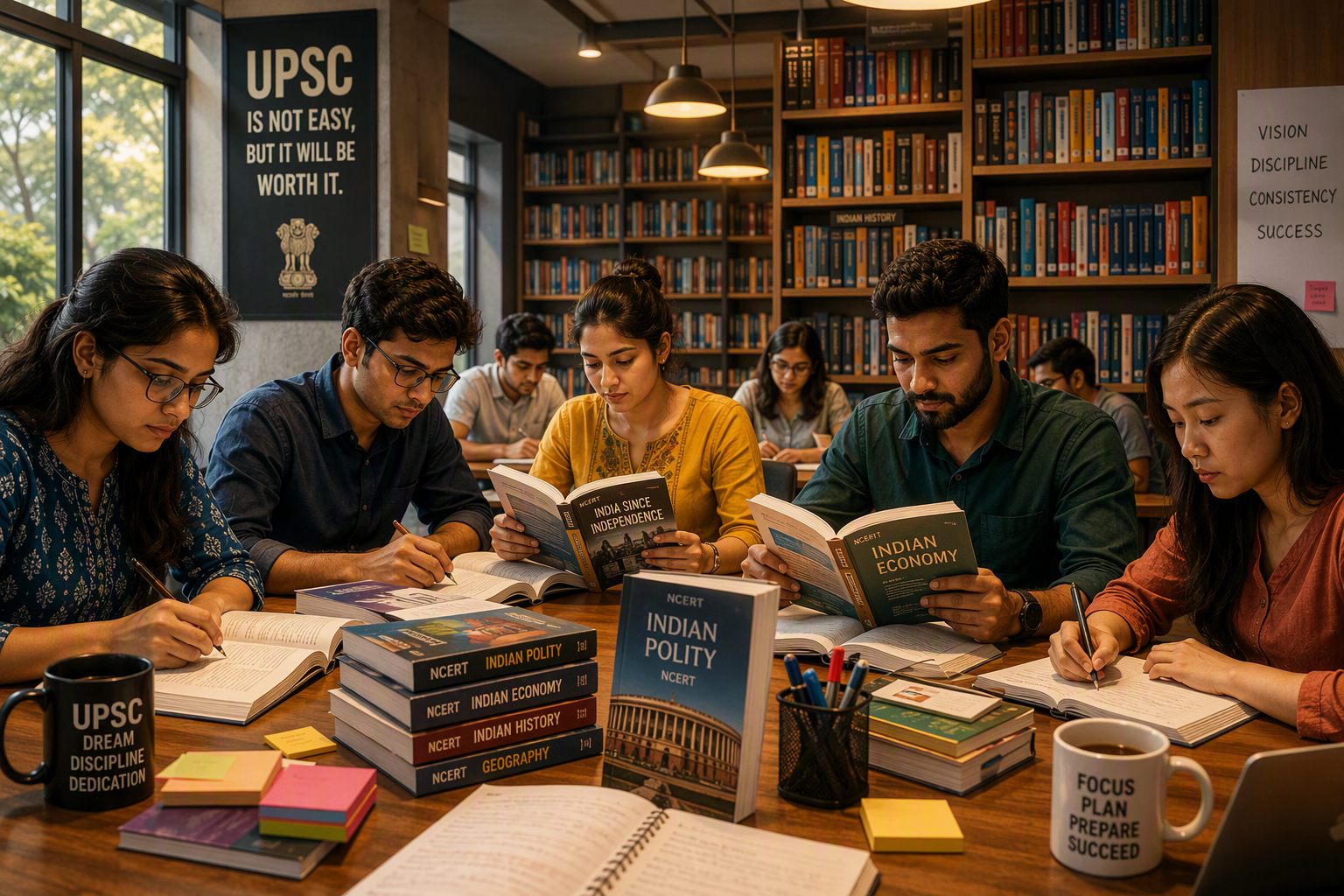
Key Highlights
- NCERT books give you a strong foundation. You should read them first before you go to other advanced study materials for the UPSC syllabus.
- The core parts you need to cover are social science, Indian history, geography, polity, economy, science, and the environment.
- Reading from Class VI to Class XII helps you follow the subject flow. It also helps you make sense of the ideas and gives you a good grip on each subject.
- Having a subject-wise list makes it easy to pick out what you need. This saves you time in your UPSC preparation.
- To remember better and write well in exams, make notes, revise often, and practice answer writing with what you read from ncert books.
- You should read both old and new editions with purpose. Both matter in your upsc preparation.
Introduction
NCERT books are a good place to start your UPSC preparation. They use simple language that helps you understand hard ideas across different subjects. If you want to do well in civil services, these books will help you learn the basics before you read other reference books. NCERT books cover many topics that you need for General Studies. They give a strong base for moving forward with your study work. Many people who want to take the civil services exam read these books at first and go back to them when they need to revise.
Why NCERT Books Are Essential for UPSC Preparation
NCERT books are important because they help you build a strong foundation in the subjects you need for the UPSC syllabus. The books use a simple structure that makes it easy to understand ideas. This can help you when you start your UPSC CSE preparation.
They also help with both prelims and mains. The UPSC exam has many questions that link to ideas from NCERT. This clear base is good for answer writing in the civil services exam. If you want to use them in the best way, start with basics. Next, link the chapters to the civil services examination syllabus. Be sure to revise often, too.
Building a Strong Foundation with NCERTs
For most UPSC aspirants, NCERT textbooks are the first step to building a strong base. They give you information in simple language. This helps you understand key topics without getting confused. Using these books is a good way to get foundational knowledge, especially if you are new to civil services preparation.
These books also help you see how different subjects connect with each other. A chapter you read in social science can give you a better idea about Indian society, how things are run, or economic development. This kind of cross-linking matters. The UPSC will not ask you about topics one by one.
To read them well, look at the main ideas first. At the end of each chapter, write a small summary in your own words. Watch for examples, diagrams, and important terms. This way helps you understand better. It also lets you do regular revision and gets you ready for harder books later.
Coverage of UPSC Syllabus Through NCERT Books
A main reason why NCERT books help so much is that they touch most areas in the UPSC syllabus. These books may not have every detail, but they do cover a good part of the main topics you get in UPSC CSE. This is why they are important NCERT books if you are starting your preparation.
You will get clear value from many general studies subjects. Subjects like history, geography, polity, economy, science, and environment start with what you learn in school. This helps you get ready for later steps faster and with less confusion.
Key areas you will find in the list of ncert books include the following:
- The past of India, starting from ancient India and up to modern history
- Physical geography, read maps, the climate, and other resources
- Political life, what the Indian Constitution says, and basics of how things are run
- Indian society, social issues, and some social science themes
- The Indian economy, economic development, and some basics of general science
For the prelims, you should read chapters that make ideas clear. These chapters often show up again in other classes. They can be your best support as you get ready for the exam.
How to Use NCERT Books for UPSC NCERT Preparation
Begin your UPSC preparation by reading NCERT books. Start with Class VI and follow the order in the main general studies subjects. This will help you build your concepts step by step. After you feel good about these basics, you can move on to reference books for your studies.
If you do not have much time, read one subject at a time instead of going through everything together. Start with history, geography, polity, economy, and science. These should be the main study materials you read. Make short notes as you read. Work on chapter exercises and practice answer writing. Try to link what you read with answer writing practice. The next parts will help you pick the edition you need and read with a better plan.
Choosing the Right Editions: Old vs New NCERTs
Many people ask if the old NCERTs or the new NCERTs are better. The real answer is that both are useful, but you need to read them the right way. The new books are good if you want clear steps to read in order. The old NCERTs are called good because they explain ideas well in some places.
This is often the case in history books. Old books like Ancient India by R.S. Sharma, Medieval India by Satish Chandra, and Modern India by Bipan Chandra help people build a strong base. Still, some parts of these books are old. They may not always fit what people need for exams right now.
A balanced approach works best:
- Use new NCERTs to cover standard school topics and help make studying easier.
- Use old NCERTs mostly for learning about ancient India, medieval history, and modern history.
- Stay alert for any old information or things that are not needed now.
- Both help as support before you go to reference books.
If you do not have much time, you should focus more on Class XII and the main areas of social science first.
Effective Reading Strategies for UPSC Aspirants
Effective reading is not just about reading books fast. It is about knowing what each chapter is teaching you. For UPSC aspirants, this means you need to read with care. Try to spot the core ideas. Then, link these points to both the mains examination and prelims.
If you have ten weeks and can study two hours each day, you should have a simple plan. Start with history and geography from the lower classes. After that, read about polity, economy, and science. Then, read the books for Class XI and XII. Go at a steady pace and do not rush through it.
Try these practical steps:
- Read one chapter at a time. Try to find the main concept in each chapter.
- Make concise notes, so you can use them for quick revision later.
- Go through chapter exercises or pick related questions to check your understanding.
- Link the topics with answer writing practice and the upsc syllabus.
- Set time blocks each week for regular revision. This will help you remember what you read.
This way can help you get better at time management. It also lets you remember what you read or learn for a longer time.
Subject-Wise List of NCERT Books Needed for UPSC
A list of NCERT books for each subject can help you read in a better way. The UPSC syllabus covers a lot, so it is good to use books that are grouped by various subjects from Class VI to Class XII. This list of NCERT books makes it easy for you to know what book you need to read first or next.
The table below is a helpful place to start if you want to learn about Indian history, the Indian economy, or physical geography. It also covers polity, science, and more. You can use it as an easy plan for what to read first. Then, as you get ready, you can learn more about any topic you want.
| Subject | Recommended NCERT Books for UPSC |
|---|---|
| Social Science / Indian Society | Class VI Social & Political Life I; Class VII Social & Political Life II; Class VIII Social & Political Life III; Class XI Sociology: Understanding Society; Class XII Indian Society; Class XII Social Change and Development in India |
| History | Class VI Our Past – I; Class VII Our Past – II; Class VIII Our Past III; Class IX India and the Contemporary World – I; Class X India and the Contemporary World – II; Class XI Themes in World History; Class XII Themes in Indian History I, II, III |
| Geography | Class VI The Earth Our Habitat; Class VII Our Environment; Class VIII Resource and Development; Class IX Contemporary India – I; Class X Contemporary India – II; Class XI Fundamentals of Physical Geography; Class XI India – Physical Environment; Class XII Fundamentals of Human Geography; Class XII India – People and Economy |
| Art and Culture | Class XI An Introduction to Indian Art; Class XII Living Craft Traditions of India (Chapters 9 and 10) |
| Polity / Political Science | Class IX Democratic Politics Part I; Class X Democratic Politics Part II; Class XI Indian Constitution at Work; Class XI Political Theory; Class XII Contemporary World Politics; Class XII Politics in India Since Independence |
| Science and Technology | Class VI Science; Class VII Science; Class VIII Science; Class IX Science; Class X Science; Class XI Chemistry Unit 14; Class XI Biology Units 4 and 5; Class XII Chemistry Part I; Class XII Chemistry Part II Unit 16; Class XII Biology Units 8, 9 and 10 |
| Economy | Class IX Economics; Class X Understanding Economic Development; Class XI Indian Economic Development; Class XII Introductory Microeconomics; Class XII Introductory Macroeconomics |
| Environment | Class XII Biology Chapters 13 to 16 |
| Ethics Support | Class XI Psychology; Class XII Psychology |
Social Science (Sociology, Governance, Political Science) NCERTs
If you want to get a good look at indian society and how it works, start reading social science NCERTs early. These books help people like us know more about social issues, how things work, and political ideas. All this makes it easier to write good mains answers later on.
The best NCERT sociology books and political science texts start with simple ideas for middle school students. Then, they go deeper in Class XII. This helps you see how society, the state, and public life connect with each other.
Useful books and focus areas include:
- You can read Class VI-VIII Social & Political Life I, II, III to know more about basic governance and political life.
- Class XI Sociology: Understanding Society helps you learn important ideas in social science.
- Class XII Indian Society talks about social structure and social issues.
- For topics like change, governance, and international relations, read Class XII Social Change and Development in India and Contemporary World Politics.
These books come in handy when you need good examples, clear meanings, and a real look at people in society for the exam.
History NCERT Books: Ancient, Medieval, and Modern India
History can seem very big in UPSC CSE. The NCERT history books help you get started with the subject in an easier way. They use clear language to tell about events, timelines, and changes. This is great when you want to have a good base in Indian history and start preparing with the right history books.
A good way to start is to use school-level books first. After you feel good about that, move on to Class XI and Class XII books. Many people also read old NCERT history books. They read these in some topics where it is important to really understand the idea.
Prioritize these books:
- Class VI Our Past – I helps you learn the basics of early ancient India.
- Class VII Our Past – II talks about how things changed in medieval India.
- Class VIII Our Past III looks at early modern changes.
- Class IX and X India and the Contemporary World give you a wider view of modern history.
- Class XII Themes in Indian History I, II, III go deeper into important parts of Indian history.
These books are good if you want to understand indian history from class vi to class xii. You can read about ancient india or learn more about modern history.
If you want to have a stronger background, old books by R.S. Sharma, Satish Chandra, and Bipan Chandra can help you. These books can give support for more advanced reading.
Key Subjects in NCERT Books for UPSC Prelims and Mains
The key subjects you need to read in NCERT books are history, geography, polity, economy, science, environment, and society. These are the core subjects in general studies. They will help you get a good foundational understanding for both parts of the exam.
For UPSC prelims, these books help you understand the ideas and facts well. For the mains exam, they help you with answer writing by giving a good structure, key terms, and some examples. If you do not have much time, start with books from lower classes to get the basics. Then move fast to Class XII books in the main subjects.
Important Chapters from Geography NCERTs
Geography NCERTs are very helpful. They bring together ideas, maps, and things that happen in the real world. These books let you answer both the direct and not-so-direct questions in general studies. This is true, especially when you look at how physical geography changes current affairs and topics like disaster management.
You do not have to spend the same time on each chapter at first. Spend more time on chapters that talk about landforms, climate, resources, India’s physical setting, and themes about population. These chapters will help you most with a quick revision later on.
Prioritize chapters from these books:
- Class XI Fundamentals of Physical Geography is good for learning about landforms, climate, and how the earth works.
- Class XI India – Physical Environment helps you get to know the physical geography of India.
- Class XII India – People and Economy explains how people and resources are linked.
- Class VIII Resource and Development will show you the basics about resources.
- Class IX and X Contemporary India has what you need to know about India-focused geography and maps.
This list can help you with your study of physical geography in class xii.
Keep maps and diagrams in your notes. They help you remember things better. They also make going over your notes much faster.
Important Chapters from Science & Technology NCERTs
Science & Technology NCERTs are good for anyone who wants to build basic concepts before the UPSC exam. They help you get these ideas clear before you have to answer tough questions. These books are not only for school students. They can help you too because they use easy words and explain how science works in a way that is easy to read.
Begin with the general science subjects from Class VI to X. This will help you get the basics clear. Next, read the important topics from Class XI and XII that are marked in the compiled list. You will find these topics in the list to be good for learning more about class vi, biology, and chemistry. They will also help you focus on what you need to know the most.
Give attention to:
- Class VI to X Science is good for learning general science basics and to help you get clear about many concepts.
- Class XI Chemistry, Unit 14
- Class XI Biology, Units 4 and 5
- Class XII Biology, Units 8, 9, and 10, plus also Chemistry Part II, Unit 16
Look at these to understand, not just to remember facts. This will help you with both science questions and also with topics that are about policy later.
Role of NCERT Books in General Studies (GS) Papers
NCERT books are important for general studies. They give you a solid foundation for all the main GS papers. These books help you understand the concepts before you move on to tougher sources or coaching study materials.
It is important to be clear in UPSC CSE because good answer writing starts when you have strong basics. Even if you take a mains test series later, what you know now shapes how good you will be as a civil servant. First, you need to get the simple ideas right. The next parts will show how NCERTs help with polity, governance, environment, and other areas.
Indian Polity and Governance Using NCERTs
Polity is easy to read when you start with NCERTs. They tell you about indian polity step by step. You can learn about things like institutions, rights, democracy, and governance without any confusion. This helps for prelims and when you write answers for general studies.
A good way to learn starts with the basic ideas of democracy taught in school. Then, you move to study the Indian Constitution and also read about political theory. This order helps you not just know the rules, but also understand the ideas that shape political life and how the state works.
Focus on these books and chapter themes:
- Class IX Democratic Politics Part I helps you learn the basics of democracy.
- Class X Democratic Politics Part II teaches you about the institutions and how political processes work.
- Class XI Indian Constitution at Work is for learning about the indian constitution and how it is set up.
- Class XI Political Theory and Class XII Politics in India Since Independence cover how governance works, social issues that matter, and development that has shaped political life.
These texts are good when you want simple and clear answers about hard polity topics. They are easy to read, and you can use them when you need help to know more about these things.
Environment and Ecology Topics from NCERT Books
The environment is one area where the NCERT books do not cover everything. Still, the book is very useful. The main source to read is the Class XII Biology. The last four chapters in this book are important for you. These chapters help you get the important points about ecology, ecosystems, and other subjects in a simple way.
This is important because the environment is often linked to current affairs, general studies, and disaster management. When your basics are clear, you will find it easier to connect these topics with the news and new policies.
Read these sections carefully:
- Learn the basics of environment and ecology from Class XII Biology Chapters 13 to 16.
- Make use of diagrams and boxed points to help you remember things quickly.
- When you read, try to connect the environmental concepts with current affairs.
- Write down examples that help you for both prelims and mains.
These topics are small and give you easy access to the main ideas. This is why it is good to go over them more than one time.
Tips on Making Notes and Summaries from NCERTs for UPSC
Notes from important NCERT books need to be short and clear. They should cover key points. Their main use is not to take the place of learning, but to help you remember things when you do a quick revision. This makes them good for both the prelims and answer writing.
Your final result depends on how well you understand the text. Summaries work best when you read the whole chapter. If you do regular revision, these notes can help you a lot. The next two parts tell you if using only summaries is enough and show you how to make them well.
Are NCERT Summaries or Notes Good Enough for UPSC?
NCERT summaries help with quick revision and can save you time when you study for UPSC CSE. But, they are not enough on their own. The summaries cannot take the place of reading the real chapters. You need to read the original text so you understand the way the ideas flow, see the examples, and really build your concepts.
Notes are most helpful after you read for the first time. When you know the chapter well, these short summaries make it easy to go over the important points. They also help you stay on top of many subjects at the same time. This is a good way to use when the syllabus feels too wide.
When you practice answer writing, summaries can help you remember things better. But you still need to read ncert books and some reference books to really understand the topics. Use ncert summaries just for another round of revision. Do not only read summaries. This way you can keep more in your mind, and your final result will be better. A good balance with ncert books, reference books, and revision is the best way to get ready.
Creating Short and Effective Notes for Revision
Good notes should help you do less work, not more. When your pages get too long, it gets hard to use them for going over what you learned. Try to keep your concise notes focused on the main ideas, examples, and how the chapter is set up. This helps with time management and makes it easier and less stressful to read over your notes again.
After you read a chapter, take a moment and think about what is important. Write down only the key points that you might forget or want to use for answer writing practice. This way is better than copying big parts word for word.
Use this simple note-making method:
- Write one short summary for each chapter.
- List keywords, dates, terms, and important points in a separate section.
- Add maps, diagrams, or tables where they help.
- Leave some space for updates during regular revision.
- Mark the facts or examples that may help you in answer writing practice.
As time goes by, these notes will be the fastest way for you to read and remember things. They help you get a better final result.
Conclusion
To sum up, NCERT books are very important for UPSC preparation. They help you build a solid foundation and cover all the key topics needed for the UPSC syllabus. If you use these books in a steady way, you can make your study time easier. You will be able to understand hard ideas better and stay on track with what UPSC asks for. NCERT books give good information for history, geography, and science. The content helps you learn and can improve your practice for both prelims and mains. When you start your studies, remember to make good notes and short summaries. This will help you remember what you read. If you follow these steps, you will be on the right path for UPSC preparation.
Frequently Asked Questions
Should I Read NCERT Books from Class 6 to 12 for UPSC?
Yes, reading NCERT books from Class VI to Class XII is a good way to get a strong foundation for the UPSC exam. You do not have to read every book with the same focus. But these books help you learn ideas in each big subject step by step.
Where to Download Free NCERT Books for UPSC Preparation?
You can get NCERT books for free from the official website. There are also some good UPSC study materials pages, where you will find subject-wise PDF files. If you want to download NCERT sociology books or any other subject, the best way is to use a trusted official website for easy access.
How Much Time Should I Dedicate Daily to NCERTs for UPSC?
A regular daily routine is best. If you have good time management, two hours each day can work well for NCERT books. The key is to read every day. Along with daily current affairs, use that time to read one chapter, write short notes, and quickly go over your old study materials.

