
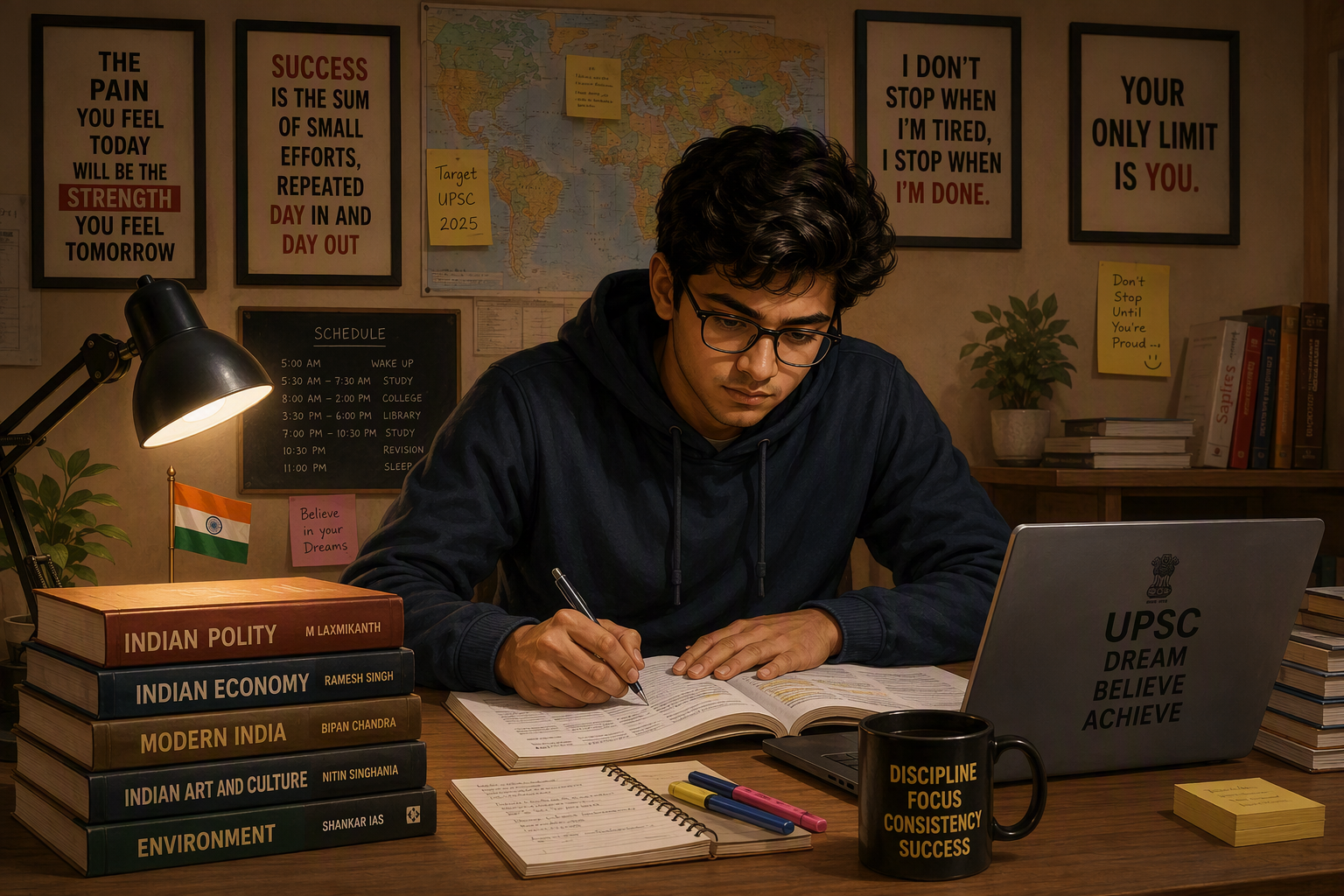
Key Highlights
- You can clear the UPSC exam by self-study if your UPSC preparation follows a simple study plan.
- Start with knowing the exam pattern, UPSC syllabus, and the different stages of the civil services examination.
- Build your base with NCERTs, standard books, newspapers, and notes for current affairs.
- Make sure you do weekly revision, practice with previous year papers, and spend time on answer writing.
- Use mock tests and online resources to check your progress and boost your performance without coaching.
- Discipline, time management, and consistent efforts are more important than joining a coaching class.
Introduction
Getting ready for the UPSC exam at home can feel tough, especially if you want to go into civil services for the first time. Many people have shown that upsc preparation does not need to happen in a class. You need to be clear about your goal, work with discipline, and have a plan that fits your life. If you read the right books, work with a routine, and keep going even when it feels hard, you will set up good upsc preparation on your own. This will help you feel sure about your steps and move ahead.
Understanding UPSC Preparation Without Coaching
Yes, you can get ready for the UPSC exam without going to a coaching institute. The main things you need to know for the civil services exam are not just taught in class. You can find all the information in the official syllabus, standard books, newspapers, previous year papers, and a lot of online resources.
What shifts with self-study is who takes charge. Your upsc preparation will be strong if you make a clear plan, stay disciplined, and check your progress often. If you can keep up with your schedule and understand what you do, self-study can be a good and real way to prepare.
Can You Clear UPSC Without Coaching? Facts and Insights
The simple answer is yes. You can clear the UPSC exam by studying on your own. A lot of successful candidates, even top rank holders, did not go to any coaching classes. They used books, online resources, and kept up with regular practice. So, if you are asking about the exam, this is your first step to feel confident in your preparation.
Coaching often helps by giving structure. It also helps you be more accountable and puts helpful resources together in one place. But, it does not own the main content you need for civil services. The real result will depend on how well you understand the topics. It also depends on how you link ideas and write your answers in the exam.
That is why self-study helps when you make your own structure. You need to be regular, show discipline, and use critical thinking. If you can stick to a routine, look at your mistakes, and keep your focus for a long time, you can get ready for civil services without being in a classroom.
What Makes Self-Preparation Feasible for UPSC Aspirants?
Self-preparation for the UPSC CSE can feel doable when you stop seeing it as a big puzzle and start treating it like a simple step-by-step process. You can start as a beginner by looking at the upsc cse syllabus, learning about the stages of the exam, and picking just a few good sources to read from. This will cut out a lot of guesswork and show you the way from the first day.
You do not need too much study material. You need the right material and a set plan. Standard books, NCERTs, previous year papers, newspapers, and online platforms can cover most of what you need. The main thing is to connect each topic to one source and read it with focus.
Focus on these basics:
- Make sure to read the official upsc cse syllabus with care.
- Begin with the NCERTs and some standard books.
- Start answer writing practice after you go through everything for the first time.
- Use online platforms for current affairs and to get help with mock tests.
Once you have the basics done, it gets easier to get ready on your own.
A Beginner’s Guide to Starting UPSC Preparation from Scratch
If you are starting upsc preparation from zero, begin with the basics. Do not rush into heavy books. First, get to know the upsc syllabus and the exam pattern. There are three stages in the exam. This will give you direction for your effort and help you not read random things.
Start by making a simple study plan that covers general studies, current affairs, and revision. The first step is to build your base. After that, you can go deeper into every subject. When your foundation is strong, you feel less stressed about the preparation. Now, let’s see what you need to get started.
Essential Items Needed to Get Started (Books, Materials, Tools)
A beginner does not have to read lots of books. You need a strong base. Make sure you use reliable study material. Set up a simple way to keep all that organized. Start with NCERT books. They explain things in a clear way. NCERT books help you build a basic understanding of general studies subjects.
After that, be sure to use a few standard reference books to learn more. For Indian Polity, read books that focus on this area. Do the same for history, geography, economy, and science. Also, keep one newspaper to stay up to date on current affairs. Make space for your notes, either on paper or in a digital file.
Your starter set should include:
- You can use NCERT books for history, geography, economics, polity, and science.
- There are standard reference books for big subjects like Indian Polity.
- A newspaper like The Hindu or The Indian Express can help.
- It is good to have previous year papers and basic note-making tools.
You can use these to start getting ready at home in a serious way.
Setting Your Mindset: Confidence and Discipline for Self-Study
Before you feel nervous about finishing the syllabus, start with your mindset. Self-study needs you to feel sure about yourself. There is no outside system telling you what to do each day. You must believe that doing a little each day is important, even if you feel you are not moving fast.
Discipline helps you turn your confidence into real results. Make a study schedule that you can stick with. It does not have to be perfect. The plan should help with time management, regular revision, and set study hours that match your day. A plan you can follow is better than trying to use one that will not work for you.
There will be good times and tough times. This is normal when you spend a long time getting ready. What helps is consistent efforts, not just working hard once in a while. If you show up day after day, look at what you need to work on, and keep a good attitude, self-study feels much better and gives you more.
Step-by-Step Guide to Prepare for UPSC Without Coaching
A clear step-by-step guide can help make self-study feel simple. It takes away the confusion and brings order to your work. You do not have to try to do everything at the same time. Go through each layer step by step. First, get to know the upsc syllabus. Then, pick your sources. After that, make a study plan. Do a weekly review. Test yourself often.
If you are starting from nothing, be sure your plan to study is real to stick to. You should set study hours that you can keep up for many months. Do not go for study hours that you only can handle for a few days. The next steps will guide you on how to sort out your subjects, timetable, what you read, how you go back to read again, and practice in a way that you can use.
Step 1: Analyze the UPSC Syllabus Thoroughly
Your first step is to read the upsc syllabus like a map. If you are new to upsc cse, do not start with random chapters or take notes from someone else. Take some time to read the official upsc cse syllabus for Prelims and Mains. Find out what is asked in each paper. This gets you ready for how the exam pattern works.
The setup of the exam is easy to understand but key for your study plan. Prelims has General Studies Paper I and Paper II. The mains exam has General Studies papers, qualifying language papers, an essay, and optional papers. When you know this early, you save time and do not waste efforts on what is not needed.
Use this basic text table to organize your view:
| Stage | What to Focus On |
|---|---|
| Prelims | General Studies Paper I, Paper II, objective pattern, elimination skills |
| Mains exam | GS papers, essay, optional subject, answer structure |
| Interview | Personality, communication, clarity of thought |
Once you know the syllabus, it is much easier to make plans.
Step 2: Build a Realistic Study Plan and Daily Timetable
After you know the syllabus, make a study plan that fits with your day-to-day life. A lot of people try to follow a study schedule that sounds great, but they can’t keep up with it after a week. A good plan should break up subjects, current affairs, and time for revision in a way that works for you.
One way that works is to spend about 60% of your study time on static topics. Use 30% of your time on current affairs. Save 10% of your time for revision. This helps keep your basics good and makes sure you stay up to date.
Your daily timetable should have study hours where you only focus on learning. Take short breaks to rest. Add a slot to go over your notes or check where you made mistakes.
Successful candidates often plan with flexibility, but not in a messy way. They set goals for each day and week. They keep track of work that needs to be done. They use weekends to catch up and review what they learned. If you study at home, being steady is better than studying many hours at once. Follow a routine that you can stick with for a long time.
Step 3: Select Core Books & Reference Materials for Each Subject
One thing that many people do wrong when they study on their own is getting too many books. It’s better to use fewer books and read them again and again. Start by using NCERT books to help you understand the ideas. If you need more detail, use standard reference books for that.
This way helps you save time and helps you remember things better. The best books are not the ones with the most pages. The best books match the syllabus well. They make ideas easy to understand. You can read them again and again. Try to make a small reading list with the best books for you. Do not try to read too many.
Keep your source list simple:
- You can use NCERT books for the main subjects.
- Go for standard reference books if you need to read more about a topic.
- Read one newspaper to stay updated about current affairs.
- Look at previous year question papers to see what is asked and to find the usual trends in them.
That is all you need to start off strong and keep things well arranged while you get ready through the whole process.
Step 4: Use Online Resources and Free Study Materials Effectively
Yes, online resources and free study materials can help you prepare well if you use them the right way. They are good for current affairs, previous year papers, updates, and practice. It is best to use them as planned support, not for endless scrolling or downloading things at random.
The smart way to do it is to use online platforms for tasks you need. Look at current affairs from trusted sources. Get mock papers online. Use digital notes to keep topics in order. If you add sources without picking the best, things get messy and tougher to handle.
Use online support for:
- Stay updated with daily current affairs and read about issues.
- Get access to previous year papers and practice questions.
- Take part in test series and get help with self-evaluation.
- Keep your notes and revision material in order.
So, are they enough? They can be. This happens if you only use a small number of sources. You also need to work hard and keep to your plan.
Step 5: Focus on Weekly Revision and Answer-Writing Practice
Reading by itself is not enough for UPSC. You have to look back at what you read every week. This helps keep things in your mind longer. You also need answer writing practice. This is so you will write your ideas well, even when you feel time is running out. These things matter even more for the Mains stage.
A good routine is to review your notes every 7 to 10 days. This repeated cycle can help you remember more. It also helps you link current affairs with other subjects. When you start answer writing, do it after your first read of the subject. Try to keep your answers clear and well-organized. Work on writing them faster instead of trying to make every answer perfect.
Make these habits non-negotiable:
- Go over notes each week.
- Write short answers after you finish topics.
- Use mock tests to help work on timing and memory.
- Look at mistakes and rewrite answers where you feel weak.
If you do not practice regular, what you know just stays inactive. Going over what you learn and writing it down help make you ready for exams.
Step 6: Practise Mock Tests and Evaluate Performance
Mock tests work as a way to check yourself when outside feedback is not there. They let you see if you can use what you learned when there is stress like the real exam. For Prelims, practice with full tests helps you with time management. It also makes you more correct and helps you remove wrong answers. For Mains, mock tests help make you write faster and keep your answers clear.
The test is just part of the process. The most important thing is how you check what you did. After each paper, see if an error is from not knowing the topic well, not remembering facts, or not reading carefully. This way of looking over your work helps you get better for next time.
To use tests well:
- Solve previous year question papers often.
- Take regular mock tests in places like the exam.
- Look at every error after the paper.
- Use weak spots to guide what you study in the next week.
A test series helps the most when it lets you see your own mistakes and fix them honestly.
Strategies for Staying Motivated and Consistent
Motivation for UPSC prep will not be high every day, and that is okay. The most important thing is to set a routine that helps you keep up consistent efforts, even when things feel tough. When you practice good time management, your study feels less stressful. It also becomes easier to handle each day.
Keep telling yourself why you want to be a civil servant. The exam is not just about facts. It helps you build the discipline, good sense, and balance you will need for the personality test and work in public service. Let’s see the most common problems people face and how to deal with them.
Overcoming Common Challenges Faced by Self-Preparing Aspirants
When you try to get ready by yourself, you might feel lost because there is too much study material. You may feel worried if you do not plan well. You may also feel unsure of yourself. These problems are normal. It is hard when there is no teacher to see how fast you are going. The good thing is that you can fix most of these problems. You just need a better plan and use fewer sources to study.
Another big problem is not having clear ideas about basic topics. If you do not get your basics right, things like current affairs and harder topics feel hard to understand. Some people do not look at CSAT parts like logical reasoning and basic numeracy until the exam is close. This adds extra stress that you could have avoided.
Watch out for these common mistakes:
- Collecting too much study material
- Reading topics that are not part of the syllabus
- Not spending time on revision and practice for answers
- Ignoring logical reasoning and having weak basics
If you find these things early, self-study will feel easier. You can keep things under control and feel less stress.
Tips for Maintaining Consistency and Motivation During Preparation
Consistency gets better when the work feels possible. A study plan that you can use each day is key. You should not only look at it. Break big goals into smaller steps for each week. Small wins help you feel good and keep going. This way you feel less stress. You also see progress in real time.
It is good to treat getting ready like a regular part of your day, not something you do only when you feel like it. Try to sit down to study at the same time each day and stick to the set study times. A steady plan for time management, like revising on fixed days, lets your mind rest from guessing what to do next.
Here are a few practical ways to stay on track:
- Set daily and weekly targets.
- Keep one fixed slot for revision.
- Measure progress through regular practice.
- Stay positive during slow phases.
You do not need days to be perfect. You need days you can do again and again. These are the days that keep you moving forward.
Conclusion
To sum up, getting ready for the UPSC without coaching can be done if you use the right methods and keep a good attitude. Take time to look at the syllabus, make a clear study plan, and use all resources you have in the best way. Stay motivated and keep up your work every day. Face any problems you have with a strong spirit. Doing self-study is a great way to build good habits and learn to be independent, both for the exams and in your life ahead. If you want to do well in your UPSC preparation, start now and trust yourself to get there.
Frequently Asked Questions
Are online resources and free materials enough to crack UPSC without coaching?
Online resources and free study materials help you do well in civil services preparation if you use them with discipline. They are good for current affairs, previous year papers, and test series. For the upsc exam, it is not about how many materials you read. It is about picking a few good sources and revising them well.
How do successful candidates plan their daily schedule for UPSC self-preparation?
Successful candidates often plan a study schedule that is easy to follow. They fix study hours each day and set aside time for current affairs and revision. Their daily plan has structure but can change if needed. Good time management means they set clear goals for each day and week. On weekends, they use time to look back at what they have studied, test what they know, and go over topics they still need to cover.
What are the most effective study materials for UPSC self-preparation?
The best study material has ncert books for the basics. You should read some standard books for more detail on the topics. Try to read one good newspaper, and practice with previous year papers as well. Your main books should be close to the upsc syllabus. It is better to read these same sources again and again, than to collect too many study material and get lost.
Do UPSC toppers recommend preparing without coaching, and what was their strategy?
Many successful candidates and upsc toppers have shown that self-study can help you do well in the upsc exam. They made a clear plan of what to read by understanding the syllabus. They also used only a few study sources. A big part of their success was doing regular revision of what they read. They practiced with previous year papers and did answer writing practice often. One thing they all did was stay consistent. They did not depend on coaching institutes.

