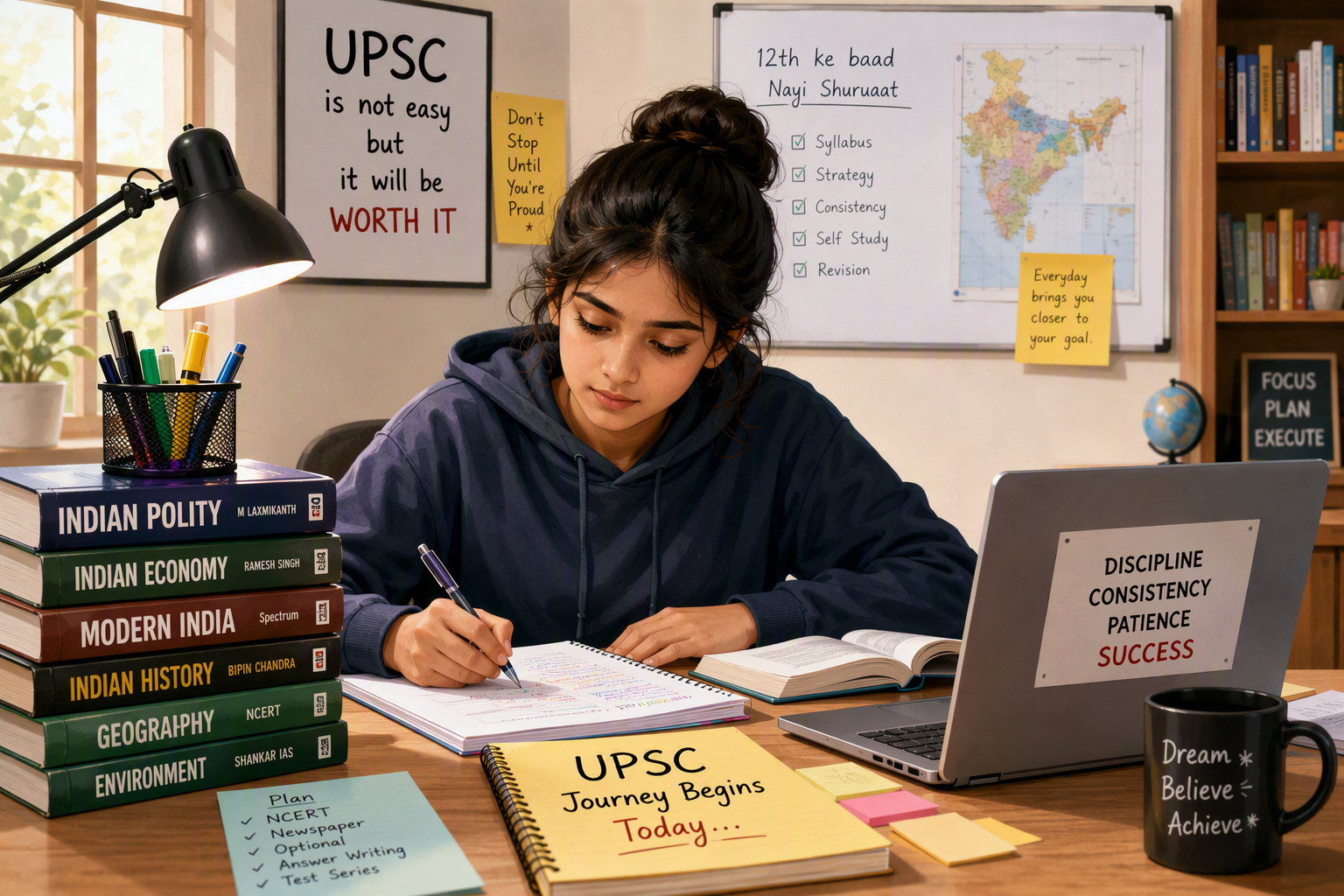
Key Highlights
- If you start your UPSC preparation after class 12th, you get a strong foundation and do not feel last-minute pressure.
- You will not become an IAS officer right after you finish school. But starting early helps a lot in the civil services exam.
- Picking a graduation subject that matches the UPSC syllabus can make your way to success easier.
- NCERT books, current affairs, and previous year question papers are the best way to begin.
- A regular plan during your college years will help you grow in answer writing, reading, and your analytical skills.
- Coaching and studying on your own can both work. The key is to have a realistic and steady plan.
Introduction
If you have finished school and want to try for the civil services, now is a good time to plan. You cannot take the upsc exam right after passing 12th, but you can start your upsc preparation early. This helps you use these years in a good way. An early start lets you know the civil services exam syllabus well, build your reading habit, and slowly get stronger with each subject. If you pick the right course for graduation, read the right study books, and stay regular in your work, you can feel more sure and ready as you move towards civil services.
Understanding UPSC After 12th – Why Start Early?
The best time to start is when you are in class 12th or right after it. At this time, you cannot take the civil services exam yet. But starting early for upsc preparation helps you learn things in a calm way. That is a big advantage for you on your civil services journey.
Starting early gives you a strong foundation in the basics before the pressure at college gets higher. You can work on the basics, keep up with current affairs, and build better study habits at this stage. This early start helps you later because you will feel more focused. Now, it is good to look more into the benefits and the limits you should know next.
Benefits of Beginning UPSC Preparation Right After 12th
Starting to prepare just after 12th gives you a strong advantage. UPSC CSE wants people who show depth, patience, and do things again and again. If you start early, you will not feel rushed later on. You can do your work slowly while you are in college. This way, you get a strong base in subjects that the general studies and mains exam need.
Your first steps can be easy. Get to know the exam well. Begin with NCERT reading. Build a reading habit every day. This will help make your hard work better. You will not study blindly when you do this.
- Get to know the exam steps. These are preliminary examination, mains, and personality test.
- Begin with NCERT books. These will help you understand the basic concepts.
- Read a newspaper each day. This will help you get a better reading habit and stay updated with current affairs.
- Take short notes while you study. This will make it easy for you to go over things later.
This way helps you save time and feel more sure of yourself. It also gets you ready to use bigger resources in the future.
Is It Possible to Become an IAS Officer After 12th?
Yes, you can try to become an ias officer after class 12th. But you cannot take the upsc civil services examination right after you finish school. The upsc civil services examination has its own eligibility criteria. You need more than just finishing class 12th to apply for the civil services examination.
You need to finish a graduation degree from a recognised university or a similar place. The candidate must be at least 21 years old. If you are in the General group, the age limit is 32. There is some age relaxation for other groups according to rules. It is also important that the candidate is an Indian citizen. Nationality does matter here.
So, here is the simple answer for you: you cannot join the service just after 12th. But you can start to get ready right now. Starting early will help you use your college time well. You can pick better subjects and get ready for your first attempt, with good prep, after college.
Choosing the Right Graduation Stream and Subjects for UPSC
Your graduation course does not decide how successful you will be, but it does help with your preparation. The best way is to pick a stream that matches the upsc syllabus. This lets you study core subjects in a simple way. It can also help you later when you have to choose an optional subject.
Humanities is a good choice for the exam. This is because subjects like political science, history, geography, economics, and public administration match well with the topics asked. But there are also ways for commerce students and science students to do well. You just have to plan in the right way. Now, let’s see how you can make a good choice.
How to Select College Courses That Align with UPSC Syllabus
When you pick a bachelor’s degree, try to choose subjects that do not repeat what you will study later. A graduation degree that matches the upsc syllabus can help with long-term learning. This also makes your journey to public service easier and more organized.
You do not need to find a perfect course. You need a course that helps you stay interested in your studies. The right course will also give you practice with the core subjects that often come up in general studies and the optional stage. This is the reason why having overlap is more important than what you call it.
- Pick subjects that you feel you can study for three years without getting bored.
- It is good to go with courses that have history, geography, polity, economics, or society topics.
- Try to keep an eye on your future optional subject when you pick your degree.
- Go for a path that lets you read, write, and think about things in a clear way.
Simply put, the right course should help you finish your graduation and also help you with UPSC learning at the same time.
Most Recommended Graduation Streams for UPSC Aspirants
For many students, the arts stream is a good choice for UPSC aspirants. It has subjects that be close to general studies. You will find political science, history, geography, sociology, economics, and public administration in the arts stream. These subjects help you with your first learning steps and later, when you choose your optional subject.
So, commerce students and science students should not feel less confident. The help given here shows that they can pass the exam, too. They need a clear plan, cover NCERT books well, and read current affairs in a steady way.
| Graduation stream | How it helps UPSC aspirants |
|---|---|
| B.A. Political Science | Strong fit for polity, governance, and international relations |
| B.A. History | Useful for Indian history, culture, and heritage topics |
| B.A. Economics | Supports economy and development understanding |
| B.A. Public Administration | Helpful for governance and public administration optional |
| B.Com | Suitable for commerce students with planned GS preparation |
| B.Sc. | Works for science students who add humanities basics separately |
Yes, some streams are suggested, but to be successful, it is all about how you do it.
Essential Resources Needed to Begin UPSC Preparation After 12th
Many people who are new to upsc preparation sometimes waste time. They collect too many books at the start. It is better to pick a short and reliable list of books. For early upsc preparation, ncert books are good. They help you get a clear idea of topics. The language is simple, so you can understand things fast.
After you finish the basics, add a newspaper and read a few books that we suggest. Only read these books after you are clear on the basics. Make a habit of practice by working on previous year question papers. Start the test series only after your foundation is strong. These tools work best when you use them one after another. Next, we will show you the right order for these resources.
Recommended Books and Study Materials for Beginners
If you are new to this, you should read ncert books from Classes 6 to 12. These books match the upsc syllabus. They help you know the topics without any confusion. If you are a beginner, this is better than hard material.
When the basics get better, you can start to read newspapers, read monthly magazines, and try practice materials. Do not try to do all these things at one time. Good writing skills and answer writing will come if you read and practice again and again. Keep looking back at your work to get even better.
- Start by reading NCERT books on History, Geography, Political Science, and Economics.
- For current affairs and current events, read The Hindu or Indian Express.
- Use previous year papers. These help you see the style of the questions.
- Join a test series when you finish the basics and begin to revise.
This order helps you keep your prep easy, clear, and aimed at the test from day one.
Importance of NCERTs and How to Use Them Effectively
NCERT books are important because they help you build a strong foundation. They explain basic concepts in a way that is easy to understand. This helps you get more clarity before you move on to harder books. For those starting early, using NCERT books is one of the best ways to begin.
You can connect NCERT learning with news you read every day. If you read about current events after you study some basic geography, polity, or economics, you will find the news easier to understand. This can help you remember more and feel more sure about what you know.
- Finish the NCERTs in steps. Do not read all the books at once.
- Make short notes for each chapter. Use your own words. This helps with revision.
- Try to link what you read in the newspaper with the topics you learned that week.
If you want to get better at reading newspapers, it’s best to start with little steps. Try to read one paper every day. Put your attention on news about policy, the economy, and big news at the national or world level. Do not worry about stories that will not help you with the exam.
Step-by-Step Guide: How to Start UPSC Preparation After 12th
The first step after school is not to jump into hard questions. It is to understand how the upsc civil services exam works. You should know the civil services exam pattern. You also have to see the role of current affairs in it. Know how different subjects in the upsc civil services exam connect with each other at each stage.
The exam has three parts. First is Prelims, then Mains, and last comes the personality test. The Prelims part has questions from general studies and the civil services aptitude test. When you know this structure from the start, it will help you get ready in a better way. Let’s go through each step so you can know where to start your civil services exam journey.
Step 1: Understanding the UPSC Exam Pattern and Syllabus
Start by understanding the exam pattern well. The UPSC process has three steps. These are the preliminary examination, mains, and the personality test. If you do not know about this, you might work hard but still not get the right result. This is why you need to know the syllabus before you start serious reading.
The upsc syllabus has topics like history, politics, geography, economy, the environment, science, ethics, essay writing, and later, one optional paper. The mains syllabus is not just about facts. You need to really understand the topics well and explain them in detail.
- Read the prelims syllabus and mains syllabus at the same time.
- Look at the previous year papers. This can help you see how topics are asked in the exam.
- Note there is a difference between getting facts ready and answering with an analysis.
When you know the structure from the start, every book, note, and study time will have a clear purpose for you. You will get what you need and feel good about learning.
Step 2: Building a Strong Foundation with Basic Reading and Current Affairs
After you learn the structure, the next step is to build a strong foundation. Start with simple reading. Begin with NCERTs and read them well. After that, read newspapers on current affairs every day. When you read the basics the right way, it helps much more than trying to read hard things too soon.
Having a daily newspaper habit can help you understand current events. You learn more about things like government, economy, and world news. One paper that is suggested in the compiled material is Indian Express. Reading Indian Express can help you be more consistent with your reading. It also helps you think more about current issues.
- Read one newspaper every day at the same time.
- Take short notes on policies, the economy, and big stories happening in the country or the world.
- You can add monthly magazines and papers from the government later, but there is no need to read all of them right now.
Here is how you can get better at reading the newspaper after 12th grade. First, read with a goal in mind. Try to link news stories to the main topics you study. Also, read your notes often. This is a good base for smart upsc preparation.
Step 3: Developing a Daily Study Routine and Time Management Plan
A good daily routine is easy to stick with for a long time. If you are in college, you can follow the plan and spend 3 to 4 focused hours each day. This will be enough at first if you make regular effort and use your time in a good way.
Divide your time between three things: static subjects, reading the newspaper, and doing revision. On weekends, spend more time to practice answers and learn with practice tests. This routine will help you make short notes. Over time, it will also help you get better at analytical skills.
- Spend some time each day on NCERTs or your main core subjects.
- Set a time in the day for reading the newspaper and making notes.
- On weekends, you should use your time to go over what you learned, practice answer writing, and later work on test series practice.
The best routine is not about how long it is. It is about what you can stick to without feeling tired all the time. This way, you can get through college well and keep up with your work.
Step 4: Deciding Between Coaching and Self-Study for UPSC Preparation
This choice will be different for each person because it is about how much discipline you have, how clear your plan is, and if you feel you need help. Self-study can be good if you are someone who is very focused. But many upsc aspirants find it hard to get direction, pick the right books and learn how to do answer writing and revision at first.
Structured coaching is helpful when you need a clear plan. It gives you regular mock tests, someone to guide you, and well-organized study material. The information shows that many beginners waste time without expert help, mainly because they do not know how to study for the exam.
- Go for self-study if you can be disciplined and stick to a good plan.
- Go for coaching if you want the structure, feedback, and practice that comes with it.
- Weekend batches are good if you want to balance college and study at the same time.
Should you join right away? Not always. Join if you feel that guidance will help you be more steady, not just because you see others doing it.
Tips for Balancing College Life and UPSC Preparation
Balancing college studies with upsc preparation can be done. You need to stop thinking like they are two different things. If your graduation course has topics that match the upsc syllabus, then your college work is already helping your upsc journey.
The real key is time management. You should use weekdays for short study blocks. Use your weekends for review, practice with mock tests, and answer practice. Take care of your health and get good sleep, because it will be a long journey. Now, let us turn that idea into steps you can actually use.
Strategies to Manage Time Between College Studies and UPSC Prep
You do not have to spend extreme hours to handle both. You just need a clear weekly plan. Since college work takes up a lot of your time, you should make your plan focus on slow and steady progress in the upsc syllabus. You do not want a heavy load every day. Good time management is always better than making random effort.
Keep your schedule linked to the exam pattern. You can read static subjects through the week. Use the weekend for revision and writing practice. This way, you can build your analytical ability without messing up your other work at school or college.
- Try to spend 3 to 4 hours each day on focused study, not long random sessions.
- It’s good to add subjects from graduation if they cover the same topics, as part of your study.
- Save weekends for practice tests, going over what you read, and working on essays.
- Make sure you get sleep, exercise, and take breaks to stay on track.
If you follow this structure, college work and UPSC prep do not fight with each other. Instead, they help each other out.
Conclusion
To sum up, starting your UPSC preparation after 12th grade can be a smart move. It can help you build a good base for your success. You just need to pick the right subjects in your graduation, use the must-have resources, and set up a clear study plan. This can help you deal with both college and UPSC preparation at the same time. You have to stay strong and keep your focus during this process because being an IAS officer takes a lot of hard work.
The steps you take now will help you get closer to what you want. If you want to start your upsc preparation, feel free to reach out for a free talk about how to set up your own study plan.
Frequently Asked Questions
What is the best time to start UPSC preparation after 12th?
The best time to start upsc preparation is when you are in class 12th or soon after you finish it. You cannot give the civil services exam at this point, but this is a good stage to build a strong foundation. You get to know the upsc cse structure early. You can also start good reading habits and practice making notes from the start. This will help you in your civil services journey later.
Can I prepare for UPSC along with a technical degree like BTech?
Yes, you can get ready for the civil services while you have a technical degree. The help shared makes it clear that students from science can also do well. You should plan out your graduation course well. Make sure to read NCERT books often. You will also need to put in more work on the humanities parts of the upsc syllabus since many other people try for civil services after learning them apart.
Should I join coaching immediately after 12th for UPSC?
Coaching is not always needed. It can help if you want more structure, a mentor, or a test series. Self-study also works if you stay disciplined. When getting ready for the civil services exam, you need to see if guidance will help you be more consistent, plan well, and practice answers better. The right choice depends on what helps you best.
How do I stay motivated throughout my UPSC journey after 12th?
Stay motivated during your upsc journey by setting small daily targets. Do not just look at the final result. The upsc journey can feel long, so try to keep track of your work every week. Go back and read your work often. Keep in mind that hard work at the start gives you a strong base. Being steady with your work gives more motivation than any kind of pressure.