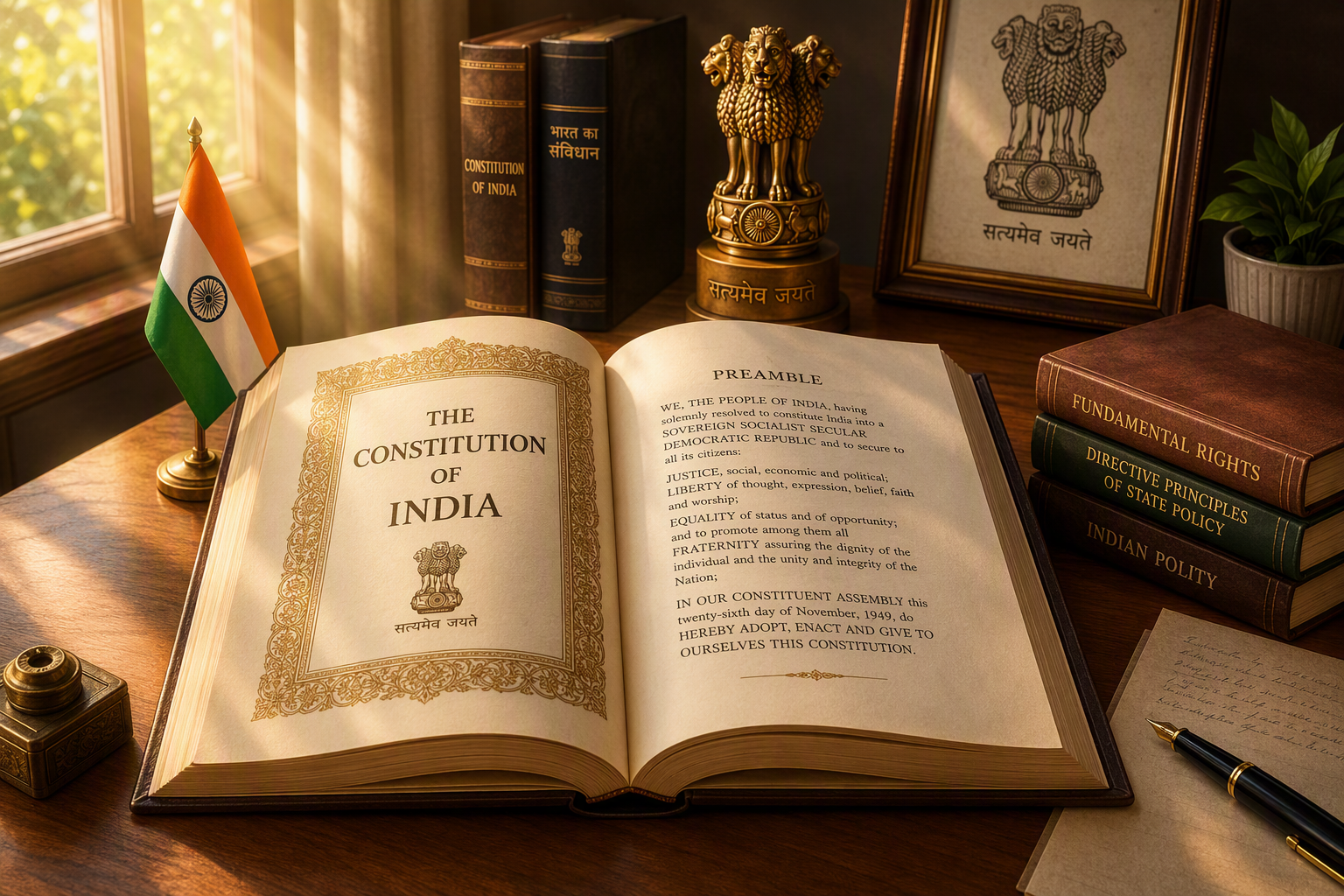
Key Highlights
- The Indian constitution is a written constitution. It has many important features.
- The constitution shapes the governance of the country. It does this by setting rules, building institutions, and making limits on the power others have.
- It gives you fundamental rights. These protect you from unfair actions by the state. They help you live a life that is more democratic.
- With the federal system, the constitution lets the Union and the states share power. But, the center is still strong.
- The directive principles are there to guide the state. They help the state move toward a welfare state and more fairness for all people.
- The Supreme Court looks after the basic structure of the constitution. It keeps the main values and ideas of the Indian constitution safe.
Introduction
The Constitution of India is more than just a set of laws. It is the main base for how the country is run every day. If you want to know how the system in the country works, you need to look at the salient features of the Constitution of India. These show the way power is shared, the way people’s rights are safe, and how the main parts of a democracy work. The Constitution shapes everything people do, from elections to how the courts act. It helps guide how life goes on in the country in clear and lasting ways.
Salient Features of the Indian Constitution
The Indian Constitution has some clear and important points. The Constituent Assembly took a lot of time to plan every part of it in a smart way. They set up a written constitution to help guide the country. The people here come from many different places and backgrounds. Each part of the constitution has its own use. These parts work together and help make the country’s system better.
You can see these main features in the way the Government of India works. This is about how rights are protected, what the courts do, and the way power is split between the Union and states. When people ask about the big salient features, they want to know things like how long the document is, the federal system, the parliamentary system, fundamental rights, directive principles, and an independent judiciary.
The Lengthiest Written Constitution in the World
One important thing to know about the Constitution of India is its size. The Constitution of India is the longest written constitution in any country that is free. When it first came, there were 395 articles, 22 parts, and 8 schedules. Over many years, it became even bigger because of changes made to it. This is one of the main salient features of the written constitution of India.
The written constitution is long for a simple reason. India is a big country. There are many different people and groups here. The written constitution is for both the Union and the states. In some other countries, states can have their own separate constitutions. But in India, this does not happen. So, the written constitution has to cover many things to be complete.
Another reason is history. The people who wrote the Constitution looked at the Government of India Act when they needed ideas. They took many things for the government of india from it. They also put more details into the Constitution. Some countries usually leave these things for usual practice or ordinary laws. This is one reason that people say this Constitution is unique when they compare it with others.
Key Influences and Sources of the Indian Constitution
The constituent assembly did not just pick one idea and stick to it. It looked at many systems before making a choice. Then, it chose what would be good for India. This careful work made the Constitution strong and open to change. It also made the division of powers work well for the country.
Important sources included the following:
- The British Constitution had a big impact on the country. It gave the ideas for a parliamentary system, the rule of law, the cabinet system, and having single citizenship.
- The American Constitution gave the main ideas for things like fundamental rights, judicial review, and the set-up of strong courts that stay independent.
- The Government of India Act made many of the rules that tell the government of India how to work.
- The Irish Constitution helped bring in the directive principles.
- A mix of other systems was used to make rules for how to change the constitution, and also set up the country’s federal structure.
What is most important here is that people can adapt. The writers of the Constitution used ideas from other places. They changed these ideas and put them together in new ways so they would work for everyone. That is why the Constitution has some parts that people have seen before, but it is also a new way to run the whole country.
Blend of Rigidity and Flexibility
A big strength of the Constitution is that it has a blend of rigidity and the power to change. It is not a fully rigid constitution, so it can change when needed. But it is not so simple to change it all the time. This helps keep the supremacy of the constitution. It also lets people make changes when they are needed.
Some rules can be changed in ways that are almost the same as making ordinary laws. But to change other parts, there has to be a special majority in Parliament. If any changes will affect the federal system, state legislatures must also agree. This step-by-step process helps make sure people do not change important rules without thinking about them enough.
Flexibility is important, as things in society can change with time. There are always new needs, and new groups show up, and people also find new ways to live. So the law needs to change along with all of this. The constitutional amendment act lets people update the law when they need to. At the same time, the steps for making changes help to keep the key values safe, so they are not lost or made weaker too soon. This is why people feel that flexibility is a strong point of the system, and not something bad.
Federal Structure with Unitary Characteristics
India has a federal system. But it does not always work just like it says in the textbooks. The Constitution calls India a union of states. It also tells how the division of powers is set between the Union and the states. This division of powers is a main part of any federal system.
The system gives the center more power than in many old unions. The Union takes the lead when there are big matters to handle, issues not clearly named, and during hard times. State legislatures can work in their own areas. Still, they need to follow the rules that keep the country strong and together.
The Indian Constitution helps federalism in some important ways. It clearly shows how power should be shared between the two levels of the government. There is also an independent judiciary that helps keep things fair.
But, the Indian Constitution also builds a strong centre. So, the country works much like a federation in most cases. Still, in some big or special times, the country can act as one whole unit.
The Basic Structure Doctrine
The basic structure idea helps keep the main idea of the Constitution safe. It means that Parliament can change many things in the Constitution, but it cannot remove the important parts needed for governance of the country. This rule helps the country stay steady, even when there are changes.
This matters to you because there is no way for any part of the constitution to be changed in a way that would hurt democracy, rights, or the balance between our institutions. The supreme court uses this rule to keep each part of the constitution safe. This also helps to make sure things work well.
Concept and Origin of the Basic Structure Doctrine
The basic structure doctrine is there to make sure Parliament cannot change every part of the constitution. While they can make amendments, the system cannot work if the whole part of the constitution is taken out. The basic structure rule keeps important parts safe.
The main point is simple and very important. Change can happen, but the heart of the Constitution must stay. The basic rules that help support democratic government, keep things steady, and make sure everything works well cannot go away. This means the Constitution can grow or get bigger with a constitutional amendment act. But people should not change it so much that it loses what makes it special.
The Supreme Court made this rule firm. When the Supreme Court did this, it showed that the people have power to change things, but there is a stop to it. Now, this is one of the best ways to keep order in the country safe and to help the people who need it.
Judicial Role in Protecting the Basic Structure
The Supreme Court has a big role in making sure the main ideas of the Constitution stay safe. When people do not agree on new laws or changes, the Supreme Court looks at them. The court checks if these changes will hurt the basic structure. This is what makes judicial review by the Supreme Court very important.
Courts are called the guardian of the constitution because of this role. They do not make the rules, but they check if anyone breaks the rules found in the constitution. If someone makes a change that goes against these basic rules, the courts can stop it.
This job helps the basic structure work in real life. Without the supreme court using judicial review, this idea would stay as just a thought. When the supreme court uses judicial review, the Constitution gets a strong way to stop those in power from misusing it. It also slows down quick changes that could hurt its main ideas.
Impact of the Basic Structure on Indian Governance
The basic structure is key for how the country is run. It tells the people who make laws what changes they can or cannot make in the constitution. So, they have to work within some limits. The basic structure helps keep things stable in the country. It also stops leaders from changing important rules just to get quick results.
Judicial review helps with this protection. When people question a constitutional amendment act, the supreme court can look at it. The court can see if it goes against any basic things in the law. This keeps the constitution strong. It does not let political groups have all the power with the rules.
For everyday rule, the result should be a balance. The government can still make changes, find answers for old problems, and come up with new rules. But they have to make sure not to harm what helps keep democracy strong. This means protecting rights, being fair, staying open to people’s questions, and making sure the system stays strong.
The Preamble as a Key Feature
The preamble is the first part of the constitution of india. It tells you what the constitution of india is for and what it wants to do. The preamble gives guiding ideas to people and shows the main goal for this system. Because of this, the preamble is not just an opening line. It has a big meaning and gives us the real reason behind making the constitution of india.
The preamble is a part of the constitution. It helps you read and know what is in the rest of the constitution. It shows the values that the document aims to protect and grow.
Guiding Principles as Expressed in the Preamble
The preamble tells us the main goals of the constitution. It points out the key ideas that guide the rest of the document. If you want to find out why it was written like this, you should begin here.
It shows the values from the constitution that guide the laws, offices, and how people should act in public jobs. Values like justice, freedom, equality, and brotherhood are all in it. The preamble also says that India will be a country that rules itself, helps everyone, treats all faiths the same, gives people a voice, and is run by the people. These words are not just there without reason. They tell us what kind of country the writers of the Constitution wanted India to be.
The preamble is a part of the constitution. It acts as a moral guide for people. The preamble does not replace the main articles. It helps people see what those articles mean. This is why the preamble is very important for understanding the constitution and learning about it in schools.
Interpretation and Significance of the Preamble
The preamble matters a lot. It shows people how they should read the Constitution. When courts deal with tough parts of the Constitution, they look at the ideas in the preamble to help them. So, the preamble does much more than just stand for something.
The Supreme Court sees the preamble as helpful when it comes to understanding the Constitution. The preamble is not filled with a lot of legal rules. Still, it gives constitutional recognition to the important ideas that hold everything together. This helps the Supreme Court during judicial review. The preamble gives a clear reason and purpose for the Constitution.
The way the amendment process works shows us why the preamble is so important. Words like socialist and secular were added after some time with a constitutional amendment act. This means that the preamble of the country can change when there is a change in the constitution. But its main use does not change with time. The preamble still gives us the big ideas and main goals for the country’s constitution.
Constitutional Values Defined in the Preamble
The preamble talks about the main values in the Constitution. These values help guide how people live together and how laws are read. The values talk about many things, but they are not hard for people to understand. They help guide the way groups act and help people know what the Constitution means for them.
Its key values include:
- There should be justice in social, economic, and political life.
- People should have liberty when it comes to thought, expression, belief, faith, and worship.
- Everyone must get equality when it comes to status and opportunity.
- A sense of fraternity is important. It helps keep both human dignity and unity.
- Secularism means the state does not favor a particular religion.
These ideas let you see the Constitution as more than a group of rules. They show the right way for the country to move forward. When courts, lawmakers, and people read the preamble again, they bring back the values that help the Constitution work well.
Fundamental Rights – Pillar of Democracy
Fundamental rights are a big part of democracy in India. You can read about these in Part III of the Constitution. They help keep people safe from any wrong actions by the government. These rights also help keep the rule of law strong. If there were no fundamental rights, then what is said in the Constitution would not matter much for most people.
Their strength comes from how these rights can be kept. If someone takes your rights, the Supreme Court and other judges can help you. This strong support from the law is what makes these rights so solid.
Definition of Fundamental Rights in India
Fundamental rights are the basic rules in the Indian Constitution. These rights keep liberty, dignity, and fairness safe for every person. You will find fundamental rights in Part III of the Indian Constitution. If someone’s rights are not kept, they can go to court for help. The court will help protect these rights. This is why they are very important in our law system.
These rights help give support to basic freedoms and protections in the constitution. They make sure everyone can get equal protection under the law. These rights also give people key freedoms, like being able to practice your religion and keep your culture safe. If your rights are hurt, you can get help. Equal protection is one of the main parts here. It is about fairness. It makes sure the law treats all people in the same way.
Unlike broad state policy goals, you can go to court and claim your fundamental rights. That is the main difference in this. State policy goals are there to guide what the state should do, but fundamental rights give all people a legal shield. This is what keeps people safe from unfair use of power by the government in daily work, as the Constitution says.
Types of Fundamental Rights Guaranteed
The Constitution gives people some important rights. These rights are about being free and being fair to everyone. They help to keep each person safe in the country. These rights also make sure that the country stays fair and works as a democracy. The fundamental rights are very important for keeping social justice strong. The Constitution helps to protect and support this system.
The main types include:
- Right to Equality
- Right to Freedom
- Right against Exploitation
- Right to Freedom of Religion
- Cultural and Educational Rights
- Right to Constitutional Remedies
Each group has a reason to be there. Equality helps stop people from being treated in a bad way. Liberty helps you stay free. The right to constitutional remedies lets you ask the court for help when your rights are not protected. This last right is very important. Rights are only real if there is a clear way to use them well.
Role of Judiciary in Protecting Fundamental Rights
The judiciary is there to make sure that fundamental rights have power and are not just ideas written on paper. Without courts, these rights may not mean much for the people. The supreme court and high courts help people use their fundamental rights in real life. They do this by listening when someone says a law or action from the government is not right.
Judicial review is the main tool for this job. If a law goes against rights in the constitution, the courts can look at that law. They have the power to take it away if needed. That is why people call the judiciary the guardian of the constitution. It stands between the power of the state and the freedom of each person. Judicial review helps protect both rights and freedom as the guardian of the system.
This role is important. People can go to the court if someone takes their rights away. The court does more than read the rules or laws. It helps keep things fair for power and freedom in people’s lives every day.
Directive Principles of State Policy
Directive principles are rules in Part IV of the Constitution. A court will not make the state follow these, but they are important for how the country should be run. These rules help the state become a welfare state and make things more fair for everyone. The directive principles guide state policy to help the country treat people better.
When people talk about the most important parts of the Indian Constitution, they should talk about directive principles. These are a big part of the constitution. The directive principles help guide how laws in India are made, even though you cannot directly enforce them by law.
Objectives and Nature of Directive Principles
Directive principles are goals that the state should try to reach when making laws and rules. You can read about them in Part IV. These ideas help to make life better for people in the country and also help the economy. The law says directive principles are just advice. Still, they are very important for all of us.
These principles shape the welfare state. They want to make life better for all people. They work to make the gap between rich and poor less. They also give help to those who need it most. These ideas show a careful choice for the country’s basic law. The people who made these rules knew that not every promise can become a law that a court will use right away.
Even though these points cannot be used in a court, they still matter a lot for the governance of the country. They help shape laws and guide public programs. They also give long-term goals for state policy. In this way, they work as goals in the Constitution that always have political power.
Relationship Between Directive Principles and Fundamental Rights
At first, it can seem like directive principles and fundamental rights are very different. You can go to court for one, but not the other. Still, the way the constitution is put together shows the two are meant to work side by side. Both directive principles and fundamental rights help bring justice. They also help keep a good way for democracy to work.
Fundamental rights keep people safe from unfair acts of the state. Directive principles, found in part iv of the constitution, help guide state policy to make life better for people and grow the economy. You can ask courts to protect your fundamental rights if they are harmed. Directive principles work with state policy and help shape laws. When you put both fundamental rights and directive principles together, they help balance your freedom with what is good for other people.
The courts have often said the same thing. They use the directive principles to help understand and grow the meaning of rights as time passes. So, it is better to see a partnership here and not a fight. The Constitution works with both tools to make things fairer for all people.
Impact on Social and Economic Policy
Directive principles are important for the government of india because they help shape social and financial policy. You cannot make the court enforce them, but they still guide what the government of india and state authorities decide to do. These directive principles keep the focus on welfare when people talk about the constitution.
You can see the effect of a welfare state in daily life. The Constitution says that the state should try to make life more equal for all. It tells the state to help weaker groups and give better living conditions to people. These goals guide how people feel about laws, and the way decisions are made for everyone through the years.
That is why the directive principles are one of the most important salient features in the Constitution. They help people see that democracy is not only about voting or power. The state policy must also work to make people’s social and economic lives better in real and clear ways.
Fundamental Duties of Indian Citizens
Fundamental duties show that the Constitution of India is about more than just rights. It tells you that all people should be responsible too. This was a new idea added later. It helps you see that democratic life needs both shared work from people and legal protections.
When people talk about the big parts of the Indian Constitution, they should also talk about fundamental duties. These duties connect good actions in daily life with the values found in the Indian Constitution and the thought of being responsible to the country.
Evolution of Fundamental Duties
Fundamental duties were not in the first Constitution. They were added later to say that people have rights, but they also have things they should do. This change says that every person needs to follow the rules and help keep the Constitution strong. Having fundamental duties helps all of us remember what is important when we are citizens.
The 42nd Amendment put these duties into the constitution of india. At first, there were ten duties. Later, another duty about giving education to children was added with another change. This shows that the constitution of india can change when people need something new.
The way people change matters a lot. It shows us that being a citizen is about more than just having rights. The Constitution does not see people as those who only ask for things. It sees them as people who have to help and work for the country. People have jobs they need to do for the country, for other people, and for the ideas that are in the Constitution.
Responsibilities Outlined for Citizens
The fundamental duties give a constitutional recognition to civic responsibilities. They are not the same as fundamental rights, so you cannot take them to court. But they are still important for everyone. This novel feature means being a citizen is about more than just what rights you have. It is also about how you act, respect other people, and take part in society.
Some key duties of the citizens include:
- Respect the Constitution and what it stands for.
- Honor all the national symbols.
- Take care of public property.
- Keep culture and heritage safe.
- Help protect the environment.
- Help make peace and encourage thinking with reason.
These duties tell us how to be a good citizen. They help people act in a way that is good for everyone and keeps society free. The courts do not make people follow these duties the way they make us follow rights. But these duties still help guide the law, teach people, and set what people feel they should expect from each other.
Importance of Fundamental Duties in Nation Building
Fundamental duties play a big part in our country. A constitutional democracy is not just about rules or laws. It is also about what people do. These fundamental duties show people how to act. They help in building the nation, and keeping the country stable for many years.
They help with the governance of the country in ways that people may not see at first, but these ways matter a lot. When people take care of public places, live together in peace, and follow basic rules in the country, everything gets better. People in the country start to trust each other more. Life in public feels safer and more friendly for all.
Fundamental duties are very important. They remind people that everyone helps build a democracy. Rights are there to keep you safe from those in charge. But when you do your duties, you help take care of the country. When rights and duties are in balance, the country gets stronger. This helps everyone get along and work well together.
Parliamentary System of Government
India picked the parliamentary system. This idea is mostly from Britain. In this system, the prime minister and the Council of Ministers have the real power. They have to answer to the Lok Sabha. This helps the government stay close to the elected members.
What makes this system different is the way it works under a written constitution. The government of India uses a parliamentary way of doing things. But there are rules in the constitution that limit its power. Also, the courts check and review what it does.
Main Characteristics of the Parliamentary System
The parliamentary system in India joins the executive and the legislature. It is not like a strict presidential set-up, where they both work apart. In this system, the executive has to answer to the legislature. This is why the parliamentary system is a big part of the constitution.
Its main characteristics include:
- The Council of Ministers has to answer to the Lok Sabha.
- The prime minister is the main head of the government.
- The person who is the head of the state and the one who does most of the real work are not the same.
- Most ministers come from the group that makes the laws.
- The rule of law and being responsible to lawmakers both shape how the executive will act.
This setup changes how the division of powers works in India. The power here is shared, but it is not fully kept apart. That is a big reason why India does not use the same system as the American presidential system. This setup also helps to get more daily political accountability. It does not work like the way you see in a standard presidential system.
Separation of Powers Between Parliament and Executive
In India’s parliamentary system, the separation of powers is not full. The executive is part of Parliament. To stay in power, it needs the support from the lawmakers. They work together in a close way. There is not a strong wall between the branches.
This does not mean there are no lines to follow. The government of India still has to work within the rules in the constitution. The Council of Ministers needs to answer to Parliament. The people in charge must not act like they are above the law. Talk, questions, and trust in the lower house help keep their power in check.
This way of setting things up is different from the presidential system of government. In a parliamentary system, there is more working together between the Parliament and the people who lead the government. This helps all the work move along more smoothly. At the same time, there is also a way to make sure the leaders answer to Parliament for what they do.
Role of Prime Minister and Council of Ministers
The Prime Minister has the biggest role in the parliamentary system. The President might be the head of state, but the Prime Minister has the real power. He leads the group of ministers. He is in charge of the governance of the country. This makes the job of Prime Minister very important in the country.
The Council of Ministers works with the prime minister. They form a group with the prime minister. They can keep their jobs if the Lok Sabha has trust in them. This is a key part of how a responsible government works. It is also the reason the executive has to answer to the Lok Sabha.
In simple words, the prime minister is the one who gives order and guides the team. The Council of Ministers helps by working together. They share the work. This way, the government of india can have both control and follow rules.
Unique Features That Distinguish the Indian Constitution
The Indian Constitution is special. It brings together ideas from many places. These ideas are changed so they work well in India. Some of the main parts of it are single citizenship, being secular, giving every adult the right to vote, and a federal system that has a strong central government.
These values make the Indian Constitution stand out. They help keep the country strong, united, and fair for all people.
What makes this stand out is the timing and size. India made big democratic promises right from the start. It did this even though there is so much variety in the people and in how they live. This real courage is what makes India so different from others.
Single Citizenship Concept
India follows the idea of single citizenship. This means every person is seen as a citizen of India and not only as a citizen of their own state. Because of single citizenship, people feel more connected and more like one country, even though India is big and has many different people.
This feature links with the idea of a single constitution for the country. In some places, people can have citizenship at both the national and the state level. The country decided not to do this. It gives everyone the same national civic status, no matter where they live. At the same time, the union government stays at the center of the country’s constitutional identity.
This idea is special because it helps people feel like they belong, wherever they are. A citizen of India has one national citizenship, even when they live in another state. This makes the country feel less split by different rules. It helps all feel part of a bigger group. People feel more together as one.
Universal Adult Franchise
Universal adult franchise is one of the biggest steps in the Indian Constitution. This rule says every adult in India can vote. There are some legal terms that you should know. A person cannot be stopped from voting because of their caste, religion, gender, how much money they have, or what education they have. Because of this, the Indian Constitution made sure the people took part in democracy from the start.
That choice was very important. Before, in the past, there was colonial rule. Many people could not vote then. Only a few were able to take part. The Constitution changed things a lot. It gave the right to vote to people who did not have it before. Now, more people can choose their leaders in a fair way. This lets the common people have power.
This feature is important for the governance of the country. It helps make sure there is equal protection in the political life of the country. Every vote is made to count the same. In short, trust in people is where democracy starts.
Secularism as a Core Feature
Secularism is a big part of the Indian constitutional system. This means that the state does not pick one particular religion as better than another. It treats all faiths in a fair way and shows respect. Because of this, people in India have the right to practice the faith and worship they want.
This model stands out because it does not leave religion out of public life. Instead, it is made on the idea that all groups get the same respect. This way works well for India, where there are many kinds of people. It helps everyone live in peace together in a country that has democracy.
Secularism is one big idea in the Constitution. It helps in the governance of the country. This is because it makes sure the government does not pick any religion over another. This way, all people are free to follow their own religion. It also means everyone is the same before the law. This fair and equal way is one reason why the Constitution of the country is called special by many people.
Integrated and Independent Judiciary
The Constitution keeps rights safe by having an independent judiciary. The Supreme Court is the highest in this judicial system. Below the Supreme Court are the high courts. Under the high courts, there are the subordinate courts. This way, all parts of the system are connected as one. So, both central and state laws work together in the courts in a clear way.
The independence of the court is very important. Just like how it is set up. The power of judicial review lets the court look at laws and what the government does. If any of these things go past what the Constitution allows, the court can step in. The court can use its power of judicial review to check them.
Structure of the Judiciary in India
India uses one judicial system for the whole country. There is not a different set of courts for the central and state parts. So, one group of courts looks at all cases. The courts read the country’s constitution, central laws, and state laws. Using the same rules everywhere in the country makes things fair. This helps the judicial system be better and more clear for everyone.
The Supreme Court is at the top of the judicial system. Below it, there are High Courts at the state level. Under the High Courts, there are subordinate courts. These deal with issues that people face every day. Each of these courts does its own work. But, they all make up one system together.
| Level of judiciary | Main role |
|---|---|
| Supreme Court | Highest court, protects the Constitution, hears major appeals and constitutional matters |
| High Courts | Operate at the state level, protect rights, supervise lower courts |
| Subordinate Courts | Handle local civil and criminal matters and apply everyday law |
This way of setting things up helps keep people’s rights safe. It lets people get justice at more than one level. At the same time, it helps keep the unity of the constitution.
Judicial Review and its Importance
Judicial review is an important part of the Constitution of India. It lets the courts look at laws and actions made by the government. Courts can make sure these things follow the Constitution of India. Without judicial review, the rules and rights in the Constitution would not be as strong.
The power of judicial review helps keep the rule of law strong. This means no one is above the Constitution. If a law or any leader does something against the Constitution, the courts can act. This makes sure their power stays within legal rules. It is not just what people in power want. Judicial review helps keep things fair for everyone.
Courts are known as the guardian of the constitution. They do not run the country, but they make sure the ones in power follow what is right by law. Judicial review is good for people. It lets them ask for help if their rights are in danger or if important rules in the constitution are not followed in the country.
Independence of the Judiciary
An independent judiciary is when the courts can make their own choices on cases. They do this without any push from the leaders or the lawmakers. This is a good thing because judges can protect people’s rights. They also help to solve fights in a fair way. If the courts are not free to work on their own, people may not trust the law. People may also not feel safe with what the law says it will do.
The judiciary is the guardian of the laws in the country. It has the power to look at rules without fear or favor. This is very important if there is a disagreement with the state, the leaders, or when it is about fundamental rights. Because judges are independent, they feel sure to protect what the constitution says.
This feature also links to the big goals in the Constitution, like the welfare ideas found in part iv of the text. People want to see their rights, duties, and the way we are ruled supported by fair courts. To put it simply, if the courts are not under any outside control, they can protect both the law and keep our freedom safe.
Constitutional Bodies and Their Importance
Constitutional bodies help the system work outside Parliament, courts, and ministries. The roles they have come from the Constitution. This gives them real power and helps them to stay important over time. These groups also help to make the government of india more open and accountable.
Some of the main salient features of the Constitution are that these bodies help protect fairness, the way things be done, and trust from the public. A few of them also work with things like elections, public money, and how people get jobs in the government.
Election Commission of India
The Election Commission of India has a key job in the country. It helps make sure that democracy works right by having fair and honest elections. If voting is not fair and how people choose leaders is weak, the government will not be strong. That is why many feel the Election Commission’s role is so important in the country.
This is important because it helps with both keeping watch and making things fair. The commission makes sure that elections go in an orderly way. This helps people have trust in the democratic process. By doing this, it supports the Constitution’s promise of a government led by elected representatives.
You can say it is like the guardian of the way people vote and choose leaders in a democracy. Courts are the guardian of the constitution. They make sure laws are followed by everyone. At the same time, the Election Commission of India is also there to watch over the system. This helps everyone take part and make their own choice.
Comptroller and Auditor General (CAG)
The CAG is one of the main groups made by the country to watch how money is used. In every democracy, it is important for the public money to be spent in the right way. If there are no good checks, people might feel a change in trust. It also gets harder to see where the money goes.
This office helps keep things fair and clear. It checks how money is used by the government of India. This is important because a government of India is not just about rights or voting. It also needs to run things in a fair and open way.
The value of the CAG is that it helps control and watch over things. The CAG looks after public money. This keeps discipline in how the state works. It makes the rules in the country stronger. It also reminds public leaders that they should use power with care, especially when it comes to money.
Union Public Service Commission (UPSC)
The UPSC is a big part of the constitution. The country needs good public servants to run well. Good rules and plans will only work if the right people follow them. So, getting and hiring good people is important for running the country by the rules.
The UPSC chooses people for public service jobs. These jobs are for india services that help run the country and the states. The UPSC has an important role in the governance of the country. A good system needs people who are fair, know their work, and do their job right all the time.
The value of the UPSC is not just at the center. The recruitment systems, which follow rules from the constitution, shape how work is done at the state level too. Because of this, the UPSC helps keep up good standards in offices and how people work for many years. This is one of the most important but often less noticed strong points of the constitutional framework.
Emergency Provisions
Emergency provisions give the Government of India more power when there is a big problem. These rules are not used every day. But they are an important part of the federal system of government. They let the government take stronger steps if the country is in danger. This helps the federal system stay safe during tough times.
This design helps show that the Constitution makes sure the center and the states share power. Most of the time, the center and the states have their own jobs and powers. But when there is an emergency, the center can take big steps and work fast. At these times, there may be less power for the states and the people’s rights may not be as much for a short time.
Types of Emergencies in the Indian Constitution
The Constitution has rules for emergencies. These emergency provisions are not for normal days. The country uses the federal system but needs these special rules to manage some problems.
When there is an emergency, the country may let the center take more power. This does not happen in everyday life. It is only there for when the country must use it.
The main types are:
- A National Emergency be called when there is war, an attack from outside, or if there is armed rebellion.
- President’s Rule happens when a state in the country cannot run by its own laws.
- A Financial Emergency is declared if there is a big threat to the country’s money system.
These rules are easy to follow. The people who wrote the Constitution wanted you to have clear steps for when times get tough. This helps show that the Constitution can bend when it needs to. You do not always have to pass a new constitutional amendment act. The system has special rules for a crisis, and these can shift the balance of power when it is needed.
Implications for Federalism and Citizen Rights
Emergency provisions can change the federal system of government in a big way. When things are normal, the Union and the states both have their own power. But when there is an emergency, the Union can get more control. The balance of power can shift. This shows us the unitary side of the Constitution. It shows how the system can move from a true federal system to more power at the center.
These rules can also change what rights people have. When there is a big problem in the country, the Constitution says that some rights may be limited. This is how emergency power works. It is known as one of the most sensitive parts of the system.
The bigger effect has two parts. On one side, emergency provisions help the state when there is danger. On the other side, they check how state policy, freedom, and how things are run between the states and the country go together. That is why people should use emergency provisions only sometimes and always watch them carefully.
Safeguards Against Misuse of Emergency Powers
Emergency powers are strong tools, so it is important to have the right safeguards in place. A country that has a constitution should not let these powers turn into something people in politics use all the time. The rule of law says that even when there is a crisis, these powers need to be limited. There also has to be a way to check and review how they are used.
The judiciary is very important in this. The courts make sure emergency provisions stay within the rules of the Constitution. When the courts are there, they stop people from making random choices. They also help protect fundamental rights, if the Constitution lets them check on things.
These rules matter because emergencies make things hard for both freedom and the federal system. If no one checks these extra powers, the country’s main systems can get hurt and people may lose trust. With laws, court checks, and rules that come from the Constitution, the system tries to stop the wrong use of power. But it also helps leaders take care of real problems.
Conclusion
To sum up, the Indian Constitution is a special kind of document. It takes many features from other places and brings them together. A blend of rigidity and being open to change makes the Indian Constitution different from the laws of other countries. The Indian Constitution has some main points like the Basic Structure, Fundamental Rights, and Directive Principles. These key parts help build a strong system for the country.
The Indian Constitution has a focus on treating all people equal, being open to all faiths, and knowing the duties of people. This makes the country open and fair for everyone.
When you know more about these features of the Indian Constitution, you feel more power as a citizen. This can help you get involved in the way the country works. If you want to know how Fundamental Rights or Directive Principles work in your day-to-day life, you can reach out for a free talk. This lets you find out why these important rules matter for you.
Frequently Asked Questions
What makes the Indian Constitution unique among world constitutions?
The Indian Constitution is different because it is very detailed. It takes parts from the parliamentary and federal systems. The Indian Constitution puts a strong focus on fundamental rights and duties for everyone. This document can also change over time with amendments. It was made to show the country’s many cultures, its history, and the hope for justice and equality for all people in the country.
Why is flexibility considered a key feature of the Indian Constitution?
Sure! Please provide the text you’d like me to rewrite in a simpler way.
How does the Indian Constitution shape everyday governance in India?
The Indian Constitution is the base for how the country is run. It puts the rule of law in place. It also makes sure there is a separation of powers. The Indian Constitution gives everyone fundamental rights. These rules guide leaders on how to work and make new plans. It also tells people how they can take part in the government. By following these ideas, there is more fairness and accountability in the country. This helps everyone at each level of government.