Key Highlights
- The preamble of the Indian Constitution shows the main values that the people of India have picked for the constitution.
- The preamble of the Indian Constitution uses strong and clear words to talk about justice, liberty, equality, and fraternity.
- With the preamble of the Indian Constitution, you can find out the basic structure of the constitution and get what its bigger goal is.
- You will also see how the preamble of the Indian Constitution links with the ideas of a fundamental right and the directive principles.
- The preamble of the Indian Constitution came from the Objectives Resolution that was given by Jawaharlal Nehru in the Constituent Assembly.
- The preamble of the Indian Constitution was changed one time by the 42nd Amendment.
Introduction
The constitution of india begins with a strong line. This line tells us much about what the country is about. People call it the preamble of the constitution. It is said by the people of india. The preamble of the constitution shares the big ideas that the country wants everyone to live by. The preamble also tells what the country will do for its people.
If you have to read, write, or remember the preamble of the constitution for school or an exam, it can help you see the heart of the constitution of india. The preamble of the constitution is one of the best ways to know what the rules and values of the nation are.
Understanding the Preamble of the Indian Constitution
The preamble of the constitution comes at the start. This part is an introductory statement. It explains what the country wants to do. The preamble of the constitution shows who has the power in the country. It tells you what kind of state India is. It also shares what the country wants to give all its people.
Over time, the Supreme Court made it a part of the Indian constitution. It also connects with the basic structure of the constitution. This idea started with the Constituent Assembly, so it means a lot. To really know what it is and why it matters in daily life, you must learn about its role in the constitution. This lets people see why it is big in civic life.
What Is the Preamble?
The preamble of the constitution is the first part of the Constitution of India. This part of the constitution acts as an introductory statement. The preamble of the constitution tells us where the power of the rules comes from, how the state will work, and what promises are made to the people. The preamble of the constitution starts with the words, “We, the People of India.” This shows that the constitution of india gets its power from the people of india.
In simple words, the Constitution gives you an idea of the big picture before you read about all the details of the law. It tells you that India is a democratic republic. India is also a country that is free, works for all people, treats all faiths the same, and tries to help everyone. The Constitution works to give justice, freedom, fairness, and brotherhood to all people.
The Supreme Court has looked at this in a very careful way when talking about the constitution. At first, people did not all feel the same about it. But later, the Supreme Court said it is important. The court also said this helps us see what the rules in the constitution mean and where they take us.
Why Every Indian Should Know the Preamble
Knowing the Preamble helps you see the main values in the Constitution. It is not just about legal words. This part tells what the people of India wanted to build as one. If you read the Preamble, you can see why justice, liberty, and equality matter for everyone in public life.
This text is very important for students, especially when they get ready for exams. The text is short. But the ideas in it are the base for civics, law, and general knowledge. It helps set the stage for many chapters that come after it.
- It tells the citizens of India that public power is for all people, not just a few.
- It says that equality of status and respect are goals the country wants to work for.
- It helps people feel like they belong together, which makes the unity of the nation strong.
If you can give a good idea of what the preamble means, the rest of the topics about the constitution get much easier to understand.
Historical Background of the Preamble
The story of the preamble goes back to the Objectives Resolution. Jawaharlal Nehru gave this idea on December 13, 1946, in the Constituent Assembly. The assembly agreed to it by January 22, 1947. After that, this became the start of the opening part of the constitution.
The preamble was adopted on November 26, 1949. The Constitution came into effect on January 26, 1950. Later, the Supreme Court checked if the preamble is a part of the constitution. This made the opening words hold even more legal and constitutional value.
The Drafting Process and Influences
The Preamble was made by people in the Constituent Assembly. They talked for a long time and thought a lot about each word. The group based the Preamble on the Objectives Resolution. So, the text in the Preamble is not just random. It tells us the main idea and dream that they had before the Constitution was finished.
There were talks on what to keep in and what to remove. Some people wanted to call India by a different name. A few people asked to add God or Gandhi, but those ideas were not taken. This shows that the introductory statement in the constitution was made after a lot of thought.
Members knew about the legal and government models that were shaping the constitution. This included ideas from the Government of India Act and how the courts made decisions. Later, the courts linked the Preamble to the basic structure. This made the Preamble more important for the future of the Constitution.
Key Contributors and Date of Adoption
Jawaharlal Nehru was a big part of this. The Preamble comes from the Objectives Resolution that he gave to the Constituent Assembly. This group took in the idea in 1947. Those same ideas later showed up in the first part at the start of the constitution.
The date of its adoption is very important. The preamble was adopted on November 26, 1949. The constitution started on January 26, 1950. People often ask about these dates in exams, so you should remember them well.
| Event | Date | Importance |
|---|---|---|
| Objectives Resolution moved by Jawaharlal Nehru | December 13, 1946 | Set the guiding vision |
| Objectives Resolution accepted | January 22, 1947 | Approved by the Constituent Assembly |
| Preamble adopted | November 26, 1949 | Final date of its adoption |
| Constitution came into force | January 26, 1950 | Marked the beginning of the Republic |
The Exact Text of the Preamble
If you want to read the text of the preamble of the indian constitution, here it is. You can read it as one sentence and see what points it talks about. The text most people use says this:
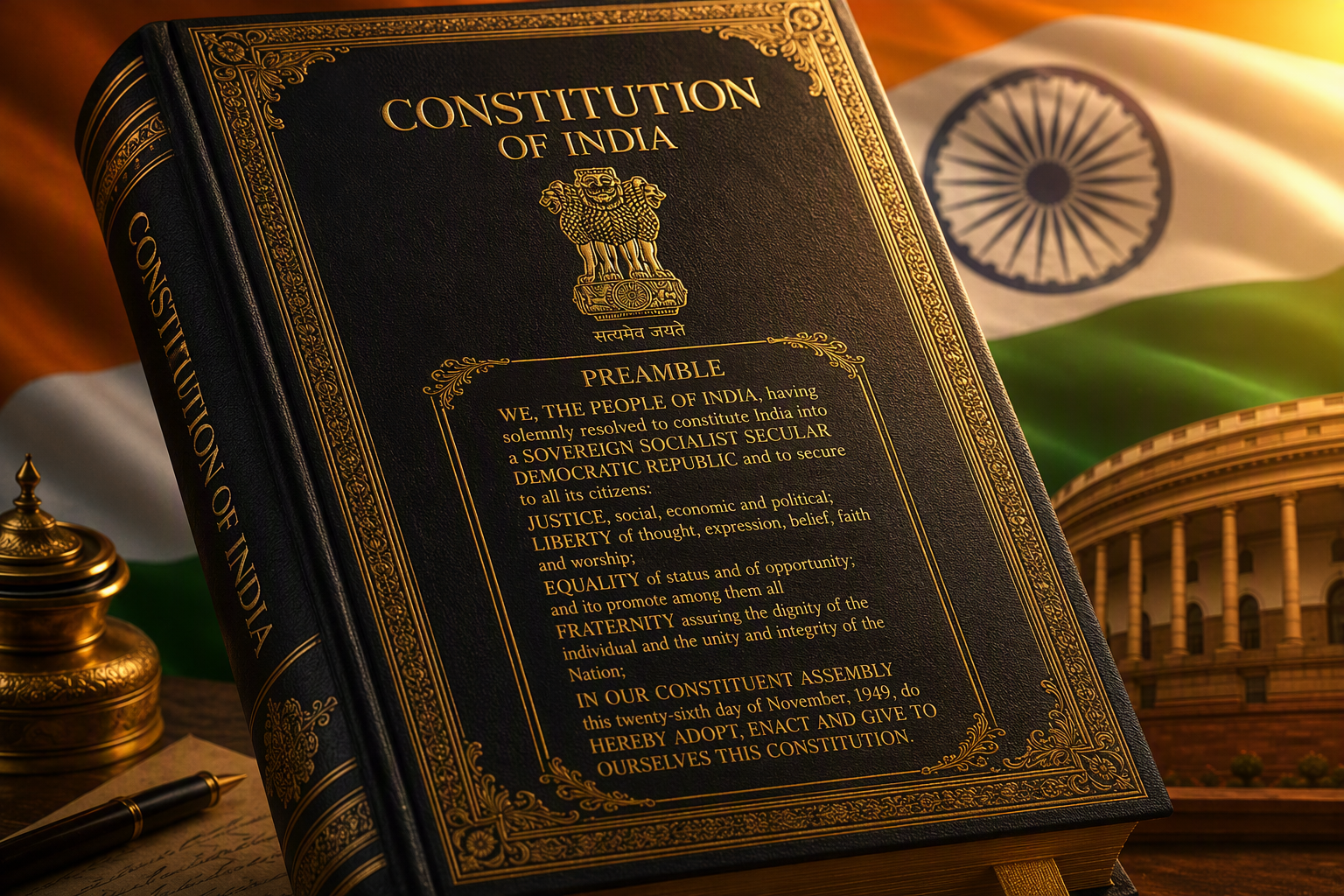
We, the people of India, made a promise together. We said we want India to be a country that is sovereign, socialist, secular, and a democratic republic. We want to give justice to all our people. This means justice in society, money matters, and in politics. We want to keep liberty of thought, letting each person speak, believe, practice faith, and worship the way they want. We hope for equality of status and also give everyone the same chance or opportunity. We know it is good to work together, and we feel that to keep dignity of the individual, we must also keep the unity and integrity of the nation whole.
The constituent assembly, on the twenty-sixth day of November in the year 1949, did adopt, enact, and gave us this constitution.
The Supreme Court thinks this text is an important part of the constitution. This text helps you know more about the law. The text cannot stand alone as a claim in a court of law. But it is still a part of the constitution. The text still matters.
Words, Phrases, and Their Arrangement
The preamble has a clear order in how it is written. First, it tells about where the power comes from. It says, “We, the People of India.” Next, the preamble describes the state as a sovereign socialist secular democratic republic. After this, it shares the goals that the preamble wants for all the people who live in India.
This setup helps you see who we are and what we want. The preamble of the constitution is not just there to sound good. It shows where this comes from. It says what the state is, what the goals are, and how the constituent assembly made the choice in a clear way. The preamble of the constitution tells a lot about why and how the rules were made.
- Sovereignty means India has the top power. It is not under any external power.
- A democratic republic means people pick the government and the head of state by voting.
- Equality of status and fraternity help people have dignity. They also make sure the integrity of the nation stays strong.
When you learn in this way, the text is simple to read. It is also easier to remember.
Reciting and Memorizing the Preamble
A good way to say the preamble of the Indian constitution is to break it into small parts. Say each part out loud and slow. Stop for a moment when you read every main value in it. This can help you remember how the preamble of the Indian constitution goes and what it says.
You have to first know the right order before you start. The order is: source, state description, objectives, fraternity clause, and then the closing adoption line. When you keep this order in your mind, writing will feel more simple. You should also think about words like liberty of thought and equality of status. These words often help give shape to each part of the text.
- Say it out loud three times each day. Make sure you do it in the same order every time.
- Try to remember it in small parts. Do not try to learn each line by itself if it does not make sense to you.
- Say the last part again for unity of the nation and for fully taking it in.
Practicing for a short time each day often helps more than doing one long practice. If you read or work on something a little bit every day, you may get it faster. You will not feel as tired, and you will remember all this for a longer time.
Core Objectives and Key Terms Explained
The goals that are in the preamble come from the ideas given in the objectives resolution. These goals are justice, liberty, equality, and fraternity. The preamble also says that India is a democratic republic.
The Preamble of the Constitution gives a promise of social justice, economic justice, and political justice. It says that people will have liberty of thought. It also talks about giving equality of status to everyone and the same chances to all. These ideas help shape the way rules in the Constitution are made. If you want to know what they mean, start by seeing the state words. Then, move to the value words.
Keywords used: the preamble, the constitution, equality of status, economic justice, liberty of thought, social justice, political justice
Sovereign, Socialist, Secular, Democratic, Republic – What They Mean
The words “sovereign socialist secular democratic republic” tell us the main ideas behind the government of india. Each word is important and has a clear meaning. When you read them together, they explain how the country works and what leads the democratic republic.
Sovereign means that India can make its own choices. It is not under the control of any other country. Socialist says there is social democracy in India. It is about being fair to people and trying to lower gaps between them. Secular says that there is no state religion. All groups should get the same treatment under the constitution and the law.
- Democratic means people can pick their government by voting.
- Republic means the head of state is chosen by an election. This job is not given by family.
- Secular means the state does not back one religion over others.
When you read these words together, you get a quick look at the Indian constitutional model.
Justice, Liberty, Equality, Fraternity – Essence and Importance
These four ideas are the living heart of the preamble. Justice is about social justice, economic justice, and being fair in politics. Liberty is about having freedom to think, to speak, to practice your faith, and to live with liberty of belief. All of these things should stay within what the constitution says.
Equality is when every section of society gets the same kind of treatment. No group is treated in a better or worse way. This gives everyone the same chance to do well in life. Fraternity means we feel close to each other. It is about all of us feeling that we are together. Fraternity helps people keep their dignity of the individual. It also helps the country stay strong even if there are many different groups in it.
- Social justice does not stand for unfair treatment or for giving special rights to some people.
- Economic justice is about making sure the wealth is shared in a fair and equal way among all people. This is called equitable distribution of wealth.
- Fraternity means that every person’s value is respected. This helps all of us live together in peace.
B. R. Ambedkar said that liberty, equality, and fraternity all need to be together. If one of them is not strong, the other two also feel it. That is why these ideas are still so important in the constitution.
How to Write and Learn the Preamble By Heart
If you want to remember the preamble of the constitution, start by thinking about what it says. Do not only try to memorize it word by word. Start with the words, “We, the People of India.” Then, read about what kind of state the text talks about. Next, look at the values that the preamble of the constitution promises. Last, read the final line where it talks about adoption. When you follow these steps, you learn the preamble of the constitution one part at a time, and your mind goes with the text in the right order.
First, it is good to know the meaning of each phrase. A ‘sovereign’ country is one that is free and does things on its own. A ‘democratic republic’ is where people choose who will be the leaders. ‘Justice’ means everything is fair for all. ‘Liberty of thought’ lets people think and speak their mind. ‘Fraternity’ helps keep the unity of the nation and also protects the integrity of the nation. When you know what each of these words means, you can remember them easily. If you know their simple meaning, you will learn better and faster.
Simple Mnemonics for Easy Memorization
A simple tip can help you remember the order of ideas in the preamble of the Indian constitution. You do not have to learn every word at one time. First, keep this order in mind: people, state type, objectives, fraternity line, adoption line. This gives you a mental map of the text.
One easy way to remember is to use this hint with steps: People-State-Justice-Liberty-Equality-Fraternity-Adopt. Say these words when you practice. This is not the full text, but it will help you know what comes next when you write.
- P stands for People of India
- S stands for State type
- JLEF stands for Justice, Liberty, Equality, and Fraternity
- A stands for Adopt, Enact, and Give to Ourselves
This way to learn can help you a lot. It keeps you from getting too stressed. When you keep the framework in your mind, putting the right words in is simple.
Step-by-Step Learning Methods for Students
For students, the best way to learn the preamble of the constitution is to take your time and break it down. On the first day, read the whole text of the preamble. On the next day, split the text into parts. Then on the third day, try to write each part without looking at it. This simple plan will help you get the preamble of the constitution into your memory and keep it there for a long time.
Another good way to understand things is to explain each phrase in simple words. Learn what each part means. “We, the people of India” shows that the people of India are the source of authority. A “democratic republic” means there is an elected government and an elected head of state. “Justice” and “equality” talk about the goals.
- Read the text out loud. Put a line under important words.
- Put your hand over the text. Write small parts one by one.
- Go over the text again when you finish.
It is good to read the constitution like this. When you read it this way, you learn more about civics. This is because civics is a part of the constitution. You also get a better idea of how the government works.
Importance and Role of the Preamble in the Indian Constitution
The preamble is important because it shows the main ideas in the constitution. Many people say that it is the soul of the constitution. It tells you what the country wants to do for itself. The preamble says what the state is and what the leaders should work for.
Its importance grew because over time the Supreme Court read the law in a certain way. The Supreme Court saw it as a part of the constitution and said it connects to the basic structure. It is not to be used as a legal claim on its own. Instead, it helps people know what the constitution means. It also keeps the spirit of the law alive, including the directive principles and other main parts of the law.
Guiding Principles and Legal Significance
The preamble shows you how to read the constitution. This small part may not often help you get something for yourself in a court of law. But it helps people know what the constitution wants to get done. Because of this, the preamble still means something in the law, even if it does not have a clear use on its own.
The Supreme Court first saw the Preamble in the Berubari matter as not enforceable. It said that the Preamble was not a part of the Constitution. But later, in the Kesavananda Bharati case, the Supreme Court changed what it said before. The court agreed that the Preamble is part of the Constitution. It helps people read and understand the Constitution better.
This is important because the preamble helps shape the basic structure of the constitution. The preamble joins big ideas in the constitution with things like the directive principles of state policy. So, the preamble is not just for show. It is a real guide and tool for the constitution. The preamble also has a strong role when people read and understand the principles of state policy and the basic structure of the constitution.
Impact of the 42nd Amendment on the Preamble
The 42nd amendment was the only time there was a direct change to the text in the preamble. This took place in the time of the Emergency. With the 42nd Amendment Act, the words “socialist” and “secular” were put in when talking about India. The text also got a change from “unity of the nation” to “unity and integrity of the nation.”
After this change, the description became sovereign socialist secular democratic republic. This update is important because it changed the key words, and also how the text talks about national unity. It did not rewrite the whole Preamble. But the changes were big for the democratic republic.
- The word “Socialist” was added.
- The word “Secular” was added.
- “Unity of the Nation” was changed to say “unity and integrity of the nation.”
The Berubari case is often mentioned when people talk about the legal story of the preamble. But the words in the preamble were changed later by the 42nd amendment.
Conclusion
To sum up, knowing and remembering the preamble of the Indian constitution is about more than just a school lesson. It is an important part of your life as a citizen of India. The preamble of the Indian constitution shares the main values and rules that help shape the country. It talks about justice, liberty, equality, and fraternity. When you learn the preamble of the Indian constitution, you get closer to your roots. You feel that you can take part in the country’s system. Take this knowledge and share it with others. This will keep the meaning of the preamble strong for many years. If you want to know more, feel free to ask for a free talk on easy ways to learn!
Frequently Asked Questions
Is the Preamble legally enforceable in India?
The preamble of the constitution can’t be used by itself if you want to make a claim in a court of law. But the supreme court says that the preamble of the constitution is a part of the constitution. The court looks at the preamble when it needs to know what the constitution means. Like the directive principles, the preamble of the constitution helps people read and use the law in the right way.
How was the Preamble changed by the 42nd Amendment?
The 42nd amendment is also called the 42nd constitutional amendment act. It made big changes to the preamble of the constitution. This change added the words “socialist” and “secular” to the preamble. The amendment also did more than that. It changed the words “unity of the nation” so that it now says “unity and integrity of the nation.”
Because of the 42nd amendment, the preamble of the constitution now has these words in it: sovereign socialist secular democratic republic. The new phrase shows how the preamble of the reflects the hopes of the people for the unity and integrity of the nation.
Why do students need to learn and memorize the Preamble?
Students should learn the preamble, as it brings together the values of the people of india in one place. The preamble tells you about equality of status for everyone. It connects to the objectives resolution. It also helps you to understand the directive principles. If you learn the preamble, you will know the basic structure of the constitution. This is very important for exams and for knowing about civic matters.