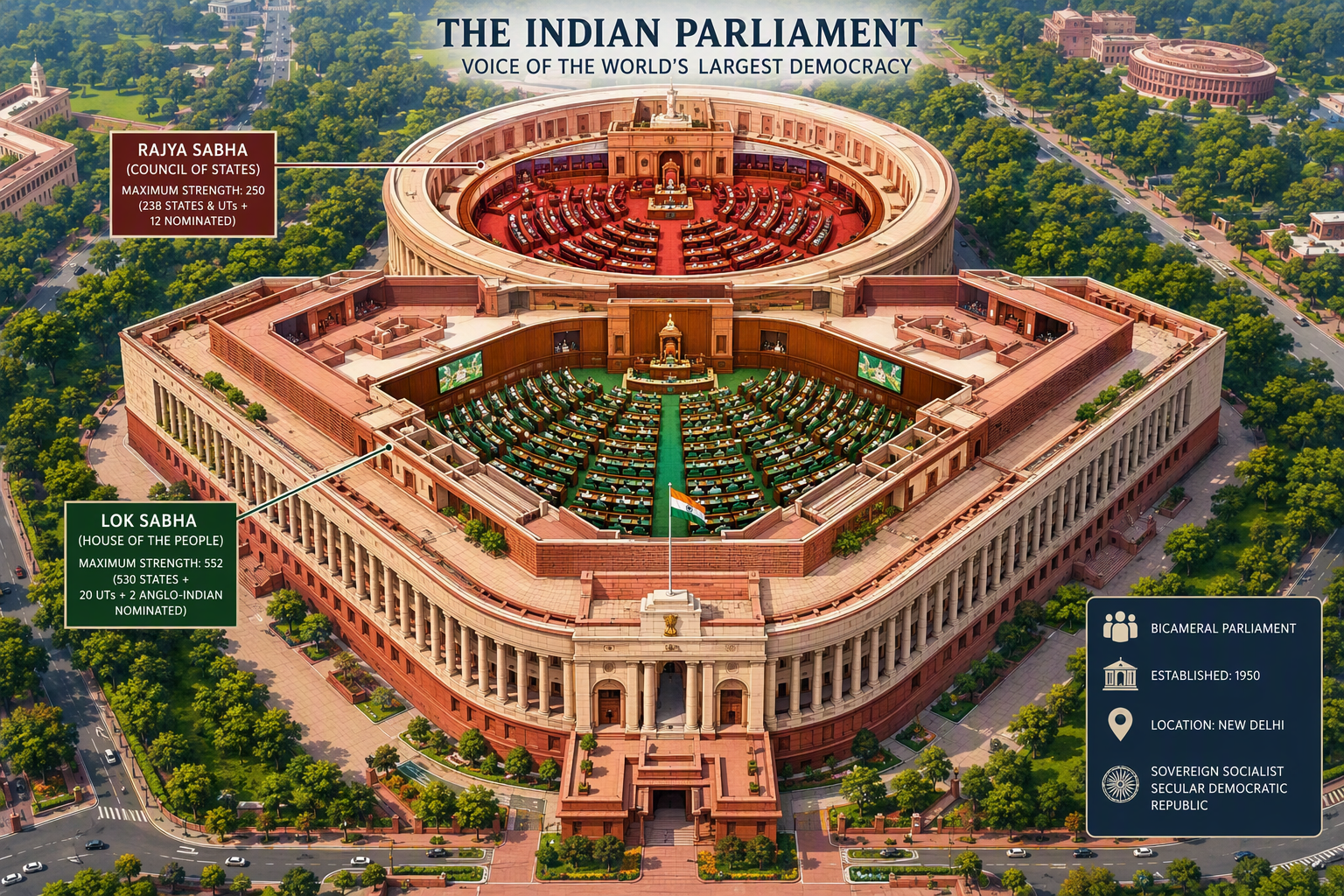
Key Highlights
- The lok sabha and rajya sabha are the two houses of the Indian Parliament. They each have different powers in the constitution.
- The lok sabha is the directly elected house. The rajya sabha gives a voice to states and union territories.
- During law-making, both houses of the Indian Parliament can work on ordinary bills and changes in the constitution.
- When it comes to a money bill, the lok sabha has a stronger role.
- The rajya sabha stays active all the time. Because of this, it acts as a permanent body for the Indian Parliament.
- Accountability for leaders of the country mainly lies with the lok sabha. This happens through a no-confidence vote.
Introduction
The Indian Parliament runs through two houses. These are the lok sabha and the rajya sabha. Both houses play a different role in India’s parliamentary democracy. If you want to know how laws are made, how governments stay in power, and why states have a say in national matters, you need to look at both houses.
The lok sabha shows the clear will of the people. The rajya sabha keeps things steady and checks powers for the states. Both the lok sabha and the rajya sabha are important. They work together and make the Indian Parliament strong at the center of this system.
Understanding the Structure of Indian Parliament
The indian parliament has two chambers. This is called a bicameral legislature. The lok sabha is the lower house of parliament. The rajya sabha is the upper house of the indian parliament. Each house has its own role in the constitution.
One house in the Indian Parliament is meant to talk for the people. The other house looks after what the states want and keeps things steady. To know why this is important, you should think about bicameralism, how people are represented, and what each house in the Indian Parliament does.
Key Features of Bicameralism in India
India uses a bicameral legislature. This means the Parliament is made up of two houses. The Lok Sabha, also called the house of the people, is one house. The Rajya Sabha, also known as the council of states, is the other house. The Indian Constitution kept this setup after independence.
The constituent assembly chose this model for several reasons. India is big and has many kinds of people, so one chamber cannot show all interests or views. The rajya sabha gives a place for nominated members. It also works as a revising chamber.
In the law making process, there is a clear difference. The lok sabha has direct support from the people. The rajya sabha brings a review, shows state voices, and gives steadiness. So, the lok sabha moves fast with votes and energy. The rajya sabha steps in to slow things down when bills need more thought.
The Role of Lok Sabha and Rajya Sabha in the Legislature
The lok sabha and rajya sabha both help make laws. But they do not do it in the same way. The lok sabha, or lower house, is chosen directly by voters. The upper house, called the rajya sabha, gives the view of the states and helps keep things steady over time.
The role of the rajya sabha is to check and review things in Parliament. This group looks at new laws so that they are not made too fast. It also gives a place for regional parties, so their voices are heard. The rajya sabha acts as a balance when there is a big talk or debate. This is why the role of the rajya sabha matters, even if it does not always win every time.
Yes, both houses have the same power in some areas. They both can work on ordinary bills. They can also work together for changes in the constitution. Both take part in electing or removing the President of India. They need to agree on ordinances and if there is an emergency. Both suggest if judges or important officers should be removed. In these ways, the two houses have equal powers.
How Representation Differs in Both Houses
Representation shows a clear difference between the lok sabha and rajya sabha. The lok sabha is a directly elected house. It stands for the people of India as a whole. The rajya sabha speaks for states and union territories. Members in rajya sabha are chosen through indirect election and by nomination.
That difference in selection affects how lok sabha and rajya sabha act. Lok sabha members are chosen by people through voting. This gives the house more democratic power for political and executive decisions. Rajya sabha members are picked by legislative assemblies using proportional representation. So, rajya sabha has a more federal feel and often talks things over before deciding.
- Lok sabha members are picked by people who vote in their area.
- Rajya sabha members are selected by state legislative assemblies. They use a way called proportional representation.
- Rajya sabha takes in people from union territories. It also has members who are experts and are nominated.
Composition and Membership of Lok Sabha vs Rajya Sabha
The membership of the lok sabha and the rajya sabha is not the same. They are different in size, how people join, and why they are set up. The maximum strength of the lok sabha is 550. Right now, the lok sabha has 543 members. The lok sabha is made for direct public representation.
The rajya sabha can have up to 250 people. Right now, there are 245 members in the rajya sabha. Members of the rajya sabha are not voted in directly. Some are chosen in other ways or are given the spot. These things show why a member of lok sabha and members of the rajya sabha do not have the same power.
Membership Criteria for Lok Sabha
The Lok Sabha is the directly elected house. This is possible because of universal adult franchise. All citizens who are above 18 can vote for candidates in each parliamentary area. This direct vote gives members of the Lok Sabha their strong democratic claim.
The minimum age to be a lok sabha member is 25 years. People, not legislative assemblies, vote in the election. This chamber is linked to political groups, what people feel, and how the government starts.
These membership rules change how power works in real life. The house gets chosen in direct votes, so the council of ministers must answer to it as a group. That is why the lok sabha can change the government’s future with a no-confidence motion, but the rajya sabha does not have this power.
Membership Criteria for Rajya Sabha
The rajya sabha is not like the lok sabha. Its members do not get in through direct votes by the people. A member of the rajya sabha is picked by elected members of state legislative assemblies. This is done with proportional representation. They use the single transferable vote for this.
The minimum age to be in this chamber is 30 years. The chamber is a permanent house. This means it does not ever get dissolved. One-third of its members leave every two years. So, the chamber stays the same even if there are changes in politics.
These rules decide what rajya sabha can do and how it works. It is not a directly elected house, so it does not decide if the government will stay or go. But it is a permanent house and is set up to give states a say. This makes rajya sabha useful for checking laws, talking about state issues, and doing some important jobs in the constitution.
Methods of Election: Direct vs Indirect
Election method tells us much about the two chambers. The lok sabha is a directly elected house, where people pick their leaders in general elections. The rajya sabha is not the same. Members come through indirect election by legislative assemblies. This is why the rajya sabha has a different feel in its political mandate.
In practice, this changes how laws are made. The lok sabha shows what people feel right now and the strength of each party in the whole country. Members of rajya sabha, who get chosen by the single transferable vote, often show what each party thinks in the states and also look over laws again.
| Feature | Lok Sabha | Rajya Sabha |
|---|---|---|
| Type of election | Direct election by the people | |
| Electoral base | Citizens through universal adult franchise | |
| Voting system | Territorial constituency voting | |
| Type of house | Directly elected house | |
| Type of election | Indirect election by legislative assemblies | |
| Electoral base | Elected members of state assemblies and eligible union territory assemblies | |
| Voting system | Proportional representation by single transferable vote | |
| Type of house | Council of states |
Tenure and Dissolution: Lok Sabha vs Rajya Sabha
The lok sabha lasts for five years most of the time. But it can end before if it gets dissolved. After that, there will be new elections. This lets the lok sabha change with the times, but it also means it does not stay the same over the years.
The rajya sabha is a permanent body. It will not be dissolved. Each person is a member for six years. Every two years, one-third of them retire. This setup keeps the rajya sabha steady even if there are big changes in politics.
Even though the lok sabha and rajya sabha are different in some ways, there are parts where both have equal powers. Both work together to pass ordinary bills and change the constitution. Both are needed for big constitutional decisions. But, if the lok sabha is not working during an emergency, the rajya sabha stays active. This makes the rajya sabha very important when the president of India needs help in such times.
Powers and Functions of Lok Sabha and Rajya Sabha
The powers of lok sabha and the role of the rajya sabha are often the same in many steps of making laws. Both take part in passing ordinary bills. Both talk about national issues. Both help to do important tasks for the constitution. This part where they work together is key to keeping a balance in parliament.
At the same time, the special powers of the lok sabha and rajya sabha are not the same. The lok sabha is stronger when it comes to keeping the government in check and dealing with financial matters. The rajya sabha has its own constitutional edge for federal interests. The next sections will show where their roles are balanced and where the power clearly moves to one side.
Legislative Powers Held by Each House
Both houses of the Indian Parliament play a big part in making laws. For ordinary bills, the lok sabha and rajya sabha have the same power. A bill must get okayed by Parliament before it can go forward.
That equality is also shown in bills that change the constitution and in several duties under it. So, if you want to know if the two houses ever have the same power, the answer is yes. They share it in many important parts of the law-making process.
Still, the process can be different when the two houses do not agree. At times like this, there may be a joint sitting for some bills. The Speaker of the Lok Sabha will be in charge at this meeting.
The Rajya Sabha is not the same as a state legislative council. It is not only there to slow things down. The Rajya Sabha is a national body that goes over laws and has real authority.
Role in Law Making and Passage of Bills
The way bills move through happens in both the lower house and the upper house. This shows that the process is not about just having more votes in one group. The lawmakers talk about the bill, look at it, and try to agree in the whole Parliament. After this, the President of India gives permission for the bill to become a law.
The lok sabha and the rajya sabha are different because of where they get their power. The lok sabha mostly shows what people in the country want right now. The rajya sabha is connected to the states and their legislative assemblies. This means the rajya sabha looks at ideas in another way and may stop a bill so it can be checked again.
- Ordinary bills can be brought in and passed when both houses take part.
- If both houses do not agree on some ordinary bills, then a joint sitting can be held.
- A bill becomes a law only when the President of India says yes to it.
Equal Powers between Lok Sabha and Rajya Sabha
It can look like the lok sabha is always stronger, but that is not all true. There are several constitutional provisions where both houses have equal powers. This balance is important in parliamentary democracy because it lets both popular and federal ideas be part of how things work.
Their equal powers let them pass ordinary bills and bills for changes to the constitution. Both can take part when voters elect or try to remove the President of India. They each help approve rules and emergencies. They can also give advice about removing judges and some leaders from the constitution.
This balance is important because it stops one chamber from taking full control of Parliament. It helps checks and keeps things fair. It also pushes them to work together and find common ground. So, in most key areas, the lok sabha and rajya sabha act as partners, not as opponents.
Joint Sittings and Their Importance
A joint sitting is used when the two houses cannot agree on some bills. It is part of the system set by the constitution to help solve problems when both houses do not reach a normal agreement while passing bills.
The Speaker of the Lok Sabha leads the joint meeting. This is important because the Speaker shows how things are done in the lower house at that time. Still, the joint meeting is there to solve issues, not to take away the rajya sabha’s role.
The rajya sabha can slow down or ask lok sabha to look again at some laws. But it cannot stop all decisions forever. A joint sitting helps both houses talk and work through problems. This happens before the president of india does anything.
Financial Powers: Lok Sabha vs Rajya Sabha
Financial powers show the biggest difference between the two houses. When it comes to financial matters, the lok sabha has more control. The lok sabha is stronger, most of all, when it is about a money bill. This is one of the best examples that show Parliament does not have equal power in both houses.
The rajya sabha talks about budgets and financial bills. But its role is limited in important places. This is because public finance is connected with the people’s say and the consolidated fund of india. The Constitution gives the lok sabha the last word. The next parts show how this happens.
Authority over Money Bills
If you are looking for a simple example of how the lok sabha has more power, look at the money bill. A money bill can be put forward only in the lower house and not in the upper house. This shows that the lok sabha is wanted more in finance by the rules.
The Speaker of the Lok Sabha gets the last say on if a bill is a money bill. This matters a lot since money bills link to things like taxes, loans, and the consolidated fund of india. These are the main parts of government money and help run it well.
The rajya sabha does not have power to change or stop a money bill. It has to send back the bill in 14 days. It can give ideas or not. The lok sabha can choose to follow these ideas or not. No matter what, the bill will be seen as approved. This shows how the lok sabha has more say than the rajya sabha when it comes to a money bill. This is one of the strongest ways to see the difference in power given in the constitution.
The Budget and Financial Legislation
The budget process makes one big change clear. The rajya sabha can talk about the budget, but it does not have a say in demands for grants. Only the lok sabha can vote to give money for these demands. This means the lok sabha has more control over daily financial matters.
Financial bills need a bit more care. A finance bill or other financial bills that do not only cover money bill matters can still be brought into the lok sabha. When these bills move along, both houses may have equal powers, based on what kind of bill it is.
- The lok sabha votes on all demands that are related to the budget.
- The rajya sabha can talk about the budget plans but it cannot vote on these grants.
- Some financial bills use money from the consolidated fund of india. These bills may need both houses to take part in the law-making process.
Limitations of Rajya Sabha on Finance Matters
The rajya sabha has clear limits on finance issues. These limits are set in the constitution and are not by chance. Its weakest role is with a money bill. It cannot make changes that must be followed and cannot reject the bill.
The rajya sabha is there to give advice in this situation. The recommendations of the rajya sabha can be looked at, but the lok sabha does not need to accept them. The lok sabha can reject these recommendations. A bill can come back in 14 days, or not. Still, its decision matters more, and the lok sabha always has the final say.
That does not mean the rajya sabha has no value in finance debates. It can still talk about policy and look at different proposals. But when it comes to control over the consolidated fund of india, voting power, and the final say on a money bill, rajya sabha is still not as strong as the other house. This is how the law is written.
Control over the Executive Branch
In a parliamentary democracy, it is just as important to keep the executive in check as it is to pass laws. In this system, the lok sabha, or lower house, has more control. This is because the council of ministers is responsible to the lok sabha and not to the rajya sabha.
The council of ministers in the Government of India can be questioned in both houses. But, only the lok sabha has the power to remove the government with a vote of no confidence. This is what ties the government and their executive accountability so closely to the lok sabha. The union council of ministers must work with the lower chamber to stay in power.
No-Confidence Motion: Who Holds the Power?
A no-confidence motion shows that the lok sabha has power over the people who run the country. The council of ministers answers only to the lok sabha. If the house takes back its support, then the government has to stop working.
The rajya sabha does not have the power to remove the government of india. Members in the rajya sabha can ask questions to ministers. The members can join in debates and check government policy. The government of india will not lose its power just because it does not get support in the rajya sabha.
This lets the lok sabha have a direct role in the constitution. The lok sabha is in charge of money bills. A no-confidence motion makes clear that the lok sabha has more power than the rajya sabha. The speaker of the lok sabha runs the house meetings. But this is about more than running the house. The government has to keep support in the lower house to stay in office.
Influence on Government Formation
If you want to know which house has more say in making a government, it is the lok sabha. In practice, the party or team with more members in the lok sabha gets to form the government. That majority in the lok sabha also decides who will be the prime minister.
The President of India picks the Prime Minister. But, the real test comes in the lok sabha. The union council of ministers must keep the lok sabha’s support to stay in office.
The rajya sabha is important when people talk and check rules and plans. But it does not pick who will be in charge of the government. This job goes to the lok sabha. The lok sabha has more say here, because those who lead the country need to have enough support in the lower chamber to stay in power and look right to the people.
Oversight Mechanisms in Each House
Oversight in a parliamentary democracy is about more than just removing a government. Both the lok sabha and the rajya sabha take part in this process. They look at policy, ask questions to ministers, and talk about reports from constitutional groups. This way, the lok sabha and the rajya sabha both help keep an eye on the government of india.
Their ways bring different results, but the goal can be the same. The lok sabha looks closely at what is happening and also has the power to remove the ministry. The rajya sabha gives extra review, adds to keeping things going, and offers a state view because it connects to legislative assemblies through how members are chosen.
- Both houses talk about policy and look over constitutional reports.
- The lok sabha alone can remove the government if they do not have confidence in it.
- Wider constitutional control is there outside Parliament too by the way of judicial review.
Special and Exclusive Powers
The Indian Constitution does not see the two houses as the same. Each has special powers because of what they do, who they represent, and how the constitution is set up. This makes the balance between them more subtle. It is not just about one being stronger or weaker.
Some powers belong to the lok sabha, mostly about money and running the country. The rajya sabha has its own powers too, mainly when the country’s states have to be heard. The constitutional provisions also set rules for bigger jobs in parliament. These jobs deal with the Supreme Court, important roles under the constitution, and state assemblies.
Unique Powers Vested in Lok Sabha
The lok sabha has more power than the rajya sabha in different ways. The best example is the money bill. Only the lower house can bring a money bill. The rajya sabha cannot change it or stop it in a way that matters.
The lok sabha handles more of the big financial matters. It votes on demands for grants. The lok sabha also has the main say in budget control. This shows that the house of the people should be in charge of public finance.
Another special power is more about politics than following a process. A vote of no confidence can only happen in the lok sabha. This is because the council of ministers is responsible to the lok sabha as a group. So, if you want a quick answer, the lok sabha has more control over finance, keeping the government going, and direct power from the people.
Unique Powers of Rajya Sabha
Yes, the rajya sabha has powers that the lok sabha does not have. These powers are real and not just for show. The rajya sabha gets these from the Constitution. It acts as a federal chamber and is called the upper house because it is always in session as a permanent house.
Under Article 249, the rajya sabha can let Parliament make laws on a subject from the State List. Under Article 312, it can let new All-India Services be made. A motion to remove the vice president can be started only in the rajya sabha.
Its importance goes up during strange times. If an emergency is declared when the lok sabha is not there, only approval from the rajya sabha can keep it going for the allowed time. So, the chamber has special powers that match the powers of lok sabha in some areas.
Rajya Sabha’s Role in All-India Services and State Interests
The rajya sabha is known as the council of states. This is because it looks out for state interests in national laws. You can see this role clearly when big questions come up that go past simple lawmaking and deal with the federal balance.
One of the most important powers of the rajya sabha is that it can let Parliament start new All-India Services. This means the rajya sabha does more than just review things. It has a role in building groups that touch both the Union and the states.
- It shows the interests of the states and has members that speak for union territories.
- It can let Parliament make laws about State List topics under Article 249.
- It can let the creation of All-India Services happen under Article 312.
Impact and Relevance of Both Houses in Indian Politics
In Indian politics, both the Lok Sabha and the Rajya Sabha are important. The Lok Sabha gives a democratic voice to the people. The Rajya Sabha reviews laws, keeps things steady, and speaks for the states. This way, the work in Parliament does not get too one-sided. The two houses balance each other and make sure every side is heard.
This balance is good for a big and mixed country like India. States and union territories get a voice, and the people together also have one. Because of this, both chambers are still needed. They do not have the same powers in every area.
Interplay and Mutual Checks in Decision-Making
The lok sabha and rajya sabha do not always fight. They check each other’s work. The lok sabha can make choices with its bigger numbers. The rajya sabha can slow things down, look things over, and ask questions if needed.
This is important for making choices in laws. The lok sabha gives Parliament its strong link with the people and keeps it democratic. If there was no rajya sabha, then there would not be as much balance. There would be less steady progress, less strong voice from the states, and not as many checks to stop rushed laws.
There are areas where both houses have equal powers. This helps keep things balanced. Both work together to pass ordinary bills, make changes to the constitution, approve emergencies, and handle big jobs. So, while the lok sabha takes the lead on some things, Parliament is strongest when both houses work well together.
Significance of Rajya Sabha in India’s Federal Structure
The rajya sabha works as the council of states, so it is very important in India’s federal structure. It helps the national Parliament to look beyond just what a direct majority wants. State needs and ideas always get talked about and stay in focus.
The rajya sabha plays a strong role when it comes to changing the constitution. It is not just standing by. A bill that wants to change the constitution needs the okay from the rajya sabha and the lok sabha. This shows that the upper house and the lok sabha have the same power in this area.
- It lets states and union territories have a say in Parliament.
- Its members are chosen from state assemblies. This keeps a strong connection between states and the centre.
- It has to agree for changes in the constitution, so it is important for any constitutional change.
Conclusion
To sum up, knowing about the powers and work of the Lok Sabha and Rajya Sabha helps you understand Indian politics better. The Lok Sabha and Rajya Sabha both play an important part in making laws, looking at financial matters, and checking what the government does. They each help in running the country in their own way. The Lok Sabha handles a lot of new laws and has control over money. The Rajya Sabha looks after the states and makes sure all kinds of people get their views heard. When you know how these two houses work together, you see how they shape decisions and guide India’s democracy. If you want to find out more about how Indian politics works, you can get a free consultation.
Frequently Asked Questions
Can Rajya Sabha Block or Delay a Lok Sabha Decision?
The rajya sabha can slow down or ask the lok sabha to think again on some decisions when they talk about ordinary bills. But, the rajya sabha cannot always stop these decisions for good. If the two houses still do not agree about an ordinary bill, a joint sitting can help end the fight.
Are There Cases Where Both Houses Have Equal Powers?
Yes. The lok sabha and rajya sabha have equal powers in many parts under constitutional provisions. This covers the way laws for ordinary bills are made, changes to the constitution, picking and removing the President, and saying yes to emergencies and rules.
What is the Rajya Sabha’s Role in Constitutional Amendments?
The rajya sabha plays an equal part with the lok sabha when passing changes to the constitution. In the Parliament of India, the upper house is not below the lower house for this matter. A change in the constitution must get a yes from both of the houses.