
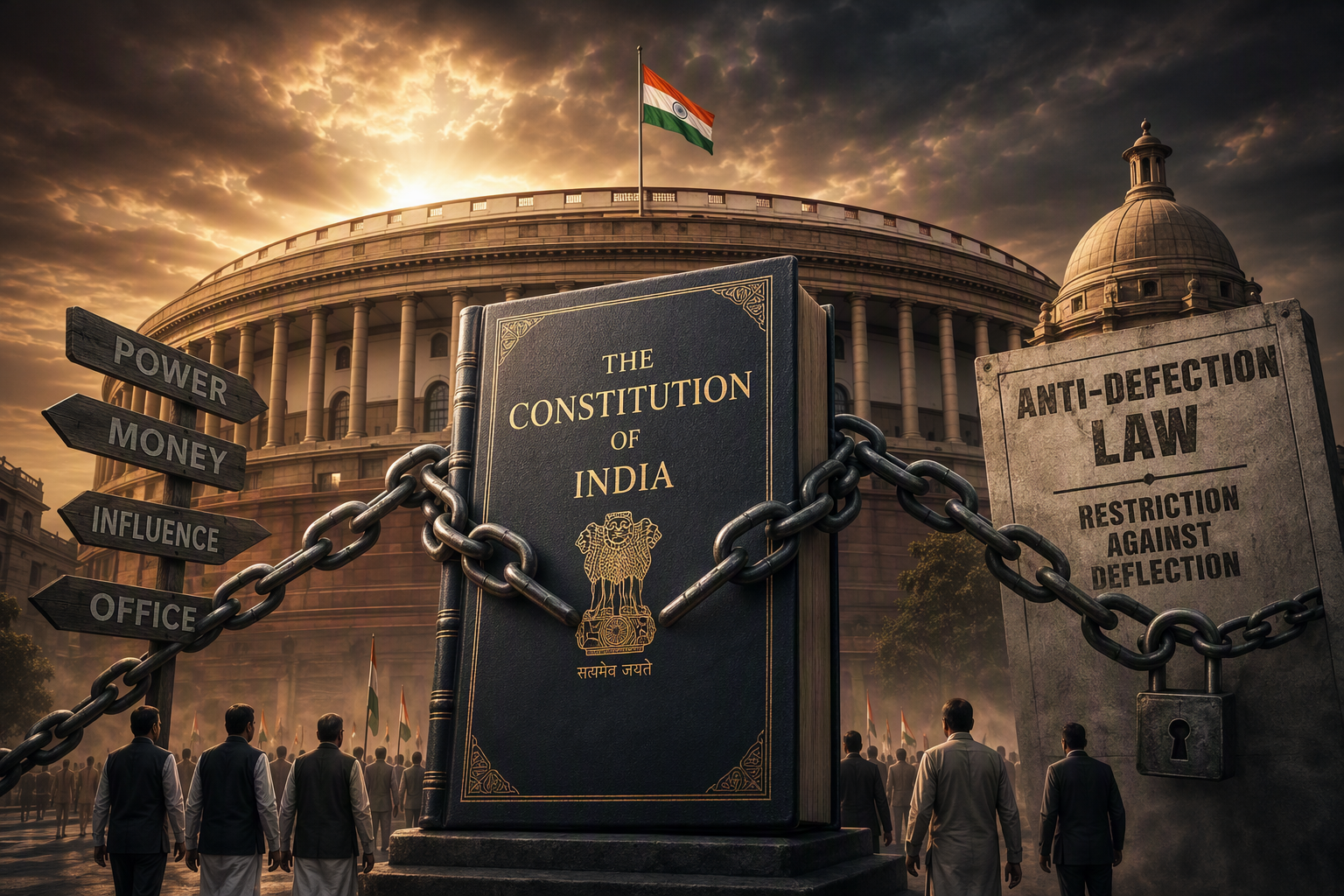
Key Highlights
- The anti defection law came into being with a constitutional amendment in 1985.
- The Tenth Schedule was added to check switching from one party to another by members of parliament.
- The 52nd Constitutional Amendment made this law by taking a key legal step.
- The main idea was to stop up and down in government because people kept changing political parties.
- The law tells what happens if someone votes against the party whip or leaves the party.
- After some time, the 91st Amendment fixed some holes in the law and made rule changes about splitting up.
Introduction
If you want to know which amendment is most important for the anti defection law, the 52nd Constitutional Amendment is the answer. This amendment changed the Indian Constitution and set rules to stop party switching. It also gave political parties a clear place in these rules. This step was the start of what is called the tenth schedule. Later on, new changes also helped shape how the law works now. To see the big picture, you need to know about the history, read the text, and look at the reforms that came after.
Historical Context of the Anti Defection Law
The anti defection law was not made in a day. It came into Indian politics after many issues, where people who got elected would switch sides. This changed the balance of power in the government. These actions made the government look weak. Many started to worry about the real grounds of defection in such cases.
One term from this time is Aaya Ram Gaya Ram. This phrase showed how often members of parliament and state lawmakers changed parties. These things made lawmakers start to think they needed a fix in the law. The next parts will talk about how that need grew over time.
Political Instability in Indian Legislatures
In the years before 1985, there was a lot of political trouble in Indian lawmaking groups. People in the legislative assembly or Lok Sabha would often switch parties after the vote. This made things very unsure for many people in the Lok Sabha and state houses. A small change in numbers could make or break the government at the time.
The anti-defection law is a rule in the Indian Constitution. It is there to stop lawmakers from switching sides. This law was made because leaders kept moving between parties. That made people lose trust in those they voted for. It also made confidence motions and big votes change quickly. With this law, the hope is to make people feel better about how the government works.
What did this mean in practice? It meant that the government could fall even if people who voted did not say no to them. It could happen when elected leaders changed who they supported after the election. This was seen many times in the Lok Sabha, Rajya Sabha, and in a lot of state forums, too. Because of this, there was pressure for a stronger law.
Early Party Switching and Its Impact
The phrase Aaya Ram Gaya Ram got well-known in 1967 when Gaya Lal changed sides three times in just two weeks. Aaya Ram Gaya Ram soon stood for the way leaders in India move from one party to another. The story showed that defecting members can quickly change the flow of things inside law-making groups.
During this time, many members of the house moved from one group to another. Some of them also helped make new political parties. This was not just a problem in one area. It was seen in many governments. The public started to feel less trust in these groups and their work.
- Party switching often made the power change after elections.
- Defecting members sometimes changed sides more than one time.
- Members of the house could change ministries and coalitions with sudden moves.
- Political parties started to feel pressure inside and faced public criticism.
Because this kept happening, lawmakers started to see people leaving their group as more than just a personal thing. Now, they thought it was a real problem for how the government works and stays steady.
Events Leading to Reform Discussions
Pressure to bring change had been growing since late in the 1960s. A group led by Y. B. Chavan was made during the fourth Lok Sabha in 1967. It shared its report in 1968. This was one of the first serious attempts to deal with defections by making a law.
Things became harder to ignore after what happened later. From 1977 to 1979, Morarji Desai was the head of a non-Congress national government. He lost power when 76 members of parliament left his side. Changes like this happened in various states too. All of these things made people feel that the Union of India needed stronger electoral reforms. These changes were needed to protect what the voter wanted.
Then, there was a big political turning point. In 1984, rajiv gandhi got a strong majority. After that, he brought a new anti-defection bill to Parliament. The main reasons for the bill were clear. There was a lot of instability. People were worried about it. Many also saw that such political defections hurt how democracy worked.
Later on, issues with parties like janata dal showed something important. The push for change did not stop in 1985.
Constitutional Amendments and Their Importance
A constitutional amendment is important because it changes the Constitution of India, not just a regular law. In the case of the anti defection law, this step gave the rules more power. It made them a part of the main constitutional framework.
The 52nd Constitutional Amendment Act made a big change. It brought in the Tenth Schedule. This schedule set the rules to remove members if they switched sides. After that, there was one more constitutional amendment to fix some weak points. To know which constitutional amendment matters more and why, you have to see both the original 52nd constitutional amendment act and the changes made later. Both the tenth schedule and each constitutional amendment play a big part in these rules.
The 52nd Constitutional Amendment Explained
The 52nd Constitutional Amendment was the law that first set up the anti-defection system. Rajiv Gandhi brought in this law, and Parliament passed it in early 1985. This constitutional amendment act changed the Constitution. Now, if a person leaves their party, this can lead to being disqualified.
The change brought the Tenth Schedule of the Constitution. This part also made the idea of a political group official under the Constitution. Now, if any elected person switches sides, there are clear rules in the Constitution to judge that. Before this, only political practice was used to decide such matters.
| Element | What the 52nd Constitutional Amendment changed |
|---|---|
| Amendment | Added anti-defection provisions to the Constitution |
| Key insertion | Tenth Schedule of the Constitution |
| Purpose | Disqualification on grounds of defection |
| Political context | Introduced under Rajiv Gandhi |
| Institutional effect | Empowered legislative presiding officers to decide cases |
To put it simply, this was the change that made up the main part of the anti defection law.
Date of Implementation of the Anti Defection Law
The anti-defection law was taken up very fast in Parliament. The bill came to the Lok Sabha on January 24, 1985. The Lok Sabha passed it on January 30. A day later, the Rajya Sabha also passed it on January 31. This showed that there was a strong political will from both the Lok Sabha and the Rajya Sabha for this reform.
The 52nd Amendment Act got the president’s approval on February 15, 1985. This day is very important in the constitution, because that is when the amendment was officially put in place. Many people see this date as the main moment the law was created.
The record shows the act started on March 18, 1985. So, if you want to know when it began, the real answer is March 18, 1985. But February 15, 1985, is the day when the constitutional amendment was approved.
Tenth Schedule: Addition and Purpose
If you want to find out where the anti-defection law is in the Constitution of India, you will see it in the tenth schedule. Lawmakers added this schedule with the 52nd amendment. Since then, the tenth schedule has been the main part that has the anti-defection rules.
The reason for this was clear. It sets the grounds of defection. It tells when members of parliament or state lawmakers can lose their seats. The schedule talks about people who leave their party on purpose, vote against what their party says, or join a different party after they win. There are also some rules about what happens with nominated members.
The Tenth Schedule also talks about what happens when two groups join, what happens to some leaders, how the Speaker or Chairman makes choices, and how rules are set. So, the tenth schedule was not just a symbol. It became the guide for how the anti defection law would work in real life.
Key Objectives Behind the Anti Defection Law
The law was made to stop harmful party switching. This was because when lawmakers changed parties after the elections, it hurt the stability of the government. The main idea was to make things more stable in politics and make sure people do not switch sides for no good reason.
Some people were also worried about how this could affect democracy. When members often leave one party for another, it can make people feel less sure about voting. This can change what voters wanted and make party leadership less strong. The law wanted to keep democracy fair and make sure lawmakers stick to the platform that got them elected. The next sections show these goals in a simple way.
Ensuring Political Stability
One big reason for the anti-defection law was to keep things stable in indian politics. Sometimes, lawmakers would change sides a lot. This could make the ruling party weak or help an opponent get strong without any new election. It made things in the government feel shaky and not linked to what people first voted for.
This was very important when the votes came close. Things like confidence motions, major policy bills, and the passage of the annual budget could change based on what the members decided at the last moment. A government could stay or fall if just a few elected members switch sides after they win on their party’s ticket.
That is why lawmakers went for a constitutional amendment and not just a weak political answer. They wanted to keep the stability of the government strong. They also wanted to lower the harm from such political defections. In short, this law was put in to stop the constant changes of power inside legislatures.
Curbing Opportunistic Party Switching
Another clear goal was to stop people from changing parties just for personal gain. People who wanted reform thought that many lawmakers changed sides, not because of what they stand for, but to get something for themselves. They also said this happened because some wanted more power or better jobs when the government’s party alliance was not strong.
The law focused on what a member of the house does if they move away from the original party. It set rules that say defecting members cannot change to another party and still hold on to their seats with no effect.
- A member of the house may face action if they choose to leave their party.
- If a member of the house votes against the party whip, it can be a ground of defection.
- Not taking part in an important vote, even when the party gives a direction, can also be a problem.
- If a member of the house joins another political party after the election, they could face disqualification.
These rules tried to say one thing to lawmakers. Your seat belongs to the reason people chose you.
Strengthening Democratic Processes
The law was made to help make democratic processes stronger. When people vote for a candidate who follows a party platform, they want to see some consistency. If that leader changes sides too quickly, then the trust and meaning from voters can be lost.
Discipline is important inside a legislative assembly or Parliament. A party whip helps organize how members of parliament vote on big issues. The party whip also shows the work of the party leadership as a group. The anti-defection rules were made so that members of parliament remember the political identity they had when they got into office.
The goal was not just to keep order. It was also to help elected groups work well. By stopping quick changes in who belongs to which group, the law tried to keep lawmakers focused on their jobs. This way, there would be less time spent on talk about changing group numbers. People saw this as a good way to help democracy work better and help make steady choices for everyone.
Main Provisions of the Anti Defection Law
The Tenth Schedule sets the main rules for the anti-defection law. It tells us what the grounds of defection are and when a member of the legislature can be removed. These rules are used in both Parliament and state houses.
The law mainly looks at what happens when someone breaks away from what the party whip says. This means it’s about people who do not follow orders from their party. The law also talks about people who are nominated, about merging parties, and the group that will decide on each case. To see how the law works, you need to look at the rules for when someone can lose their position, the rules about sticking with your party, and some special cases where the rules do not apply.
Disqualification Criteria for Members
The main point of the Tenth Schedule is that there will be disqualification if someone changes sides, known as grounds of defection. These rules are there for people in parliament and the state legislatures. The goal is to see if the elected person moves away from the party that helped him or her win the seat.
The law looks at more than just formal resignation. A person can lose their place in a party if they choose to leave, even without writing it down. This can also happen if they vote or choose not to vote against what the party wants. This is true when a party whip tells them what to do on big matters.
- A person may leave the membership of the political party by choice.
- A person may vote against the party whip when there is an important issue.
- A person may choose not to vote even when the party says to vote.
- A person may join another party after they win the election.
These actions matter when talking about the disqualification of a member. They are used as proof that the person has not kept their party loyalty that should be protected by the Tenth Schedule.
Rules for Party Affiliation
The anti-defection rules see party ties as something that goes on and does not end after the vote. If someone wins because of their party, they should stay with the original party, unless the law says it is fine to change. This is the reason people look at party switching so closely.
This rule matters a lot for members of parliament. The way they vote can affect the government of a country. If they vote against what the party whip says or go against their original party in public, it can look like they have left their party. This can happen even if there is no formal resignation.
The law makes a difference between elected members and those who are nominated. If an elected person joins a new party after the election, there can be some consequences. In simple words, staying with the chosen party is about being loyal, voting with your group, and making sure the decision of the voters is respected. This system is to keep the mandate of the people safe.
Exceptions Within the Law
No anti-defection system works without some exceptions, and the tenth schedule includes a few. These exceptions are there for special cases, not for people who often change parties. They show the law wants to set a line between when one person leaves and when there are bigger changes in the system.
One important thing to know is what happens in the case of merger. If two-thirds of all the members in a legislative party say yes to join with another political party, the rule about disqualification will not be used the same way. Before, even when one-third of the members broke away, they were protected, but that rule is not there now.
The law has some rules that are just for a nominated member. A nominated member can lose their seat if they join a party after six months of taking it. Some people in certain jobs, like the Speaker or Chairman, also get special treatment under these rules. This means the law is for both the nominated member and the elected member, but not always in the same way.
Role of the Speaker in Enforcing the Law
The anti-defection law does not work on its own. Under the tenth schedule, the speaker of the house or another presiding officer has the main job of deciding who gets disqualified. This means the presiding officer or the speaker of the house becomes very important in the rules of the country.
In a legislative assembly or a parliament, the decision of the Speaker plays a big part in how strong a party is and if the government can stay in power. At the same time, people sometimes say bad things about this job, because the Speaker often has a past in politics. The next parts talk about the Speaker’s authority, the problems this job can bring, and how courts may look over the speaker’s decision.
Decision-Making Powers of the Speaker
The anti-defection law lets the Speaker of the House or the presiding officer decide who gets disqualified. This is one of the key parts of the tenth schedule. So, if there is a fight about party loyalty, the court or the Election Commission does not address it first. The speaker of the house or the presiding officer makes the decision.
That power has a direct effect on Parliament. When members are said to not follow a party whip or when there are other grounds of defection, the Speaker has the final say. In practice, the decision of the Speaker can change voting numbers, help a ministry stay in power, or decide what happens during confidence motions.
The law changes what the Speaker does. Now, the Speaker acts like a referee in the middle of political fights. The Speaker does not only control debate. This office is at the center when it comes to deciding who gets to stay as a member or who will be disqualified because of the anti-defection rule.
Challenges Faced by the Speaker
This job comes with real challenges. The Speaker of the House should act in a fair way. But the person is usually from a political party. This makes people feel unsure when the speaker makes choices. The decisions can affect the ruling party, the other side, or times when confidence motions and government survival are involved.
Another thing to think about is timing. The compiled material shows people want a better way to help lawmakers hurt by the Speaker’s ruling. Many worry about whether decisions are made fast enough. This is even more important when party leadership is pushing for something and the political stakes are high.
Because of these concerns, the idea of judicial review turned into a big issue. Lawmakers and other people said that members should be able to get help from courts like the high court. The main challenge is not just how you read the law. It is also about keeping trust that the Speaker can do his job as a fair and neutral part of the constitution.
Judicial Oversight and Review
At first, the Tenth Schedule tried to stop courts from looking into matters about disqualification. But that did not stay the same for long. In Kihoto Hollohon v. Zacillu, the Supreme Court of India said that the Speaker’s choice can be checked by the courts through judicial review under the Constitution.
That ruling changed things in a big way. It meant the High Court and Supreme Court could review the decision of the person in charge. Now, there can be judicial intervention if someone questions the rules, fairness, or the process that was followed. This means that the Speaker does not have the last word like before, even if the original rules made it look that way.
The Election Commission has a different role in this case. It has made it clear that the anti-defection law is not used in Presidential elections. Parties cannot tell their members how they must vote during these elections. After this, people have raised questions about freedom of speech and the basic structure of the Constitution. This shows that courts still play a key part in how this law works.
Criticisms and Drawbacks of the Anti Defection Law
The anti defection law was made to fix a big political problem. But, people have always criticized it. Many say the constitutional amendment made things less unstable. At the same time, it caused new problems inside legislatures.
Some people are worried about the freedom of speech. Others are more concerned about delay, fairness, and what party leadership does. Many opposition members and groups like the Law Commission often ask if the way things work now finds the right balance. The next sections will look at the biggest concerns in a simple way.
Limiting Dissent and Debate
One big criticism is that this law can make it hard for members of parliament to speak up. If they worry about being removed for voting against the party whip, they might not wish to say if they feel the party is wrong. This can hurt good debate.
This is important because a member of the house is more than just a member of the party. This person has to speak for voters, for local needs, and also use their own judgment. Some people say strong anti-defection rules can make party leadership too strong. These rules can stop members of the house from thinking for themselves.
People start to worry more when each key vote is seen as a test of loyalty. In that case, freedom of speech inside political groups can get smaller. So, even if the law helps keep things steady, many say it does this by cutting down room for open talk and true debate in the group.
Issues with Implementation
Putting the law into practice has also been a problem. The Speaker of the House gets a lot of responsibility here. But when the ruling party is involved, or their government is at risk, things get very sensitive. This makes people wonder if the speaker can truly be fair.
One more problem is that there is no clear time limit for deciding each case in the compiled material. If rulings take too long, the anti-defection rule can lose its power. A member can go on to influence votes even when a dispute is still waiting for a decision.
Some people also say that there is a problem with the party whip being used only when it helps someone, and with split-related rules being used in the wrong way in the past. These worries show that the way the law is set up and the way people use it do not always work well together. This means the anti-defection law might be written down, but there is still space for leaders to slow things down or use it to get ahead in politics.
Calls for Reform and Amendment
Yes, the anti-defection law is not the same as when it started. A big change happened with the 91st constitutional amendment in 2003. It was made official at the start of 2004. The change worked on problems with the old rules about splits. This amendment tried to make the law tighter and less easy to use in the wrong way.
People are still talking about change. A lot of groups have asked for electoral reforms, and want new rules for the anti-defection law. Some of these groups are the Law Commission, the Dinesh Goswami Committee, the Election Commission, and a few other review bodies. The supreme court has also played a part. Its judicial review keeps shaping the talks about what should change.
- The 91st amendment took away the rule that protected one-third party splits.
- It stopped people who left their parties from getting minister jobs or paid political posts for some time.
- It closed gaps in the law that let many members leave their parties together.
- Over time, reform groups have kept asking for better and stronger electoral reforms.
The law has changed over time. But many people feel that there is still a need for more change.
Conclusion
To sum up, it is important to know about the Anti Defection Law if you want to understand how Indian politics stay steady. The reason this law came in was to stop leaders from moving from one party to another. It also tries to make the voting process more firm and clear. The law does have some good sides, like keeping leaders honest with their party. But, many people still talk about what it does not do well and if there should be some changes. If you want to learn more, you should read about the history, main points, and what people criticize about the law. This will help you have a better talk or take part in the politics in India. If you want to ask more questions about the Anti Defection Law or want to know what it means for the future, feel free to ask for help and advice.
Frequently Asked Questions
In which Schedule of the Constitution can the anti defection law be found?
The anti defection law is in the Tenth Schedule of the Constitution of India. It was added in 1985 by the 52nd Amendment. This part gives details about the grounds of defection for members of parliament and other lawmakers. It also shows when they can be disqualified.
How does the anti defection law affect Members of Parliament who change parties?
The anti defection law lets parliament remove members of parliament if they leave their political parties. A member can also lose their seat if they join another party after the election. Members can be forced out if they vote or do not vote on important matters against the party whip. The grounds of defection hope to stop people from joining new parties after the election. This helps keep the parliament stable and strong.
Has the anti defection law undergone any amendments or changes since its introduction?
Yes. The anti defection law got stronger after the 91st constitutional amendment in 2003. This change was made public in 2004. The new rule removed the split exception. It also stopped people who switched sides from getting minister jobs. The supreme court also said that there can be a judicial review. The law commission has kept talking about new changes to the tenth schedule.

