
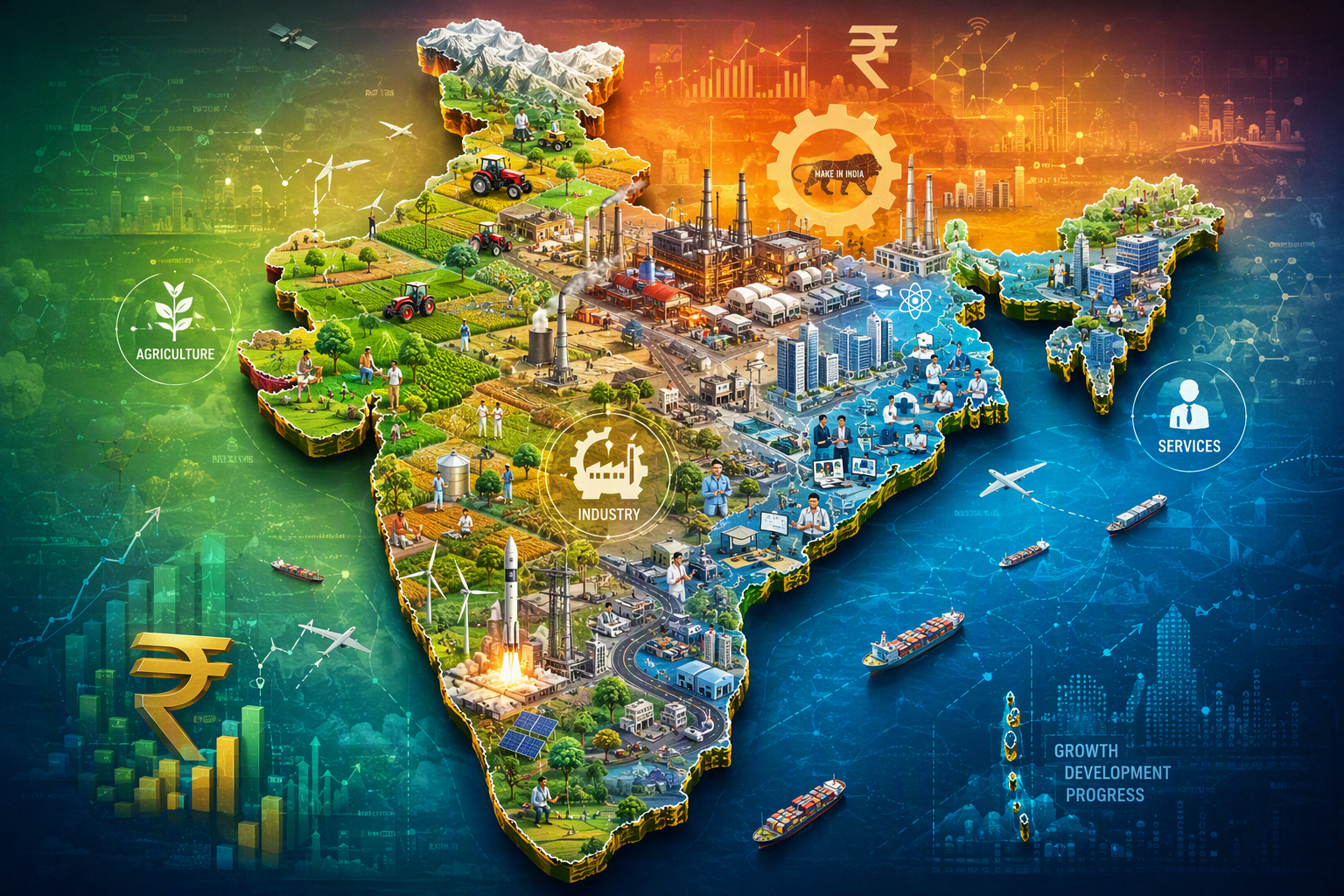
Key Highlights
- The Indian economy stands on the primary sector, manufacturing sector, and service sector.
- Each part helps with economic growth in its own way and adds to the gross domestic product.
- The primary sector still gives work to many people, mostly in rural parts of India.
- India’s GDP gets the biggest share from the service sector now. The manufacturing sector is in the middle.
- Over the years, India’s economy has moved more from farming to service work.
- When you know about this structure, you see how jobs, what people make, and development link together.
Introduction
To know about India’s economic growth, you have to see how work, making goods, and providing services are spread out in the economy. This is important as the shape of the economy affects national income, jobs, and the way people live.
India’s population is very large and made up of different groups. Each group gets support from different parts of the economy. Some people grow food, some work to make things, and some are in services. All these types of work help us see how the economy works and where things are changing.
Basics of Indian Economy
The sectors of the indian economy are grouped by the type of economic activity that people and businesses do. This helps us know more about the indian economy. It also makes it easier to see how each sector works.
The primary sector makes use of natural resources. The manufacturing sector takes raw items and changes them into goods. The service sector gives help and know-how. If you want to get how the system works, ask yourself: who makes, who turns things into products, and who offers services? This simple way shows how output, jobs, and worth pass through the economy.
Key Concepts Shaping the Indian Economy
First, you should look at a few main ideas. These will help you see india’s economic landscape more clearly. You will not feel lost in big words or details. The two most useful ideas to focus on are output and jobs.
In simple words, gross domestic product is the total value of goods and services made in the country. National income is the money people get from the whole economy. The two are both linked to economic activity in places like farms, factories, and offices.
- Gross domestic product shows the total things made in the whole economy.
- National income is the money people earn from making things and services.
- Economic activity is any work that makes goods or gives services.
- Sectoral structure shows where most things are made and where most jobs are.
Once you get these ideas, you will find that understanding how India works gets a lot easier.
Unique Characteristics of the Indian Economic Structure
One thing that stands out about the Indian economy is how jobs and output are spread. The sectors of the Indian economy do not share these things in the same way. This is what makes the Indian economy different from others.
The primary sector still has many workers, even though it gives much less to India’s GDP than the service sector does. At the same time, the manufacturing sector has grown. But it has not grown enough to take in workers like we see in many other places where there are many factories.
- The primary sector is still key for many people living in rural areas.
- The service sector gives the biggest part to India’s GDP.
- The manufacturing sector does matter, but it has not grown as fast.
- There is not an even change in these sectors for all places or all people.
These patterns show why many people see India’s economy as both new and not the same in all places.
Historical Evolution of India’s Economic Structure
The evolution of the Indian economy tells us how a country can change a lot over time. At the time of independence, it was clear that most work and goods came from farming and things related to farming.
India has had a big and clear change in how its economy is built. A major part of this story is how much less important farming is, and how much bigger the services sector has become. To really see what happened, it helps to look at where things started. Then, you can see what changed over the years.
Structure of the Indian Economy at Independence
At independence, the indian economy was mainly run by the primary sector. Most of the people did economic activity in villages. Agriculture was a big part of daily life, income, and work for them.
Many people made a living from small family-owned farms and jobs linked to them. There was some industry. Still, the country was not in a time when big factories ruled the economy. Because of this, farming and jobs using natural resources did most of the work to keep the country running.
Over the years, the Indian government helped the country grow by building public systems and working on infrastructure. It also worked on making different sectors bigger. Even with these changes, the old way of doing things was important. This is because it helps us see why so many people kept working in farming long after farming stopped making up a big part of the country’s output. That first step the Indian government took still has an impact on the economy today.
Major Shifts in Sectoral Contribution Over Time
Over time, the biggest change has been a sharp decline in how much agriculture adds to total output. In the 1970s, agriculture was giving about 40% of Gross Value Added. But by 2024, this number had dropped to less than a fifth.
At the same time, the service sector was the main driver of economic growth and overall growth. The manufacturing sector got bigger too. But it did not become the main step between agriculture and services like in other places.
- The share of what comes from agriculture went down a lot over time.
- The service sector went up and became about 55% or more of the economy.
- The manufacturing sector did grow, but it happened more slowly.
- The change in the output moved faster than it did for jobs.
This is why people say that India has moved from farms to services faster than most would think.
Overview of Economic Sectors in India
There are three main parts of the Indian economy. These are the primary sector, secondary sector, and tertiary sector. These three groups help us see most of the ways that people make things and find jobs in the country.
The quaternary sector and the quinary sector show how India is moving toward a knowledge-based and decision-based economy. To make it simple, one group takes out resources. Another group makes products. A different group offers services. The next sections explain this in detail with clear examples. This will help you see how each sector works within the larger system.
What are Primary, Secondary, and Tertiary Sectors?
First, let’s look at the basic chain of production. In the start, the primary sector gets what we need from nature. After that, the secondary sector makes these things more useful. Services then help people and businesses by giving support.
The primary sector in the Indian economy is made up of agriculture, mining, fishing, forestry, and quarrying. A lot of primary sector companies rely on the direct use of the earth. The secondary sector covers manufacturing, construction, and how we produce energy. The tertiary sector of the Indian economy deals with banking, transport, healthcare, education, and trade.
- Primary sector: This part is about crops, fishing, forestry, and mining.
- Secondary sector: This is where you will find factories, food processing, cars, and building work.
- Tertiary sector: Here, there are teachers, doctors, drivers, banks, and shopkeepers.
When you look at it like this, the economy is not so hard to see. Farmers grow cotton. Mills take the cotton and make fabric. Then, transport and stores help get it to people who want to buy it.
Distinction Between Organised and Unorganised Sectors
Another good way to know more about the indian economy is to look at work conditions. This is the part where the organised sector of the indian economy is not the same as the unorganised sector.
The organised sector has formal jobs. These jobs follow labor laws. They keep records and most people get steady pay. People also get social security benefits here.
The unorganised side has jobs where work is informal. Here, the nature of employment is not fixed. There is no regular work. The protection for workers is weak. Even so, many people get their livelihoods from these jobs.
- Organized work can give stable pay and legal protections.
- Unorganized work does not offer many benefits and is not as secure.
- Both groups help make income and goods in important ways.
So, the informal sector is not separate from the economy. It is a big part of how India works each day.
Primary Sector: Agriculture and Allied Activities
Agriculture is a big part of the primary sector of the Indian economy. It helps people get food, gives job to people in rural areas, and gives raw materials for different industries.
For many households, small family-owned farms give the main income and work. This sector also has an impact on food prices and can shape the bigger economy as well. To know its full impact, you have to look at what it makes and how many jobs it gives. It is important to also think about how modernization is starting to change the sector.
Role of Agriculture in GDP and Employment
Agriculture has a vital role in India. It is true that the share of agriculture in India’s GDP is much lower than the number of people who work in this field. This is one of the most important things to know about the economy.
The primary sector gives about 15% to 18% of the output. Yet, it still helps more than 40% of the workforce. This shows the primary sector is important for employment opportunities. A lot of people, especially in rural areas, rely on agriculture because there may not be many other jobs.
It helps set food prices, makes food more safe for all, and keeps raw materials going to factories. So, even though services are now on top and factories add to the value, agriculture is still what most people count on to live. A clear example is growing rice or wheat. It gives food to families, helps markets work, and even has links to moving, keeping, and processing food.
Recent Trends and Modernization in Agriculture
Agriculture is not just about old-style farm work now. It is getting tied to the modern economy. This is because of better systems, new technology, and other services that go with it.
This change is important because better infrastructure development can help with storage, transport, and getting to markets. Over time, things like this can also help make people more productive and lead to the creation of more jobs, not just on the farm but outside of it too. More money coming in, like fdi equity inflows, also helps make the economy new by supporting the work that connects different areas.
- Better roads and good logistics can help reduce waste. These can also make it easier to get to farms.
- New technology and better ways to work can help us raise efficiency as time goes by.
- Allied activities can help with the creation of more jobs in the rural areas.
The sector is still moving at a slow pace right now, but it is heading toward better integration with the larger economy.
Secondary Sector: Industry and Manufacturing
Industry helps the economy be strong. It does this by turning raw stuff into things we can use. This is why the manufacturing sector is important. It helps to add value, grows cities, and supports development for all.
The share of the manufacturing sector has gone up. But, it has not been enough to change jobs in the way many people hoped. Because of this, there is still focus on the significance of industrial corridors and growth that comes from investment. If you look at jobs and the main industries, you can see both the promise and the limits of India’s story with the manufacturing sector.
Industrial Growth and Its Impact on Employment
India’s manufacturing sector is important. This is because it can create many employment opportunities. It helps to add value to raw materials. In many countries, the manufacturing sector helped people move out of farm work where not much gets done. It lets them find other jobs with more value and better pay.
In India, the shift has not been strong. The failure of the manufacturing sector to take in enough extra workers means many people still have to work in the informal sector or do daily-wage construction work. This is why the change across sectors has not felt even for everyone.
- Manufacturing can help create jobs for many people.
- Slow growth in factories means fewer people get jobs there.
- Construction has given jobs to many, but most of these jobs are not formal.
So, the industry helps with growth, but it has not given as many jobs as it could. This difference is important in talks about development and how good jobs are.
Key Industries and Their Contribution to the Economy
India has an industrial base made up of manufacturing, construction, energy, and processing. These are activities that link the primary sector to the final markets. These industries help add value and also support bigger supply chains.
Some of this work is done by public sector undertakings. Large private corporations and other business groups do some parts as well.
Industrial production also covers things like petroleum products, steel, cement, electricity, textiles, and cars.
- Food processing takes things from the primary sector and turns them into goods we can use.
- Petroleum products help keep transport, industry, and daily living moving forward.
- Public sector undertakings are active in important industries and services.
- Private firms drive new ideas, growth, and bigger markets.
These industries work together to help keep things running. They support output, build and keep up the infrastructure, and also help move goods through the economy.
Tertiary Sector: The Service Economy
The services sector is now the main support for the economy when we talk about what is produced. It covers many areas like transport, banking, education, healthcare, trade, and tourism.
This area has public systems like Indian Railways. It also has private financial institutions and other companies run by private owners. Technology, skills, and present policies of the government help this area grow, especially in new services. The next two sections will talk about why this sector is so important now and show which industries are leading it.
Growth of Services and Its Importance Today
The service sector is important as it drives most of the overall growth in India. It gives the biggest share of output. The service sector also helps a lot with exports and investment.
There are several reasons for this rise. Some of the main ones are new technology, outsourcing, skill-based work, and a large group of people who speak English. The sector covers both the work the government does and private jobs. This is for areas like finance, transport, healthcare, and tourism. It has helped with the country’s national income. It also made India closer to the world economy.
Today, leading service industries help make jobs in cities. They also help businesses work better and give people what they need. Goods may be made in other places, but services then help move, bank, teach, insure, and sell them. That is why this area is not only big. Services are a key part of the modern economy and touch how we all live each day.
Leading Service Industries in India
India’s service sector is very wide and covers many areas. It takes in things that help homes, companies, trade, travel, money, and government in a modern economy.
This part of the indian economy gives the largest share to india’s gdp. It includes both the public sector of the indian economy and private companies. Some services work like a market, where people pay for what they get. Others are key public systems that help people every day and help the country grow over time.
- The banking and finance area, with many private sector groups in it.
- Transport and communication, including public ones people use every day.
- Education, healthcare, tourism, and services that give information.
You can see this in everyday life. A farmer will grow crops. A factory will put food in boxes. But the service sector does other things. It helps move money. It helps move goods from one place to another. It gives medical care, and it helps buyers and sellers find each other.
GDP Composition by Sector in the Indian Economy
If you want to get a fast look at india’s gdp, the sectoral shares are a good place to start. They tell you which parts of the economy make the most output.
Official economic estimates from the Ministry of Statistics show that services are still the main part of the economy. After that comes industry, and then agriculture. These main groups tell us a lot about how the economy is set up, how much people work, and how things change over time. The next part explains this in a clear way and then looks at how India matches up with other big economies.
Current Sectoral Shares in GDP
Right now, most of india’s gdp comes from services. After that, the industry sector adds more to india’s gdp. Agriculture and related work give a smaller share to india’s gdp. But, this area still matters a lot because many people depend on it for their living.
The main pattern is easy to see. The primary sector gives about 15% to 18%. The secondary sector adds around 25.3% to 28.7%. The tertiary sector makes up about 55% to 60%. These numbers show how much each sector gives, based on the latest official reports.
| Sector | Approximate share in India’s GDP |
|---|---|
| Primary sector | 15%–18% |
| Secondary sector | 25.3%–28.7% |
| Tertiary sector | 55%–60% |
The table gives numbers as percentages, not in lakh crore values. Still, you can see the way things are set up. The biggest part of output is from services. Industry is in the middle. Agriculture gives less output, but a lot of people work in it.
Comparative Analysis with Other Major Economies
A close look shows that India has not taken the usual path that many rich countries did. In those places, farming went down first. Then, making goods grew fast. After that, the service sector became the biggest part.
India’s economic landscape is not the same as most other big economies. In India, the services sector grew very fast. But the usual growth in industries was not as strong. This makes india’s economic landscape different from others. It is why many people who talk about economic growth in India often talk about jobs, how productive the work is, and how the different sectors match up.
- India changed from mostly farming to more service jobs faster than many thought.
- Making things in factories did not turn into the big link.
- The present policies of the government often try to grow industry and bring more jobs.
So, when you look at many big economies, you see that India is different. India’s growth is led by its service sector. Also, it has a mix of how people are employed.
The Role of the Informal Sector in India
The informal sector is a big part of India’s economy. It should not be seen as a small or less important thing. This sector helps many people earn their living. People work in farms, on building sites, as street vendors, and in homes.
The informal nature of employment often gives people less job stability and fewer protections. Still, it brings in a good amount of income for many. Words like balance of payments, fiscal deficit, and trade deficit are used when people talk about the whole economy. But for most people, making a living depends a lot on informal work. To truly understand India, you have to look at how big and important this part of the economy is.
Size and Influence of the Informal Economy
The informal economy is big. It takes in people who cannot get safe jobs with formal companies. This part of the economy covers farming, selling on the street, working in homes, and short-term jobs in many markets nearby.
This part of the economy is not like formal work. People in this area often do not get many social security benefits. They also have less legal help. But, it still adds a lot to what the country makes and how much people earn. It goes along with businesses in the private sector. For example, there are bigger firms and service providers who are organized.
- It helps people get jobs when there are not many regular job chances.
- It does not always give steady pay or protection for workers.
- It still helps people buy things, keeps supply chains running, and helps local markets.
The current account deficit is important for the whole country. But for many families, getting by each day is about finding work in the informal sector. Their daily life depends more on these jobs than on bigger money problems.
Implications for Growth and Employment
The informal sector can both help and slow down economic growth. It lets people find work fast and make money when there are not many proper jobs. But, because work in this area is often not very productive and people do not get much safety or support, their income does not grow much as time goes on.
As the economy gets bigger, there needs to be the creation of more jobs. These jobs should be good, steady, and pay well. So, growing the economy by itself is not enough. It is also important for people to have better jobs.
When economic growth spreads across farming, factories, and services, people can move to better jobs. If this change happens slowly, many people stay stuck in jobs that are not safe. So the way growth works not only affects the things we make, but also the jobs that people can get.
Conclusion
To sum up, understanding the structure of the Indian economy helps you see how it works and changes over time. The primary, secondary, and tertiary sectors all play an important role in how the economy grows. The informal economy is also key in this. India’s economy has changed a lot from the time of independence to now, showing it can bounce back and keep up with the world. When you get to know these parts, you start to see both the problems and the chances for growth that are coming. If you want to know more about how the indian economy affects your daily life, you can ask for a free consultation.
Frequently Asked Questions
How does economic growth impact the structure of the Indian economy?
Economic growth changes the way the economy works. It moves output to jobs and businesses that get more done. In India, overall growth has been best in the service sector. The manufacturing sector is still not growing as fast. The main challenge is to give people more jobs, so this shift helps improve both lives and the country’s output. Economic growth, service sector, manufacturing sector, overall growth, and more employment opportunities are all linked in this change.
Why has the service sector become dominant in recent years?
The service sector grew bigger with help from technology, outsourcing, skills, and policies that support it. Now, the service sector gives the most to India’s GDP. Key service fields like finance, transport, healthcare, and tourism have helped with economic growth. These industries work in both public and private places.
How does India’s economic sectoral structure compare to other countries?
India’s economic landscape is different from other countries. The change from the primary sector to the tertiary sector happened fast. In many places, manufacturing grew and became the main step between them. In India, economic growth has come more from the service sector. Even now, many people still get their work from agriculture.

