
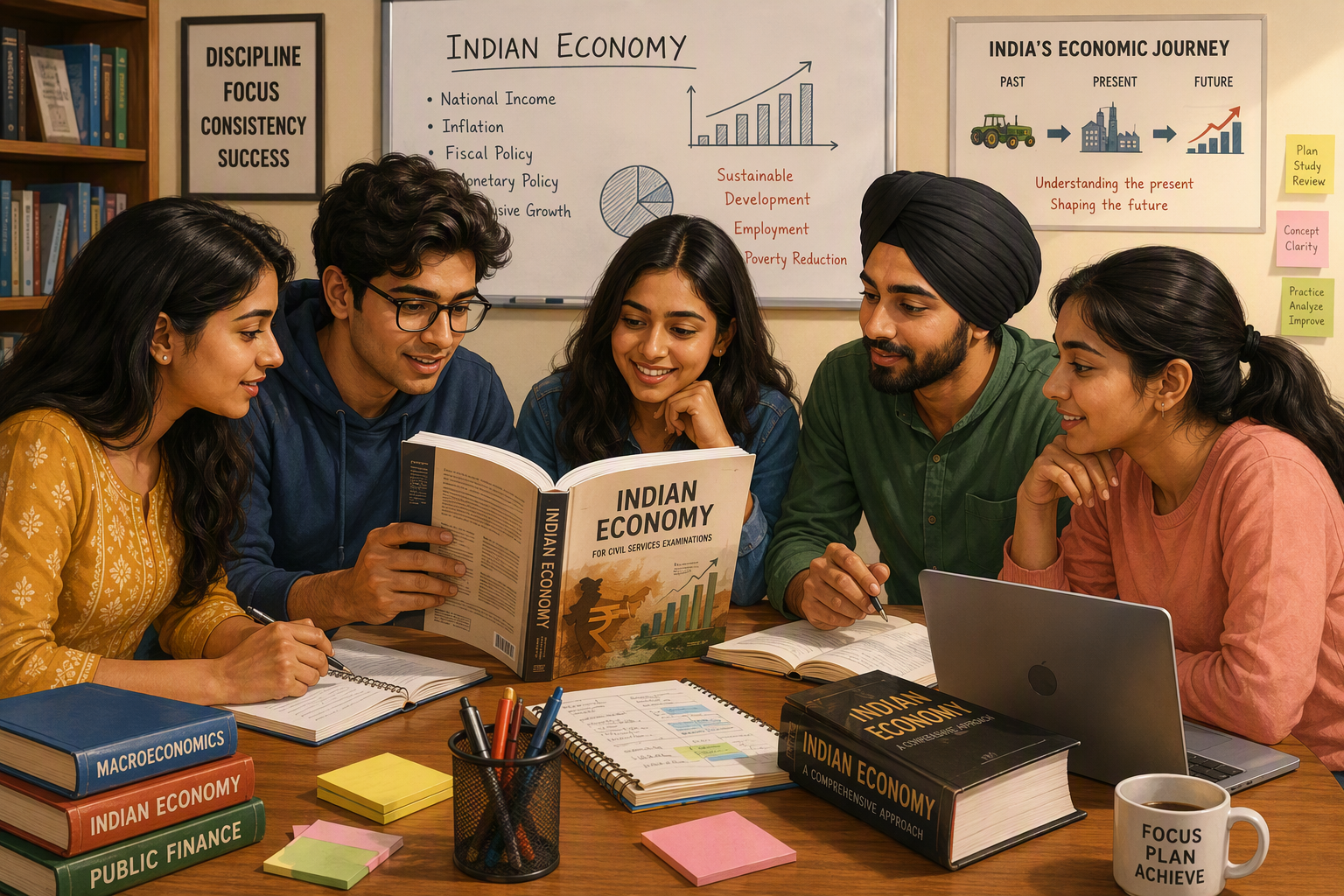
Key Highlights
- Indian Economy by Sanjiv Verma is a good book for UPSC beginners. Many aspirants choose it to help get clear ideas about the indian economy and its concepts.
- A lot of civil services aspirants pick this book for prelims. The reason is that the language here does not feel heavy. It is simple to read for most people.
- The revised edition from Unique Publishers follows the revised syllabus. It gives support to IAS preparation and fits well according to what is needed.
- The 14th edition of the book is made in line with the GS III syllabus and covers the new pattern of the UPSC syllabus.
- Verma knows how to make tough economy topics feel easier to read and remember. This is why many see this book as helpful to read, revise, and learn from.
Introduction
If you are just starting to study the indian economy for upsc, you will often hear about Indian Economy by Sanjiv Verma. This is because many civil services aspirants want a book that is clear, gives good help, and is not hard to read. Verma’s book does not give too much heavy reading or theory. Many ias and prelims aspirants pick it as their first read, to feel less stressed and get the basics right. So, is this the right book for your upsc preparation? Let’s see how Verma’s book is useful and where it is the best fit for civil services aspirants.
Overview of ‘Indian Economy’ by Sanjiv Verma
Indian Economy by Sanjiv Verma is a well-known book for people preparing for UPSC. Many who want to learn about indian economy or macroeconomics in a simple way start with this book. Verma wrote this book for those taking civil services examinations. A lot of learners read it first before going to books that are harder to read.
The revised edition is now split into new sections and chapters. This follows the new pattern of the UPSC syllabus. Some chapters have been rewritten to fit the revised syllabus. This change makes the book feel more focused on the exam and better for your current UPSC preparation needs.
Importance of the Book for UPSC Preparation
For many beginners, the Indian economy can feel hard to understand at first. This book by Sanjiv Verma helps with that problem. Indian Economy by Sanjiv Verma is said to be a good book for UPSC because it gives clear ideas before you read more tough material. If you do not feel comfortable with economics words, this book can make your first read much easier.
Another thing that makes it good is how helpful it is for civil services examinations. In these exams, you need understanding, not just memorization. The way it is set up is nice for revision. It helps you connect topics to the GS III syllabus more easily. That is important if you want one source that is easy to read.
The book is good as a base text. Many aspirants use it at the start to get clear ideas about the topics. After this, they add new material like the Union Budget and other news from officials. This way, the book is a practical starting point for everyone.
How the Book Aligns with GS III Syllabus
One good thing about this book is the way it has been changed to fit the revised syllabus. The book is now set up in different sections and chapters. This follows the new pattern of the UPSC syllabus. It helps civil services aspirants read and study for the IAS exam in a better way.
You can see this alignment in the topics that have been rewritten and in the ones that are new. The main goal is not only for people to read more, but also to have good conceptual clarity in the parts often linked with the GS III syllabus.
- Land Reform – A New Perspective is about the way India uses land for farming. It is also about how to help people who live in rural places. This fits the themes in the revised syllabus.
- The Investment Model looks at how money can make the economy grow. It talks about development and how the country plans money matters. It matches with the topics of growth in the revised syllabus.
- Food Processing Industries work with local industry jobs and ways to add more value to what farms produce.
- Port in India and Railways are both about building things people use every day. They help link with the infrastructure parts in the revised syllabus.
Because of this design, the book is set up more for exam needs and not just like any random book on the economy. Next, you can look at what is new in the latest edition.
Unique Features and Updates in the Latest Edition
The latest edition is different because it is not just a reprint. This revised edition has been updated fully. It is now put together into different sections. These sections follow the new pattern of the UPSC syllabus. This makes the book more useful for focused UPSC preparation.
What makes the 14th edition a good book for readers is how clear it is and the way it adds important updates. The chapters have been rewritten, and there are new parts that help with what people need for exams. These fresh changes are good to look at more closely.
Coverage of Current Economic Issues
The revised edition stands out because it talks about newer topics that matter to the economy. A textbook cannot cover every news story, but this version shows what is happening in India. It adds new sections and updates chapters. This makes it more useful for people preparing today.
Still, you need to keep one thing in mind. If the topic keeps changing, a book is most helpful when you read it along with the union budget documents and other news from official sources. This is really true for things like monetary policy and when policy goals change.
The revised edition brings in new topics and updates old ones.
- Land Reform – A New Perspective
- Investment Model
- Food Processing Industries – Industry of the Future
- Port in India – A Economic Perspective
- Railways – Life Line of the Nation
It also has information on globalization and a look at big troubles the world has faced since 2008. So yes, the latest edition has new changes in how it is set up and what it talks about. But it is still good to read other up-to-date things.
Comparison with Other Popular Indian Economy Books (Ramesh Singh, Vivek Singh)
When people who want to study about the Indian economy look for books, their pick often depends on what level they are at. Beginners usually go with Sanjiv Verma because it is more clear and easy to read first. Ramesh Singh’s book is known to give more detail, and many feel it covers things deeper. Then there is Vivek Singh, which is shorter, so people like it when they want to read quickly and go over things again for revision.
So what makes Sanjiv Verma stand out? The answer is easy. It is less scary. If you are new to economy, this matters the most for UPSC. Finishing one book is better than having three books that you do not read.
| Book | Best Fit | Main Strength |
|---|---|---|
| Sanjiv Verma | Beginners | Simpler language and conceptual clarity |
| Ramesh Singh | One deeper reference | Broader GS III depth |
| Vivek Singh | Revision stage | Compact approach and quick review |
If you are looking for a good book to start with, many people choose one by Sanjiv Verma. Verma is often the practical pick for someone who wants a simple read for their first time.
Chapter-Wise Key Concepts and Takeaways
For UPSC, it helps to look at the chapter-wise key concepts. This way, you can see what each part should cover, and economy preparation gets easier. In this book, you will find that the focus is on easy-to-read macroeconomics, policy-linked themes, and topics that help with prelims and IAS revision.
The new setup makes it easy for you to see how subjects fit together. There are new and changed chapters. These chapters help link the main ideas with issues that come up from the Union Budget and what people study today. Now, let’s go over the main points in a way that helps with exams.
Summarized Highlights for Exam-Oriented Study
If you want study that helps with exams, don’t read the book like a story. Go through one chapter at a time. Write down why each section is there. This way, beginners find it easier to do revision, and the main ideas stay connected to upsc instead of just reading in random order.
A good way to get ready for revision is to write short notes after each chapter. This helps you make your own set of summaries. These will be better and feel right for you, instead of waiting for notes made by other people.
Focus on highlights such as:
- The basics of macroeconomics and main economy terms
- Land reform and how people see it now
- Investment model and new ways to think about growth
- Food processing industries and where they can grow in the future
- Ports and railways as key parts of infrastructure
- Globalization and big problems around the world after 2008
This way, each time you read, it takes less time and you get to the point faster. Yes, you can make summaries from the book, but the notes you make by yourself often help more.
Common Questions Addressed in Each Chapter
A good way to use this book is to ask what kind of common questions the chapters help you answer. In UPSC, it is better to study chapter-wise and connect the topics with possible prelims and concept-based questions. This helps a lot in macroeconomics, because the terms may feel hard to get at first.
Instead of looking for notes or summaries for each chapter, try to turn each chapter into a list of questions. This will help you stay focused while you read. It also keeps your reading active and helps you get more out of it.
Typical chapter questions may include:
- Land reform helps a lot in economic development. It gives land to more people. This means, more farmers can work and earn from their land. This makes farms better and towns can also grow. When the land is shared well, the whole country gets to use its land well.
- An investment model shows the way money goes into new work and builds up industries. This makes the market grow and gets more people to work. A strong investment model will help the economy get bigger over time.
- Food processing industries are important because they turn crops and raw foods into things people use and buy every day. This gives people more jobs. It also lets farmers earn more, because the food can be sold for a better price. Food processing helps the country have more food all year too.
- Ports and railways are needed for any economy. They help move things and people across the country and to other countries as well. When goods can go in and out fast, trade gets better and the whole business world works well.
- The crises since 2008 had a big impact. Many jobs were lost and people faced hard times. But some new ideas and changes helped countries get back on their feet. Now, most business and workers are more careful so they do not have the same problems again.
These questions at the chapter level help you review more quickly. They also help you see what UPSC may ask about, either in a straightforward way or with an applied approach.
Accessibility and Formats Available
Many people who want to learn about Indian economy by Sanjiv Verma often ask how easy it is to get this book. From what is out there, Verma’s Indian Economy shows up in PDF lists, on different sites, and as a printed book. So, you can find it in more than one way which makes it good for aspirants who want to read it.
For people who read in English medium, the details show that there is an English version. At the same time, many people look for Hindi on study sites. This makes many want to know about how to get Hindi, and what form it will be in. Here is what you should know.
Availability in PDF, Online, and Print Editions
From the information given, you can find a PDF of Indian Economy by Sanjiv Verma on some internet study platforms. It is a 350-page file and it is in English medium. This book is made for UPSC and IAS exam preparation. The publisher is Unique Publishers India.
Print books are still the safer and better choice if you want to do serious study. A paperback or hard copy is easy to write notes in, read again, and check against new versions. This is important because economy books need you to pay attention to the edition you use.
Available format clues include:
- You can find PDF lists on study sites online.
- You can buy hard copy prompts from the same pages.
- Books are in english medium.
- Book lists show print references for revised edition.
So, if you ask where to get it online, you might see some pages in PDF format. But, many aspirants like to use the newest print edition for practice, as it is more reliable.
Hindi Edition and Other Language Options
There is no clear proof of a Hindi edition of Indian Economy by Sanjiv Verma in the information we found. But, there is a lot of demand for the book in Hindi and other local languages. Many people getting ready for UPSC in India ask for it on study sites. This shows that having the indian economy book by Verma in hindi is very important for many readers in India. Language is a real concern for them.
The PDF you see talks about the English medium. If you want the Hindi version, you should check if it is there on the seller’s page or in the publisher’s list. You should not just guess that a Hindi edition will be available.
What the available information shows:
- It is clear that the english medium is shown.
- Aspirants who use hindi to study are looking for resources.
- There is not any strong confirmation for a hindi edition in the data.
In short, you may want to see if the Hindi edition is out there. But right now, the material shows that only the English version is easy to get.
Buying Guide for ‘Indian Economy’ by Sanjiv Verma
Before you buy, you should know what to look for first. The newest edition is the most important thing. You also need to check if the seller can be trusted. Make sure the book comes from Unique Publishers. Economy content changes so the right edition is more important than only picking the cheapest book.
You need to look at the price on different top shopping sites. Also, check if the listing is for the revised edition. The next two parts will help you with this.
Price Range on Leading Indian Shopping Sites
The gathered info does not give a set price for Indian Economy by Sanjiv Verma on big online stores. So, it is best to check the latest prices from seller listings before you buy. This matters because the cost of the paperback can change with the edition, stock, and where the seller is in India.
When you check a print listing, do not just look at the price. See if the revised edition is shown. Make sure the publisher name is right. Check if all the product details are there.
| What to Check | Why It Matters |
|---|---|
| Paperback or hard copy | Helps you compare usable study formats |
| Revised edition mention | Reduces the chance of buying an older copy |
| Publisher details | Confirms alignment with Unique Publishers India |
| Seller listing quality | Helps avoid incomplete or unclear product pages |
There is not an exact number in the source text. Compare several websites. Pick the newest confirmed print version.
Where to Find the Newest Edition Online
If you want the latest revised edition online, begin on seller pages that show the edition year or say if it is a revised edition. The collected info also shows online study pages where you may get PDF access. But for UPSC prep, it is most important to check which edition you get.
Do not think that every book you see online is always up to date. Economy books can change when there is a new syllabus or extra content is added. If you read the product details, you can make sure you do not study old material.
Look for these signs:
- The 14th edition or revised edition needs to be named.
- The publisher should be listed as Unique Publishers India.
- There must be a clear what is changed in chapters or what new sections are in it.
- A full product page should be there instead of just talking about a PDF.
This easy checklist gives you a better way to find the newest edition online. It helps you feel sure about your choice and keeps you from getting an old or unclear copy.
Supplementary Resources and Study Aids
A standard book is good. Still, many aspirants to need more help for quick revision. This is where extra resources can be useful. They can cut down the reading you have to do before a test. You can also use these aids to go back to hard topics without opening the whole book again.
For IAS, you need to use notes and summaries with care. Good notes can help you learn, but they should not take the place of your main reading. Let’s see what kind of help really works.
Summaries, Notes, and Revision Materials
Many UPSC beginners want to know if they can get ready-made summaries or notes for this book. The compiled information does not show any official summaries that come from the publisher. But you will see that there are a lot of online study platforms. People on these platforms talk about, list, and share supporting material for standard UPSC books.
Even so, the best way to get ready for revision is to make your own materials. Why is that? When you read and write your own notes, you remember things better. It also helps you break the book up into smaller parts. That makes the revision feel easier and less stressful.
Useful revision material can include:
- You get chapter-wise short notes written in simple words.
- There is a one-page list of key ideas for every section.
- Topics are grouped under macroeconomics, infrastructure, and globalization.
- A final revision sheet is given for prelims terms.
So yes, the notes and summaries are in some casual places. There is not clear proof that there is official material for each chapter. The best way is to use your own notes.
Other Relevant Books by Sanjiv Verma
Based on the collected information, the only Sanjiv Verma book talked about here in detail is Indian Economy. There is not a set list of any other books by Sanjiv Verma for UPSC, IAS, or other resources. So, you should not think there are more books by Verma without looking them up first.
The talk about this book puts it with other well-known UPSC economy resources. So, most upsc aspirants use it along with other study materials. They do not use it as a replacement.
What the compiled material allows us to say:
- Sanjiv Verma is clearly connected with the indian economy.
- This book by Verma is meant for upsc and ias exam preparation.
- There is no sure list of other books by Sanjiv Verma given.
- People often talk about this book with other economy books when they study indian economy for upsc or ias.
So, if you want more books by the same author, you should check them on the publisher or seller pages.
Conclusion
In the end, “Indian Economy” by Sanjiv Verma is more than just a book. It is a full guide for students, with a special focus on those who will take the UPSC exams. The way it is put together fits well with the GS III syllabus. It covers the main points of the indian economy and deals with current problems. The latest edition has fresh updates and gives key points for each chapter. This helps make your study easy and interesting. The book comes in print and digital forms. So, you can choose what works best for you. Take a look at this great resource to get better at indian economic topics and your UPSC studies. Try a free trial today if you want to boost how you study with Verma’s book!
Frequently Asked Questions
Is ‘Indian Economy’ by Sanjiv Verma recommended for UPSC?
Yes, Indian Economy by Sanjiv Verma is often seen as a good starting point for people preparing for UPSC. This book is especially useful for beginners and civil services aspirants. Verma explains things in a way that is easy to read and understand. It helps new learners feel less worried about the Indian economy and builds a base for deeper study later.
How updated is the latest edition of the book?
The 14th edition is the latest edition of this book. It is a revised edition. Many chapters are changed and there are new topics in it to match the new UPSC pattern. The structure and topic coverage in the 14th edition are more updated. This helps readers get better conceptual clarity. Some new sections like land reform, investment model, and issue-based topics are added in this edition.
Are official chapter-wise notes or summaries available?
The gathered details do not show official chapter notes or summaries for UPSC revision. You could get some notes on the web, but the ones you make by hand are often more good. These self-made chapter summaries help you revise quicker, remember things well, and keep your work matched to how you read and study.

