Key Highlights
- Heuristic search helps ai systems get answers faster. It does this by ranking choices instead of testing every single one.
- This is not like blind search algorithms. A heuristic function helps move the search toward a likely best or optimal solution.
- Some common search algorithms are A*, greedy best-first, hill climbing, simulated annealing, and beam search.
- These search algorithms work well when the search space grows fast and when getting an exact answer would take a long time.
- In machine learning and planning, heuristic search often gives a good answer in less time.
- You should pick the right search algorithms based on your goal, your memory, and how your problem is set up.
Introduction
Heuristic search techniques help solve tough problems in artificial intelligence. These search algorithms do not check every possible way to get to a goal. Instead, they use what people know to make smart guesses and move faster. This way of working helps a lot when the search space is too big for checked methods that take too much time.
You can see heuristic search used in route planning, puzzle solving, and other tasks that need to find the best way or answer. If you want to know how AI is able to get to good results so fast, you should look at heuristic search techniques first.
Understanding Heuristic Search in Artificial Intelligence
Heuristic search in artificial intelligence is a way to make smart choices when searching for answers. Instead of following every choice, it uses a heuristic function to guess which way is better. This can save time and often uses less memory too.
In many complex problems, it’s not possible to look at every option. A heuristic search helps by finding the most useful places to start. This method is why people use it in planning, games, and other AI work. To make this clear, let’s see what these ways are and how they help us make choices.
Definition and Significance of Heuristic Search Techniques
Heuristic search techniques help ai systems solve problems faster. They use clues or rules of thumb to guide the search. Instead of trying all possible solutions, these search algorithms rank choices and look at the ones that seem best. The goal is to find a good answer in a reasonable amount of time.
Different methods work in their own ways. A* finds the shortest path by using both path cost and the guessed cost left to go. Greedy best-first looks at what seems closest to the final goal right now. Hill climbing moves to a better spot every time it can. Simulated annealing may take a step back early on, so it does not get stuck along the way. Beam search keeps just a few strong choices to try next.
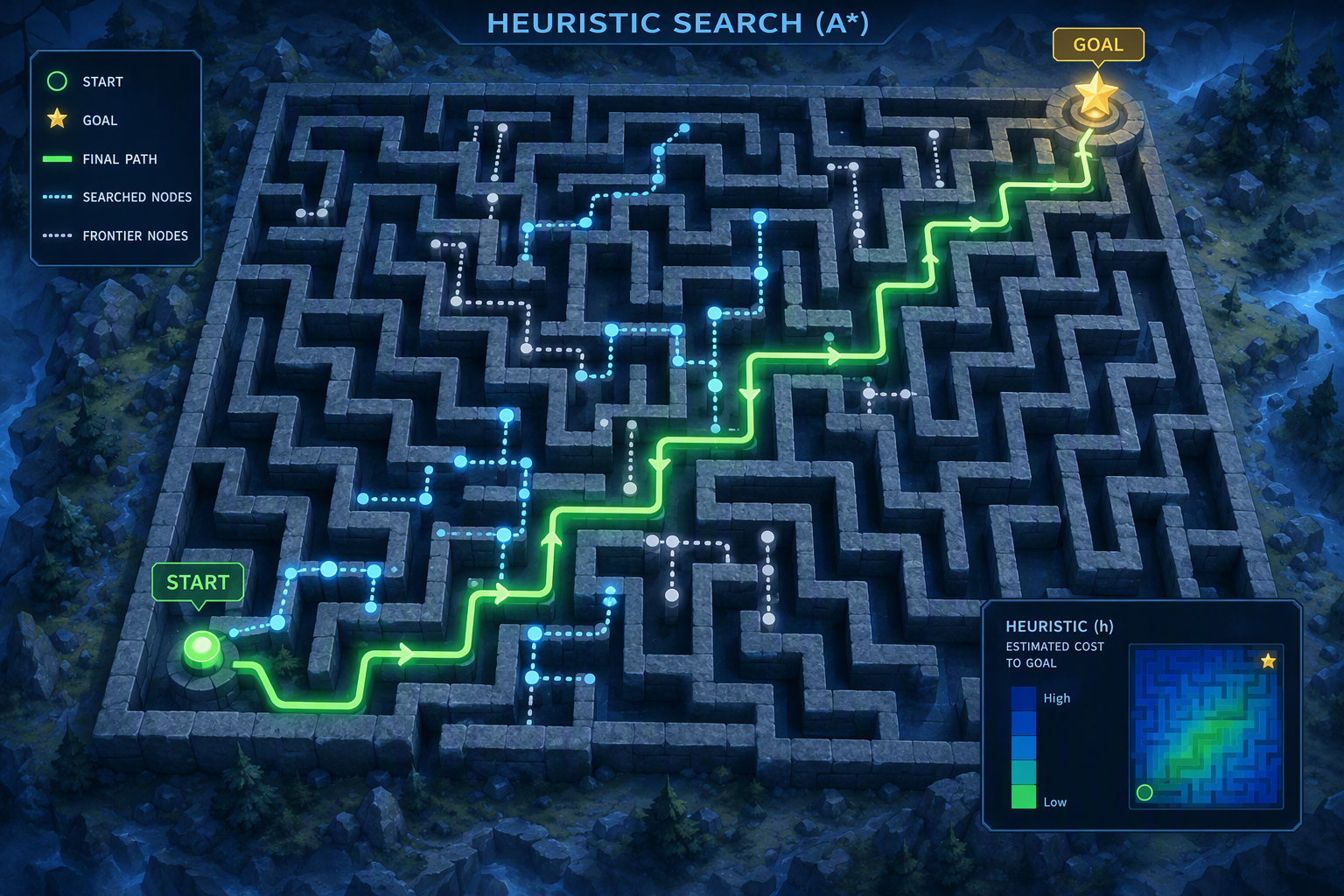
Finding a route in a maze can feel tricky. A* is good if you need the best path and want the best result. If you want to go fast and do not care much if it is perfect, greedy best-first search can be better. Hill climbing works well for optimization problems. Simulated annealing can help you when there are local optima. Beam search is best to use when you have to keep memory use low.
How Heuristics Guide AI Search Algorithms
Heuristics help search algorithms by giving an idea about which move could be best from the current state. A heuristic function does this job. It scores each choice using the available information. In short, heuristics let AI save time by not going down paths that are not likely to help.
You can think of heuristics as tools that help with choices in ai applications. They do not always give a perfect answer, but they help you move faster in optimization problems and large search spaces. When it takes too long to find an exact solution, these methods can be very good to use.
- They rank neighboring nodes. This way, the search can check better options first.
- They cut down time and memory by skipping parts that do not need to be explored.
- They help move from the initial state to the goal state with more focus.
Heuristic Search vs Traditional Search Methods
Heuristic search and traditional search methods both try to solve the same big problem. But, they do it in different ways. Traditional search algorithms like blind search do not use any extra help. They use fixed rules and explore every possible path, even if some paths do not look good.
Heuristic search gives direction. It uses guesses to pick the next step. This helps get to a solution faster when the problem is big. But, the speed can come with some trade-offs. To see this better, let’s compare how they work and how fast they are.
Differences in Approach and Solution Efficiency
The big difference is in how they choose a path. Heuristic search uses hints about the problem. These hints help it pick paths that look good. It can help you get the answer faster.
Traditional search, like blind search, does not use any hints. It just checks every path in a set order. It may need to look through much more of the search space before it gets to the answer.
That change in approach has an effect on efficiency. A heuristic method can get to a useful or even optimal solution faster if the heuristic function helps. Traditional search is more step-by-step. But, it often needs more time or memory because it does not sort choices by what they might give.
| Aspect | Heuristic Search | Traditional Search |
|---|---|---|
| Guidance | Uses estimates and a heuristic function | Uses no problem-specific guidance |
| Exploration | Focuses on promising paths first | Explores in a preset order |
| Speed | Often faster in large problems | Can be slower in big spaces |
| Result quality | May find a strong or optimal solution | May be exact but less efficient |
| Example style | A*, best-first | Breadth-first, depth-first |
Advantages of Using Heuristic Search in AI
In many ai systems, heuristic search is important. A full search takes too much time and power when there are a lot of possible paths. Heuristics help narrow down what the system needs to check. This way, the system can find a better solution faster, even if it does not look at every single option.
Another benefit is that heuristic search has flexibility. It can fit the task by using domain knowledge to make better choices. In some ways, like A*, this method can still get to an optimal solution if the estimate works well. In other cases, the goal is to find a good answer fast without having to wait a long time.
- It makes it easier to find things in big and hard places.
- It helps ai systems give answers faster in real work.
- It can choose between speed and how good the answer is, depending on what you need.
Common Examples of Heuristic Search Techniques
Many heuristic search techniques are used a lot in ai applications. These methods are good for handling big search space problems. In these techniques, a heuristic function or a rule is used to pick the next move. However, they are not all the same. They keep different amounts of information, and they handle risk in their own way.
Some ways of heuristic search try to go straight to the best answer first. Others keep several choices open or use a bit of random choice. This mix of plans makes heuristic search techniques good for planning and finding better ways to do things. Next, we will talk about a few of the most common heuristic search techniques.
Overview of A*, Greedy Best-First, and Beam Search
A* is a well-known search method in artificial intelligence. It works by using an evaluation function. This function adds together what you already spent and what you still need to spend. A* helps a lot when you want to get the best path, for example, to find the shortest path. It is used in cases where getting the right or best way ahead matters most.
Greedy best-first also uses an evaluation function. But in this way, it looks only at what seems closest to the goal from the point you are at now. This can help it go fast. But, at the same time, it may skip a better way to go because it does not watch the total path cost closely.
Beam search is not like other methods. Instead of keeping all possible options, it holds only a set number of good ones at every part of the search. This can help with memory use when the search space is big. If you want to move fast and use less storage, beam search is a good idea.
When to Use Each Heuristic Search Method with Simple Examples
Picking a way to solve a problem depends on what you care about the most. It could be speed, how much memory you use, or how good the answer you get will be. Each method starts at an initial state. The aim is to reach a goal state. The way to reach that goal can be different for each method. A good heuristic function helps the method make better choices along the way.
Think of a maze, a map you need to follow, or a problem where you want to spend the least money. Some ways to solve these are slow and careful. Others are fast and try to get a quick answer. A few can help you get away from problems that seem hard to fix. This is why you need to use the right way for the job you have.
- Use A* when you need the best path or an optimal solution, like for route planning.
- Use greedy best-first when you want a quick answer and are fine if it is not always the best.
- Use hill climbing when you want to make the current state better by moving to a better choice nearby.
- Use simulated annealing or beam search if you worry about getting stuck in local traps or have memory limits.
The Role of Heuristics in Improving Problem Solving
Heuristics help ai systems solve problems better. They let ai systems pay more attention to the best parts of a task. When dealing with complex problems, this focus is very important. Checking every option takes too much time and can cost a lot. By using heuristics, ai systems can work faster and use less.
Heuristics do not treat all moves as equal. They rank each one. This helps people move forward faster and find answers that work in the real world. You can see this when you look at how well they search and how much they help when you use them day to day. Let’s look at both of these now.
Impact on Efficiency and Effectiveness of Search Algorithms
Heuristic search methods make search algorithms better by showing them where to focus their effort. A heuristic function tells you how close a state is to the solution state. This helps the algorithm skip weak paths and go toward better answers with more purpose.
This has a direct effect on how well things work. When there is less unnecessary looking around, you spend less time. Often, you also use less memory. This also makes the search better. You get to a good answer faster, especially if the search space is big and has a lot of stuff that does not help.
- They help the search go to states that look closer to being done.
- They cut down wasted checks across all the possible paths.
- They can give good answers faster, even when the task is tough.
Real-World Use Cases of Heuristic Search in AI Applications
Heuristic search is used in many real-world ai applications. A good example is route planning. In this, the system has to pick from many roads and possible paths. It does not try every single way. Instead, heuristic search helps the system guess which way could give the shortest path or the best path.
You can see the same ideas in tasks where you have to meet set limits. Things like planning, scheduling, and using resources all have rules that need to be followed. In these jobs, ai systems try to find answers that stay inside the limits. They do this without trying every single way there is.
The material collected also talks about speech recognition and planning with games or robots. Both of these are good areas to use. In these cases, having some rules or shortcuts helps the system get a good answer faster. When you do not have much time, memory, or need to work on big things, this way of working really helps.
Challenges and Considerations in Heuristic Search Algorithms
A heuristic search algorithm can help a lot, but it is not perfect. In optimization problems, the result can be bad if you get a wrong guess. It might send the search the other way or make it stop before getting all the way. This is more clear in large search spaces where there are many ways to go.
Methods like hill climbing can get stuck at local maxima or in flat spots, too. So, if you want to use these ideas well, it’s good to know not just how fast they are, but also where they fail. Let’s look at the most common problems with hill climbing and some simple ways to deal with them.
Typical Problems Faced and How to Address Them
One big problem in hill climbing is getting stuck before you find the best solution. A local maximum happens when you can move in the hill climbing path, but every step nearby looks worse, even though the best solution may still be somewhere else. Plateaus and ridges also make it hard to know which way to go, so you may miss out on reaching the best solution state.
Another problem is how good the heuristic function is. If the guess is not strong, ai systems can spend time in the wrong places or go down bad paths. Because heuristic methods need to be led in the right way, bad guidance can make them less useful fast.
- Use backtracking if a local maximum stops you from moving ahead.
- Make a random big jump to get out when there be a plateau where all states have the same value.
- Try things like simulated annealing early in the search to get past local optima.
Conclusion
To sum up, heuristic search techniques are important in artificial intelligence. These methods help search algorithms work faster and better. When you know how these techniques work, you can see how ai systems get through complex problems. This often leads to quicker and better solutions. The field of artificial intelligence keeps changing, so heuristics will become even more important. They offer new ways to solve problems in many areas. If you want to learn more or ask questions, you can reach out for a talk or more resources.
Frequently Asked Questions
How does the hill climbing algorithm work in heuristic search?
Hill climbing starts at the current state. It looks at nearby options using a heuristic function or cost value. The algorithm moves to a better state if it can find one. Then, it repeats this process again and again. In ai systems, hill climbing is a quick and easy way to find answers. But, local maxima can make it stop before getting the best result.
Why are heuristic search techniques important in AI applications?
Heuristic search techniques are important in machine learning and ai applications. There is a huge search space in many of these tasks. Instead of looking at every possible choice, these methods help guide the search toward good options. This makes optimization problems easier to handle. It also helps these systems get useful answers in less time and with less memory.
How do heuristics affect the efficiency of AI search algorithms?
Heuristics help search algorithms work better by letting them rank choices with a heuristic function. This way, they do not waste time looking in bad places. With this, search can find a better solution much faster. When the guess from the heuristic is good, the search takes less time and effort to move toward its goal.